
Hello everyone,
We are currently having a Luxhaus (timber frame construction) built and had our shell inspection last week. An independent master carpenter pointed out to me that the staples used to attach the vapor retarder (I assume it is a vapor retarder and not a vapor barrier since it is a PVC foil) at the transition to the attic should have been sealed with airtight tape for better airtightness. (Currently, they are not sealed).
By the way: The attic of the pitched roof is located outside of the insulated area.
At Luxhaus, this is not seen as a problem, and they referred us to the blower door test. If there were actual leaks, they said the blower door test would detect them. They also mentioned that taping over the staples would make them uncompetitive.
After some research on the blower door test, I have come to the conclusion that it is not necessarily a definitive confirmation that there are no leaks. For one thing, the test can be performed by anyone without special certification, and also meeting the KfW (Kreditanstalt für Wiederaufbau) limit values offers no guarantee that there are no leaks due to construction defects.
What are your thoughts on this?
Best regards,
Anton
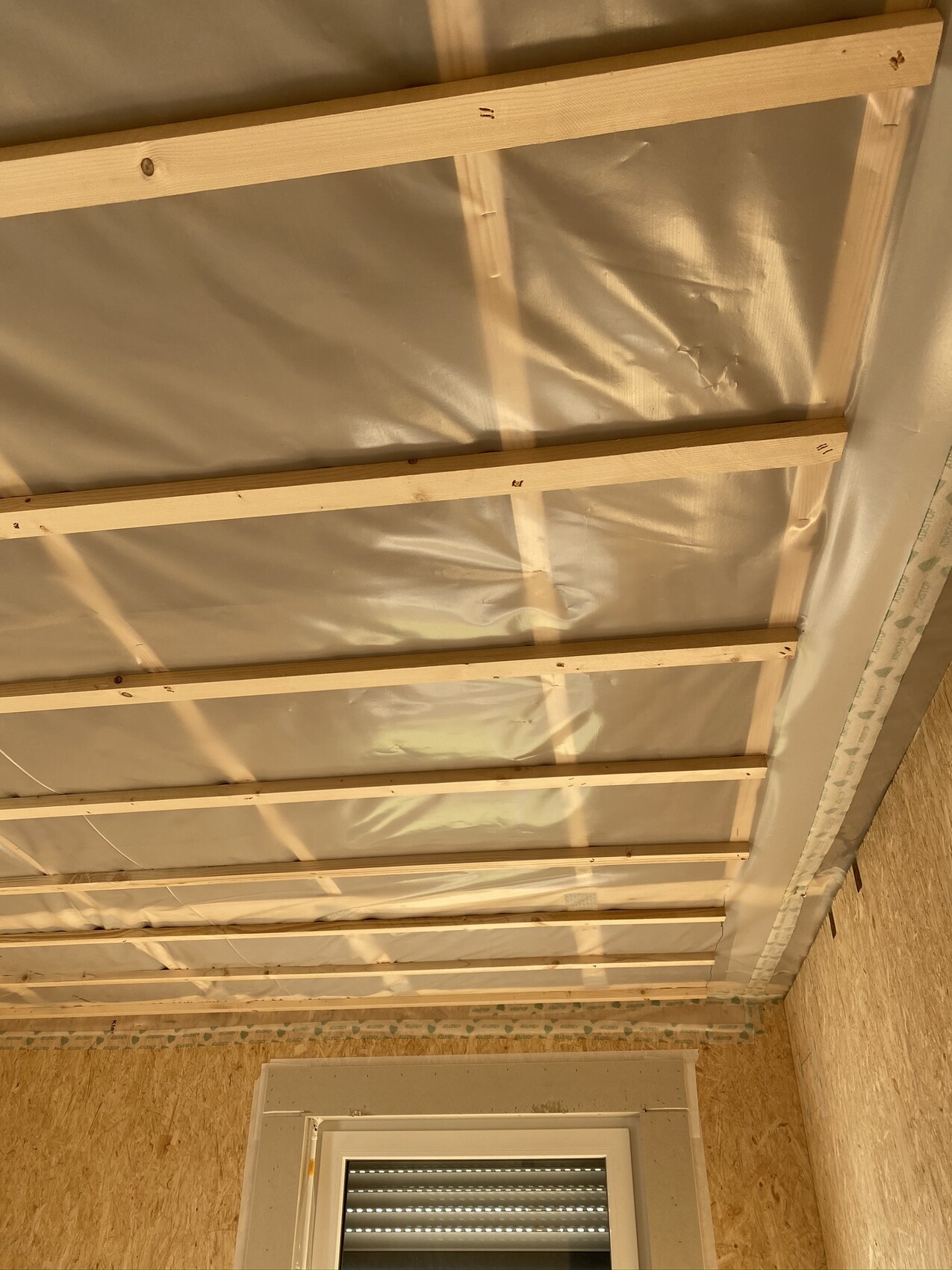
We are currently having a Luxhaus (timber frame construction) built and had our shell inspection last week. An independent master carpenter pointed out to me that the staples used to attach the vapor retarder (I assume it is a vapor retarder and not a vapor barrier since it is a PVC foil) at the transition to the attic should have been sealed with airtight tape for better airtightness. (Currently, they are not sealed).
By the way: The attic of the pitched roof is located outside of the insulated area.
At Luxhaus, this is not seen as a problem, and they referred us to the blower door test. If there were actual leaks, they said the blower door test would detect them. They also mentioned that taping over the staples would make them uncompetitive.
After some research on the blower door test, I have come to the conclusion that it is not necessarily a definitive confirmation that there are no leaks. For one thing, the test can be performed by anyone without special certification, and also meeting the KfW (Kreditanstalt für Wiederaufbau) limit values offers no guarantee that there are no leaks due to construction defects.
What are your thoughts on this?
Best regards,
Anton
 Winniefred14 Sep 2020 06:34
Our roofer is doing it. Our drywall contractor said that according to some DIN standard, it is no longer required.
I would just do it myself, it’s just busy work.
I would just do it myself, it’s just busy work.
superzapp schrieb:
If you have doubts and some time, it would be easy to do this yourself with a roll of Sicrall tape We have already thought about that as well
S
Stefan2.8414 Sep 2020 08:00I also masked it myself. It does take time, but that’s an investment you can make. Whether it was necessary or useful is another question.
P
pffreestyler14 Sep 2020 09:02Just do it yourselves afterwards. It will cost you about 30 € and 1–2 hours of work. I find the company’s statement about competitiveness quite ridiculous.
Last year, there was a report that condensation formed on an unsecured staple, which eventually caused building damage.
Last year, there was a report that condensation formed on an unsecured staple, which eventually caused building damage.