
ᐅ Basement for Utility Use: Insulation, Heating, Raising the Ceiling?
Created on: 18 Nov 2021 10:43
B
blubbernase
Hello,
We’re a bit overwhelmed and I’d like to organize my thoughts here and also hear other opinions. Unfortunately, our architect and basement builder haven’t been much help so far— all we get is “You need to know what you want.” Our building inspector won’t be back for another two weeks.
Let me start from the beginning:
Since our space requirements would exceed the allowable floor area ratio, we planned a partial basement outside the thermal envelope of our KfW55 house, intended for technical equipment, storage, and a small workout room. The basement is completely underground.
This was the initial plan (room layout is not final yet, please ignore):
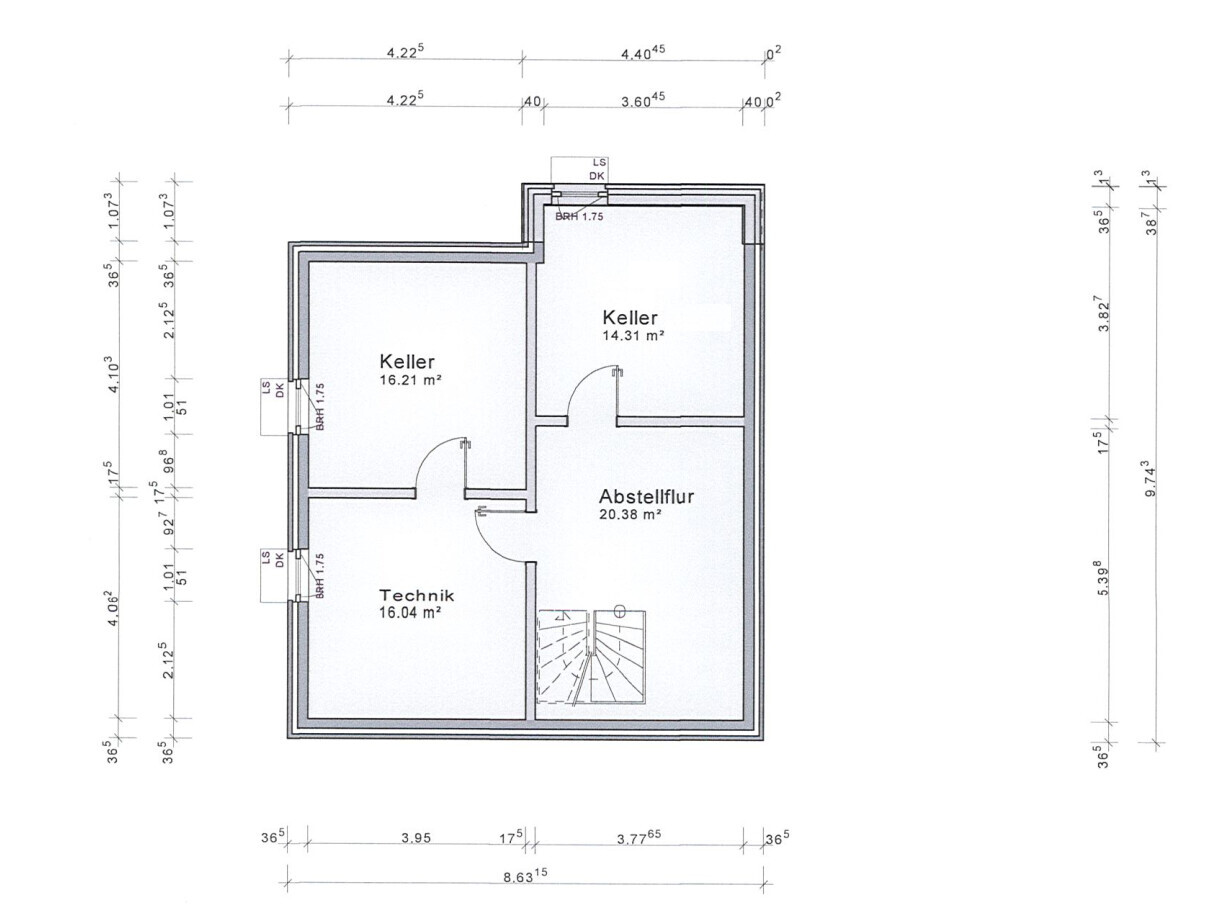
It then became clear that we would switch directly to the full basement, with the same specifications as the partial basement.
Well—suddenly we have much more space, and the workshop we had planned attached to the garage could fit inside the basement. This also makes an external basement entrance useful, as well as a possible living area where multimedia equipment could be set up or where kids could be noisy without disturbing others.
This brings up the question: Should we still leave everything uninsulated and unheated? We originally planned to install perimeter insulation ourselves, but the basement builder said doing it ourselves would affect the warranty. Now we have an offer for an insulated basement here, though the room layout is also not finalized...
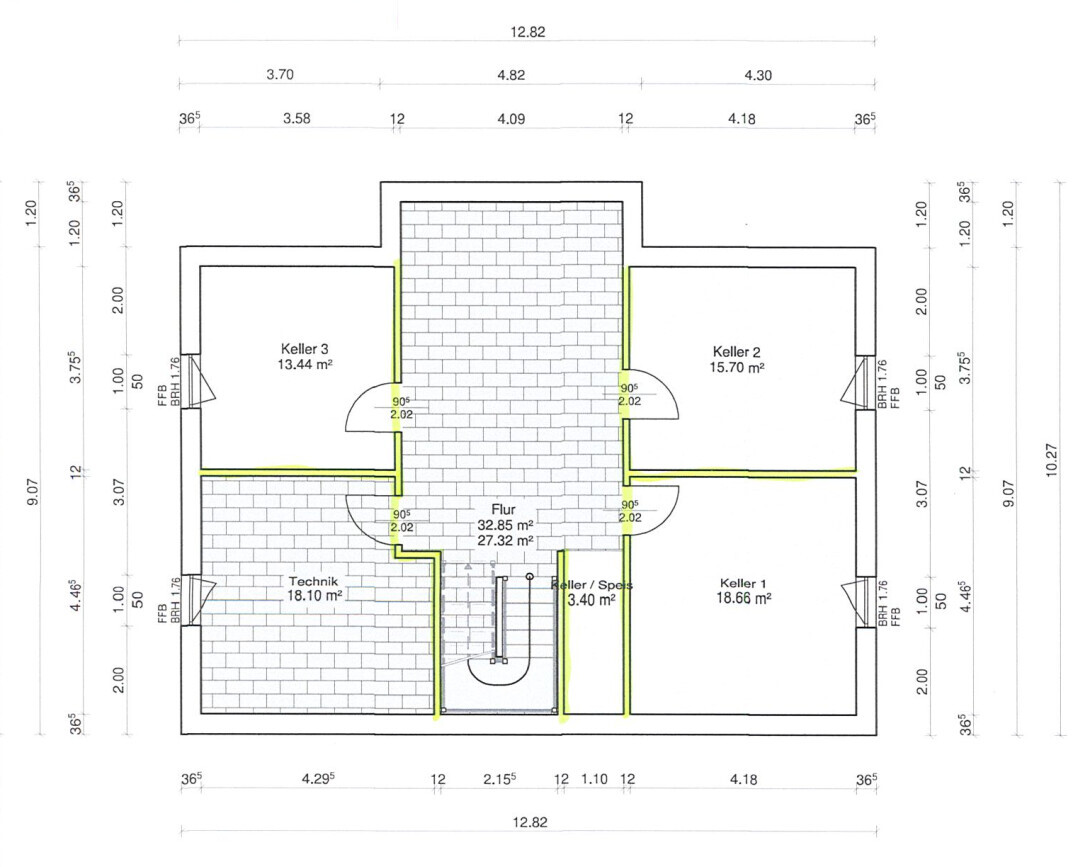
If we choose insulation below the basement slab, a separation within the thermal envelope is no longer necessary, and the interior basement stairs would not need to be closed off and insulated for the KfW standard.
The remaining question concerns heating. The basement builder insists on underfloor heating, but that seems oversized to me because the basement will be used too infrequently: the technical room doesn’t need heating, and for the few hours per month spent in the workshop or workout room, an infrared heater might be sufficient? In my current workout room, which is uninsulated and has two exterior walls, temperatures range between 16 and 19°C (61 and 66°F), which is completely fine. However, that room adjoins heated and insulated interior rooms.
I just don’t know what the best solution is for KfW standards and what actually makes sense. Off the top of my head, I’d say:
- Choose insulated walls with core insulation but without insulation under the basement slab
- Keep the interior basement stairs insulated
- In rooms that will be used more often, plan for infrared heaters (or similar) — right now, our workshop is in the garage, and my wife, the main user, just wears a thick sweater
Bonus question: External basement entrance— is the investment worth it? I haven’t yet received a formal offer but have heard a ballpark figure of €7,000 to €10,000.
That’s where we stand now. Any opinions?
We’re a bit overwhelmed and I’d like to organize my thoughts here and also hear other opinions. Unfortunately, our architect and basement builder haven’t been much help so far— all we get is “You need to know what you want.” Our building inspector won’t be back for another two weeks.
Let me start from the beginning:
Since our space requirements would exceed the allowable floor area ratio, we planned a partial basement outside the thermal envelope of our KfW55 house, intended for technical equipment, storage, and a small workout room. The basement is completely underground.
This was the initial plan (room layout is not final yet, please ignore):
- Room height 2.25m (7 ft 5 in)
- Technical room downstairs
- Basement exterior walls: The exterior walls are prefabricated double-shell concrete elements, C25/30, wall thickness 36.5 cm (14 in), including built-in reinforcement. The cavity between the elements is filled with ready-mixed concrete on site.
- Uninsulated
- Unheated
- Water exposure class W 1.1-E (groundwater is at 30 meters (100 ft) depth here)
- Interior insulated basement stairs
- Price: approximately €66,500
It then became clear that we would switch directly to the full basement, with the same specifications as the partial basement.
Well—suddenly we have much more space, and the workshop we had planned attached to the garage could fit inside the basement. This also makes an external basement entrance useful, as well as a possible living area where multimedia equipment could be set up or where kids could be noisy without disturbing others.
This brings up the question: Should we still leave everything uninsulated and unheated? We originally planned to install perimeter insulation ourselves, but the basement builder said doing it ourselves would affect the warranty. Now we have an offer for an insulated basement here, though the room layout is also not finalized...
- Room height 2.40m (7 ft 10 in)
- Technical room downstairs
- Insulation under basement slab (€5,605)
- 120 mm (5 inches) load-bearing perimeter insulation (XPS) below the basement slab
- 120 mm (5 inches) perimeter insulation (XPS) single-layer on the front edge in the base area
- Basement exterior walls with core insulation, 120 mm (5 inches) thick. U-value: 0.25 W/m²K. The exterior walls are made of C25/30 concrete, wall thickness about 36.5 cm (14 in), including built-in reinforcement; wall construction as shown
- Water exposure class W 1.1-E
- Price: €96,800
If we choose insulation below the basement slab, a separation within the thermal envelope is no longer necessary, and the interior basement stairs would not need to be closed off and insulated for the KfW standard.
The remaining question concerns heating. The basement builder insists on underfloor heating, but that seems oversized to me because the basement will be used too infrequently: the technical room doesn’t need heating, and for the few hours per month spent in the workshop or workout room, an infrared heater might be sufficient? In my current workout room, which is uninsulated and has two exterior walls, temperatures range between 16 and 19°C (61 and 66°F), which is completely fine. However, that room adjoins heated and insulated interior rooms.
I just don’t know what the best solution is for KfW standards and what actually makes sense. Off the top of my head, I’d say:
- Choose insulated walls with core insulation but without insulation under the basement slab
- Keep the interior basement stairs insulated
- In rooms that will be used more often, plan for infrared heaters (or similar) — right now, our workshop is in the garage, and my wife, the main user, just wears a thick sweater
Bonus question: External basement entrance— is the investment worth it? I haven’t yet received a formal offer but have heard a ballpark figure of €7,000 to €10,000.
That’s where we stand now. Any opinions?

blubbernase schrieb:
But then an external basement entrance also makes sense The external basement entrance for the other participants in the main thread would be this one: https://www.hausbau-forum.de/threads/grundriss-1-5-geschossiges-haus-mit-kapitaensgiebel-auf-knapp-200m.39863/ 🙂
https://www.instagram.com/11antgmxde/
https://www.linkedin.com/company/bauen-jetzt/
P
pagoni202018 Nov 2021 21:22Just now I thought of another "case" that I know quite well. My niece bought and renovated an old house with a basement in Hessen. Her bedroom is in the basement level, as is the guest room, where I always stay. I haven’t noticed any cold issues there, and the basement’s insulation standard is roughly from around 1980.
So I would recommend carefully considering the relationship between usage and costs.
So I would recommend carefully considering the relationship between usage and costs.
B
blubbernase18 Nov 2021 22:58Thanks for the feedback.
I’m thinking of raising the ceiling a bit. If I go for an overhead press now, I’ll need almost 2.21m (7 ft 3 in).
apokolok schrieb:Thanks, that is one of the main reasons: I don’t want to spend a fortune on my basement, but still make it usable for our purposes.
The question is whether the additional costs are justified by added value.
Tolentino schrieb:Yes, that’s a good point, but the house will already be quite large with many rooms, so we probably won’t use the basement as living space. Maybe in 12-13 years, the kids could have 2-3 sofas placed down there somewhere.
Planned use today!
At 14°C (57°F) in the home cinema, watching Batman vs. Pumuckl 3 is not very comfortable, or the children don’t really like playing with their train set down there and it ends up having to be set up upstairs anyway.
But yes, 30,000 EUR would also cover running direct heating for a long time.
11ant schrieb:Exactly, I will add the latest iteration there in due course. There have been a few pivots.
The external basement entrance for those discussing in the main thread would be this one: https://www.hausbau-forum.de/threads/grundriss-1-5-geschossiges-haus-mit-kapitaensgiebel-auf-knapp-200m.39863/ 🙂
pagoni2020 schrieb:Thanks for the examples; I will discuss everything again with the company.
So I would consider the individual ratios of use and cost carefully.
I’m thinking of raising the ceiling a bit. If I go for an overhead press now, I’ll need almost 2.21m (7 ft 3 in).
B
blubbernase21 Nov 2021 12:41Is it actually possible to install the central mechanical ventilation system in the basement rooms and then do without the light wells?
blubbernase schrieb:
Is it actually possible to install the central controlled residential ventilation system in the basement rooms and then do without the light wells?That should be possible. However, it probably won’t be cheaper than installing light wells and windows, but it does save space all around.Similar topics