
Hello everyone,
I measured the voltage at the starting device on the back of my refrigerator (similar to the one in the attached picture) using a multimeter and noticed some unusual readings. Terminals 1 and 2 are directly connected to the power cable and therefore have constant voltage; here, about 230V is measured, as expected. Terminals 3 and 4 have voltage when the relay switches on (meaning when the compressor is supposed to run). When the unit is running and you measure here, you get a voltage of over 270V (!). Even when measuring between 4 and 2 or between 1 and 3 (in the switched state), you get this value. How can this be explained?
Best regards,
N
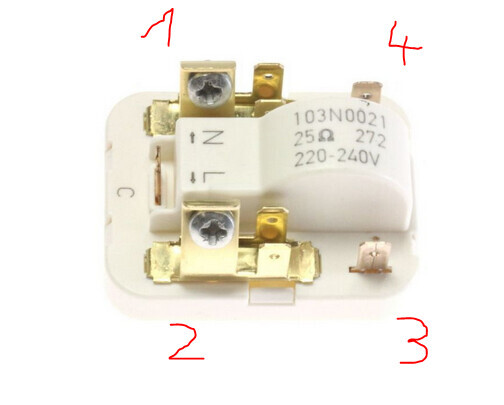
I measured the voltage at the starting device on the back of my refrigerator (similar to the one in the attached picture) using a multimeter and noticed some unusual readings. Terminals 1 and 2 are directly connected to the power cable and therefore have constant voltage; here, about 230V is measured, as expected. Terminals 3 and 4 have voltage when the relay switches on (meaning when the compressor is supposed to run). When the unit is running and you measure here, you get a voltage of over 270V (!). Even when measuring between 4 and 2 or between 1 and 3 (in the switched state), you get this value. How can this be explained?
Best regards,
N
N
Nanopixel14 Mar 2021 02:21A small correction: it was not a transformer but an AC/DC power supply.
The power supply says 230V ±15%. That is probably the reason why it works, even though the voltage is slightly outside the 15% tolerance.
@seat88 What ulterior motives? I simply want to do exactly what I described—no hidden agenda.
The power supply says 230V ±15%. That is probably the reason why it works, even though the voltage is slightly outside the 15% tolerance.
@seat88 What ulterior motives? I simply want to do exactly what I described—no hidden agenda.

Nanopixel schrieb:
Small correction, it was not a transformer but an AC/DC power supply.
The power supply is rated 230V ±15%. That’s probably why it works even if the voltage is slightly outside the 15% tolerance.
@seat88 What ulterior motives? I just want to do exactly what I described—no hidden agenda. I already understood that, but what is it for? 😀
H
hampshire14 Mar 2021 22:35Nanopixel schrieb:
Who says I am a layperson.No one says that; it’s just an assumption triggered by your questions. I would stay away from that device and instead take a switched positive feed to power the fan from a securely operated power supply.N
Nanopixel15 Mar 2021 01:01Sure, I’m not a certified electrician—if that makes me an amateur, so be it. However, I am capable of completely renewing the electrical system of an apartment during a full renovation, including switching from classic neutral grounding to TN-C-S. I know how to use crimping tools and a multimeter. Working on car electrical systems with numerous non-standard modifications is also no problem for me.
OK, I didn’t know about the Steinmetz connection—shame on me? I would at least somewhat claim that I mostly know what I’m doing. There’s no need to tell me phrases like “Electricity is deadly.” Water is deadly too, if you can’t swim.
To the point: The reason for the whole planned setup can be found here: https://www.hausbau-forum.de/threads/schimmelproblem-in-neuer-Küche-wie-in-zukunft-verhindern.38135/
In brief: To prevent moisture (and thus mold) behind a refrigerator placed on an outside corner in the future, fans are to be installed in the ventilation grill at the base under the fridge to promote air exchange behind and beside the appliance. For this, five 8cm (3-inch) PC fans placed side by side are to cover the entire cutout in the base. These fans should not run continuously but be switched on from time to time. Hence the idea: The refrigerator’s compressor turns on and off periodically—that could be used. Quick splice connectors with flat socket terminals were crimped easily, but then came the surprise with 270V. That’s why I created this thread.
OK, I didn’t know about the Steinmetz connection—shame on me? I would at least somewhat claim that I mostly know what I’m doing. There’s no need to tell me phrases like “Electricity is deadly.” Water is deadly too, if you can’t swim.
To the point: The reason for the whole planned setup can be found here: https://www.hausbau-forum.de/threads/schimmelproblem-in-neuer-Küche-wie-in-zukunft-verhindern.38135/
In brief: To prevent moisture (and thus mold) behind a refrigerator placed on an outside corner in the future, fans are to be installed in the ventilation grill at the base under the fridge to promote air exchange behind and beside the appliance. For this, five 8cm (3-inch) PC fans placed side by side are to cover the entire cutout in the base. These fans should not run continuously but be switched on from time to time. Hence the idea: The refrigerator’s compressor turns on and off periodically—that could be used. Quick splice connectors with flat socket terminals were crimped easily, but then came the surprise with 270V. That’s why I created this thread.
H
hampshire15 Mar 2021 08:00As mentioned, take the power for the power supply unit from an electrical outlet and use a switched positive for the fans. It is better to control this via a humidity sensor rather than the compressor.
N
Nanopixel15 Mar 2021 12:30I could do that, and controlling it with a Raspberry Pi was already considered.
However, the idea came up that it shouldn’t be made more complicated than absolutely necessary.
The existing regular switching of the compressor fit well in this context – which also has the added benefit that the noise from the fans and the compressor only occurs simultaneously, while otherwise it stays quiet. I can’t think of any other (simple) setup that would reproduce exactly this behavior.
What exactly is your reason for advising against my idea? Is it that you don’t trust me to properly access the correct terminals, or is it from a technical perspective that nothing should be done with the 270 V present?
However, the idea came up that it shouldn’t be made more complicated than absolutely necessary.
The existing regular switching of the compressor fit well in this context – which also has the added benefit that the noise from the fans and the compressor only occurs simultaneously, while otherwise it stays quiet. I can’t think of any other (simple) setup that would reproduce exactly this behavior.
What exactly is your reason for advising against my idea? Is it that you don’t trust me to properly access the correct terminals, or is it from a technical perspective that nothing should be done with the 270 V present?
Similar topics