
Hello,
I am a complete beginner when it comes to building plans. If my question sounds a bit silly, please be patient with me.
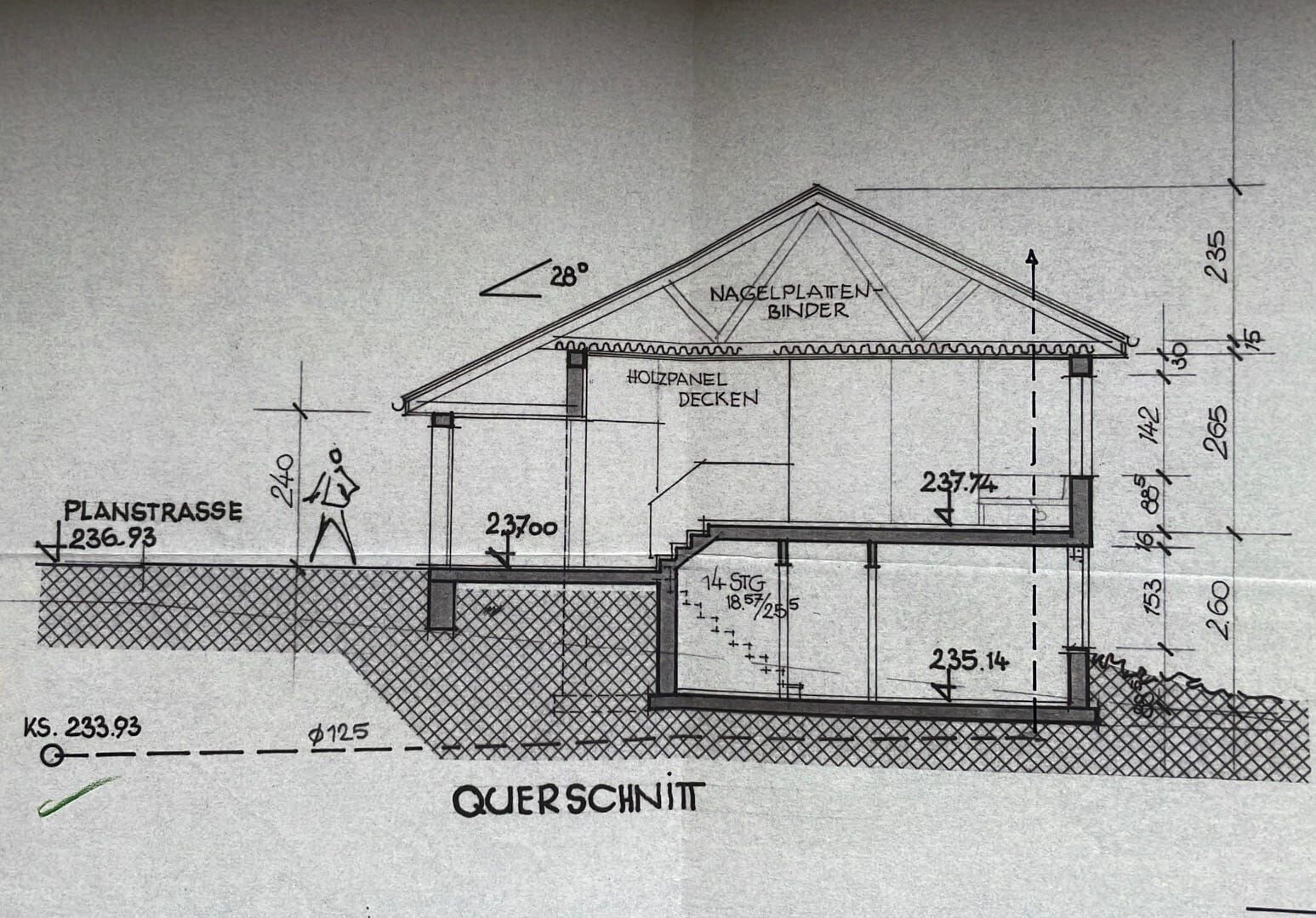
I have this cross-section and would like to know if the floors correspond to the general standard height of 2.4 m (8 feet). For the upper floor/ground floor, it seems clear with 2.65 m (8 feet 8 inches). However, the floor below seems a bit tricky. Should I calculate it as 2.60 - 0.16 = 2.44 m (8 feet)? But then the sea level markers at 237.74 and 235.14 don’t make sense to me.
Basically, it would be a great help if you could explain how to read this.
Thank you very much.
I am a complete beginner when it comes to building plans. If my question sounds a bit silly, please be patient with me.
I have this cross-section and would like to know if the floors correspond to the general standard height of 2.4 m (8 feet). For the upper floor/ground floor, it seems clear with 2.65 m (8 feet 8 inches). However, the floor below seems a bit tricky. Should I calculate it as 2.60 - 0.16 = 2.44 m (8 feet)? But then the sea level markers at 237.74 and 235.14 don’t make sense to me.
Basically, it would be a great help if you could explain how to read this.
Thank you very much.

ajokr2025 schrieb:
... and that is why DIN 1356 clearly defines that hollow triangles refer to finished height and filled triangles to the structural ceiling. If you look for height specifications on construction drawings, you will find a suitable drawing. Unfortunately, links are not allowed here.Oh, the amount of "fluffy" drawing styles I have seen is beyond what our DIN standard wisdom could imagine. Anyone relying on strict compliance with this standard might as well expect target and actual measurements to be identical.https://www.instagram.com/11antgmxde/
https://www.linkedin.com/company/bauen-jetzt/

The finished floor level is always specified because external 0.00 heights, such as ridge/eaves heights in connection with a development plan, refer to it. The heights of the raw subfloors are indicated in the construction planning drawings. Additionally, the stair risers can be added up, which must naturally also align with the finished floor level of the respective floor.
wpic schrieb:
The finished floor level is always indicated because the 0.00 elevation references outside also relate to it, for example ridge/eave heights in connection with a development plan / building permit. The heights of the structural subfloors are shown in the construction drawings. Okay, so the elevations relative to sea level refer to the finished floor level. The story height between ceilings remains, which has to be reduced by the unknown screed thickness to get the clear room height. Potentially, tiles, parquet flooring, or similar will be installed on top of the screed, and even carpet (floor covering) will consume about one centimeter (0.4 inches).
https://www.instagram.com/11antgmxde/
https://www.linkedin.com/company/bauen-jetzt/
No, top edge of finished floor = top edge of finished floor = top edge of tile/floorboard/parquet, etc. The entire structure above the raw ceiling = RC top edge is deducted from the top edge of the finished floor. The RC top edge is usually only relevant for planners and contractors. For the retrofitting of underfloor heating during a renovation, the dimension between the RC top edge and the top edge of the finished floor is, of course, important.
wpic schrieb:
No, top edge of finished floor = top edge of finished floor = top of tile/plank/parquet, etc. The entire structure above the raw ceiling = raw ceiling top (RCT) is subtracted from the top edge of the finished floor. [...] The measurement between RCT and top edge of finished floor is obviously important. ... and unfortunately not clear from the drawing, because "235.14" and the base point of the floor height indication "260" are not the same, but differ by the unknown measurement between the top edge of the finished floor and RCT. Therefore, the original poster is left with uncertainty (apart from the difference between target and actual): they can only assume (but nothing more) that "260 minus 16 minus screed thickness" is still greater or equal to 240.
https://www.instagram.com/11antgmxde/
https://www.linkedin.com/company/bauen-jetzt/
Similar topics