
Hello,
I am a complete beginner when it comes to building plans. If my question sounds a bit silly, please be patient with me.
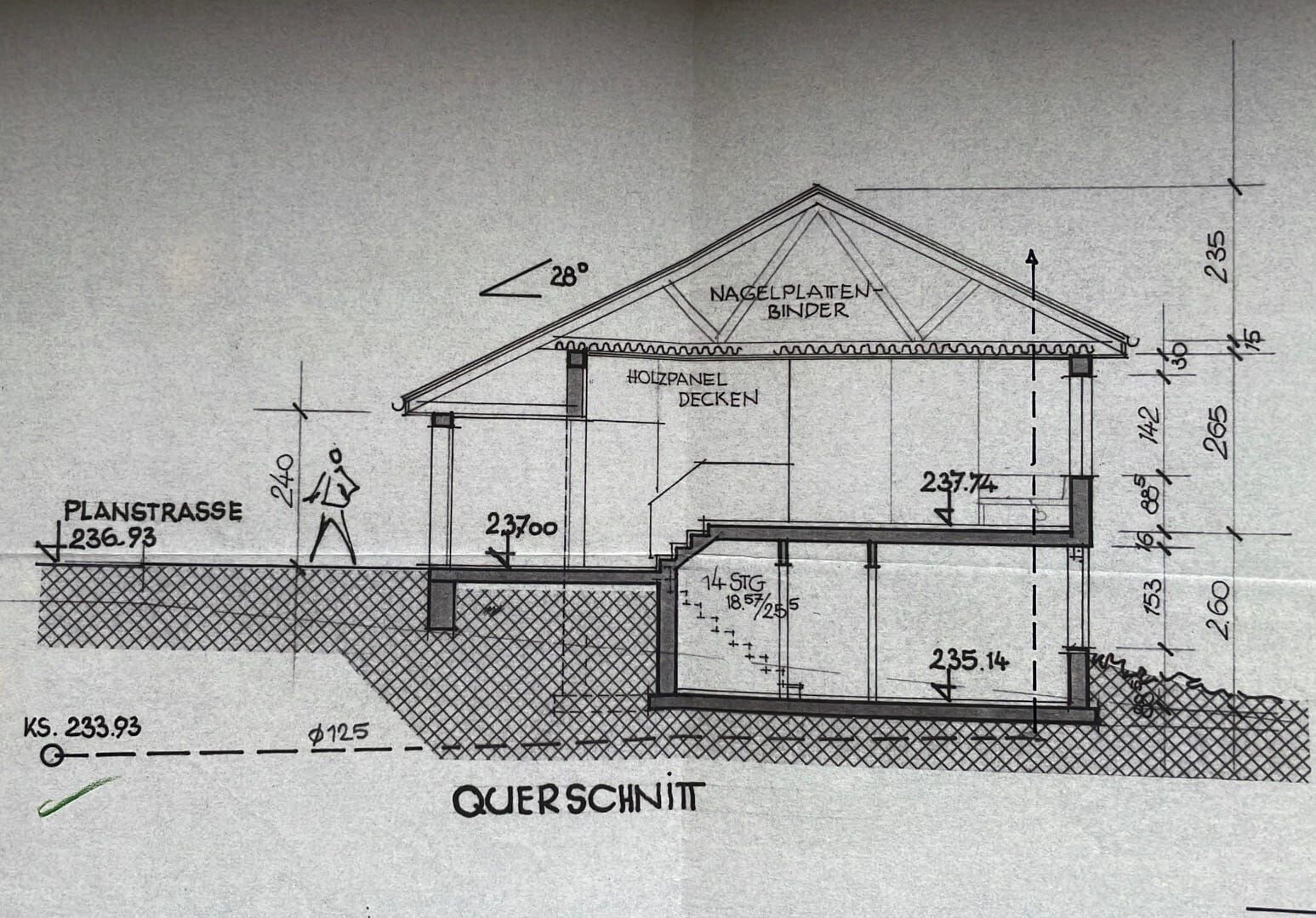
I have this cross-section and would like to know if the floors correspond to the general standard height of 2.4 m (8 feet). For the upper floor/ground floor, it seems clear with 2.65 m (8 feet 8 inches). However, the floor below seems a bit tricky. Should I calculate it as 2.60 - 0.16 = 2.44 m (8 feet)? But then the sea level markers at 237.74 and 235.14 don’t make sense to me.
Basically, it would be a great help if you could explain how to read this.
Thank you very much.
I am a complete beginner when it comes to building plans. If my question sounds a bit silly, please be patient with me.
I have this cross-section and would like to know if the floors correspond to the general standard height of 2.4 m (8 feet). For the upper floor/ground floor, it seems clear with 2.65 m (8 feet 8 inches). However, the floor below seems a bit tricky. Should I calculate it as 2.60 - 0.16 = 2.44 m (8 feet)? But then the sea level markers at 237.74 and 235.14 don’t make sense to me.
Basically, it would be a great help if you could explain how to read this.
Thank you very much.

A
ajokr202515 Oct 2025 08:04The dimension chain of 2.60 and 2.65 meters (8 ft 6 in and 8 ft 8 in) refers to the shell construction, while the height levels of 237.74 and 235.14 meters above sea level correspond to the finished floor level.

wpic schrieb:
237.74 - 235.14 = 2.60m (8.5 feet) - 0.16m (6.3 inches) = 2.44m (8 feet) clear room height. I read it differently: 237.74 - 235.14 or 2.60 - 0.14 = 2.44, yes; but in my opinion, not the clear room height, because the unfortunately unmeasured screed still needs to be deducted.
ajokr2025 schrieb:
The dimension chain with 2.60 and 2.65m (8.5 and 8.7 feet) refers to the shell construction I agree with that, but ...
ajokr2025 schrieb:
the height levels 237.74 and 235.14 m above sea level refer to the finished floor. ... I would only share that as a hope: I don’t clearly see those thick arrowheads positioned exactly on the shell floor or the finished floor. So it’s not a reading comprehension issue of the original poster, but rather a drawing clarity problem.
Such component heights are basically outdated nowadays. If a used property from around 1980 (?) is retrofitted with underfloor heating, it basically doesn’t add height, since the pipes can be milled into the screed. But considering the build-up height of the insulation, the 2.40 m (7.9 feet) clear height would likely already be undershot. Three or four centimeters (1.2 to 1.6 inches) of screed were common back then, today it’s more like 6 cm (2.4 inches) plus insulation on the structural floor slab. So effectively more like 2.30 m (7.5 feet) clear height (in Baden-Württemberg, Germany, to my knowledge this is compliant; the room height requirements in state building regulations vary).
https://www.instagram.com/11antgmxde/
https://www.linkedin.com/company/bauen-jetzt/
A
ajokr202515 Oct 2025 14:5611ant schrieb:
... I would only share this as a hope: I do not clearly see the thick arrowheads standing on either the unfinished or finished floor level. So it’s not a reading comprehension issue of the original poster, but a drafting clarity issue.... and that is why DIN 1356 clearly specifies that hollow triangles refer to the finished floor level and filled triangles refer to the structural ceiling. If you look for height indications in construction drawings, you will find an appropriate drawing. Unfortunately, links are not allowed here.
Similar topics