
ᐅ Underfloor heating is not warming up – 20,000 kWh energy consumption
Created on: 24 Nov 2017 07:46
B
BrosBrosBros BrosBrosBros24 Nov 2017 07:46
Hello everyone,
I am writing on behalf of my parents-in-law, who are having problems with their heating system and underfloor heating. It is a single-family house built in 2005 with a Buderus boiler/water storage and underfloor heating. The house is 130 sqm (1400 sq ft) and has only one story. I was shocked to find out that the two of them used 20,000 kWh of gas last year... However, I don’t find the house to be really warm. For example, 2-3 rooms (office, bedroom) are not heated at all... So the consumption seems really high...
In fact, a heating technician visits once a year to perform maintenance. They have a proper maintenance contract. But when asked questions like "why doesn’t it get properly warm," he doesn’t give a clear answer and just says, "We didn’t install the heating system..." They are lucky if the maintenance costs only 300 € (about 320 USD), often it’s more expensive... He recently suggested replacing the heating system, with an estimated cost between 5,000 € and 8,000 € (about 5,300 to 8,500 USD)...
Currently, a few things are confusing me and maybe I can get some help here:
1) They have to refill water in the heating circuits every 5-6 weeks... We also sometimes need to add water to our heating system about once a year, which I understand... but every 5-6 weeks?? They used moisture meters to check for damp areas... everything was dry.
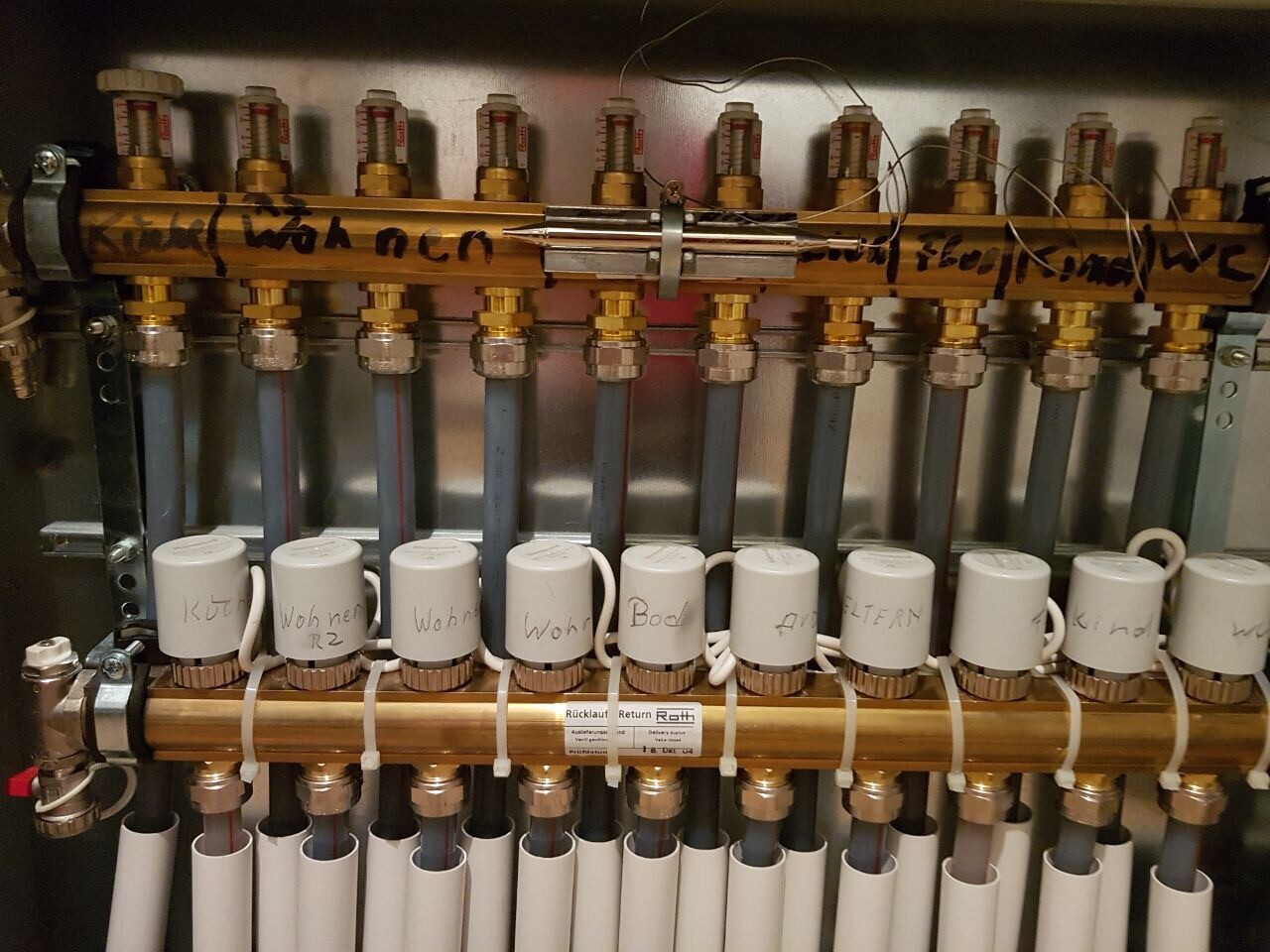
2) In the photo of the heating circuit manifold, it’s clearly visible that all flow meters are almost at zero... Since I don’t have anything like that on my underfloor heating, I don’t know what it means... but zero doesn’t sound like much.
3) The pipes all remain cold to at most lukewarm. With my system, when heating is running, you can feel the pipes warm up. Also, I can read the position of the actuators on my valves. That doesn’t seem possible with their system. The small valves can be easily pressed down with a knife or something similar.
4) They also "wonder" at our place how our tiles are always nicely warm... noticeably warm enough to walk barefoot comfortably (and with three of us we use 12,000 kWh). Their tiles remain cold... you don’t freeze but they don’t get warm either. Is there a way to check if perhaps too much screed was used or if the heating loops are simply installed too deep?
So many questions despite having a maintenance contract... Thanks in advance for your tips and advice...
Good luck, BrosBrosBros
I am writing on behalf of my parents-in-law, who are having problems with their heating system and underfloor heating. It is a single-family house built in 2005 with a Buderus boiler/water storage and underfloor heating. The house is 130 sqm (1400 sq ft) and has only one story. I was shocked to find out that the two of them used 20,000 kWh of gas last year... However, I don’t find the house to be really warm. For example, 2-3 rooms (office, bedroom) are not heated at all... So the consumption seems really high...
In fact, a heating technician visits once a year to perform maintenance. They have a proper maintenance contract. But when asked questions like "why doesn’t it get properly warm," he doesn’t give a clear answer and just says, "We didn’t install the heating system..." They are lucky if the maintenance costs only 300 € (about 320 USD), often it’s more expensive... He recently suggested replacing the heating system, with an estimated cost between 5,000 € and 8,000 € (about 5,300 to 8,500 USD)...
Currently, a few things are confusing me and maybe I can get some help here:
1) They have to refill water in the heating circuits every 5-6 weeks... We also sometimes need to add water to our heating system about once a year, which I understand... but every 5-6 weeks?? They used moisture meters to check for damp areas... everything was dry.
2) In the photo of the heating circuit manifold, it’s clearly visible that all flow meters are almost at zero... Since I don’t have anything like that on my underfloor heating, I don’t know what it means... but zero doesn’t sound like much.
3) The pipes all remain cold to at most lukewarm. With my system, when heating is running, you can feel the pipes warm up. Also, I can read the position of the actuators on my valves. That doesn’t seem possible with their system. The small valves can be easily pressed down with a knife or something similar.
4) They also "wonder" at our place how our tiles are always nicely warm... noticeably warm enough to walk barefoot comfortably (and with three of us we use 12,000 kWh). Their tiles remain cold... you don’t freeze but they don’t get warm either. Is there a way to check if perhaps too much screed was used or if the heating loops are simply installed too deep?
So many questions despite having a maintenance contract... Thanks in advance for your tips and advice...
Good luck, BrosBrosBros
Test:
Open the heating manifold cabinet. Turn all room thermostats up to 30°C (86°F). Within about 15 minutes, the thermostatic valves in the manifold should open. If they don’t, the boiler is basically heating against a closed system.
No idea why the maintenance service doesn’t check this. Karsten
Open the heating manifold cabinet. Turn all room thermostats up to 30°C (86°F). Within about 15 minutes, the thermostatic valves in the manifold should open. If they don’t, the boiler is basically heating against a closed system.
No idea why the maintenance service doesn’t check this. Karsten
BrosBrosBros24 Nov 2017 09:04Nordlys schrieb:
The thermostatic valves in the manifold should open within about 15 minutes now.Hello Karsten, thanks for your feedback... How can I tell if the thermostatic valves are open? Should I be able to see this at the actuators or from the components sitting on each circuit shown in the picture above?
C
chand198624 Nov 2017 09:19First of all: Just as Karsten says.
However, I don’t see the water loss explained yet. Since you don’t have any damp spots, it almost sounds like 20,000 kWh per year is mainly causing water to evaporate somewhere...
Does the maintenance contract specify the type of plumbing system? I would definitely seek a second opinion on that!
However, I don’t see the water loss explained yet. Since you don’t have any damp spots, it almost sounds like 20,000 kWh per year is mainly causing water to evaporate somewhere...
Does the maintenance contract specify the type of plumbing system? I would definitely seek a second opinion on that!
There seem to be several issues here. First, open all the valves completely. Then it will probably get too warm everywhere at first, but this takes some time.
By the way, tiles do not need to feel noticeably warm with underfloor heating. The goal is to have the lowest possible supply temperature.
Water loss can be caused by a faulty membrane expansion vessel. Water expands when heated. If the vessel is damaged, the excess pressure is released. This results in a loss of water in the system.
Also, it is not recommended to leave individual rooms unheated. Since all rooms are within a thermal envelope, the heated rooms will warm the “unheated” ones. This reduces efficiency because higher supply temperatures are required in the heated rooms.
By the way, tiles do not need to feel noticeably warm with underfloor heating. The goal is to have the lowest possible supply temperature.
Water loss can be caused by a faulty membrane expansion vessel. Water expands when heated. If the vessel is damaged, the excess pressure is released. This results in a loss of water in the system.
Also, it is not recommended to leave individual rooms unheated. Since all rooms are within a thermal envelope, the heated rooms will warm the “unheated” ones. This reduces efficiency because higher supply temperatures are required in the heated rooms.
Similar topics