
ᐅ Underfloor heating with an air-to-water heat pump. House gets too warm when the sun is shining.
Created on: 4 Dec 2019 14:18
C
chewbacca123
Hello everyone,
I have a general question.
We moved into our new build four months ago. The living area on the ground floor has three large floor-to-ceiling windows facing south. We have underfloor heating and an air-to-water heat pump.
It provides a really comfortable temperature inside the house, but we have a problem – whenever the sun is shining in winter, even if it’s -2°C (28°F) outside, the temperature suddenly rises to 24°C (75°F) in the living room. It gets uncomfortably warm in here, and the underfloor heating can’t be turned down quickly.
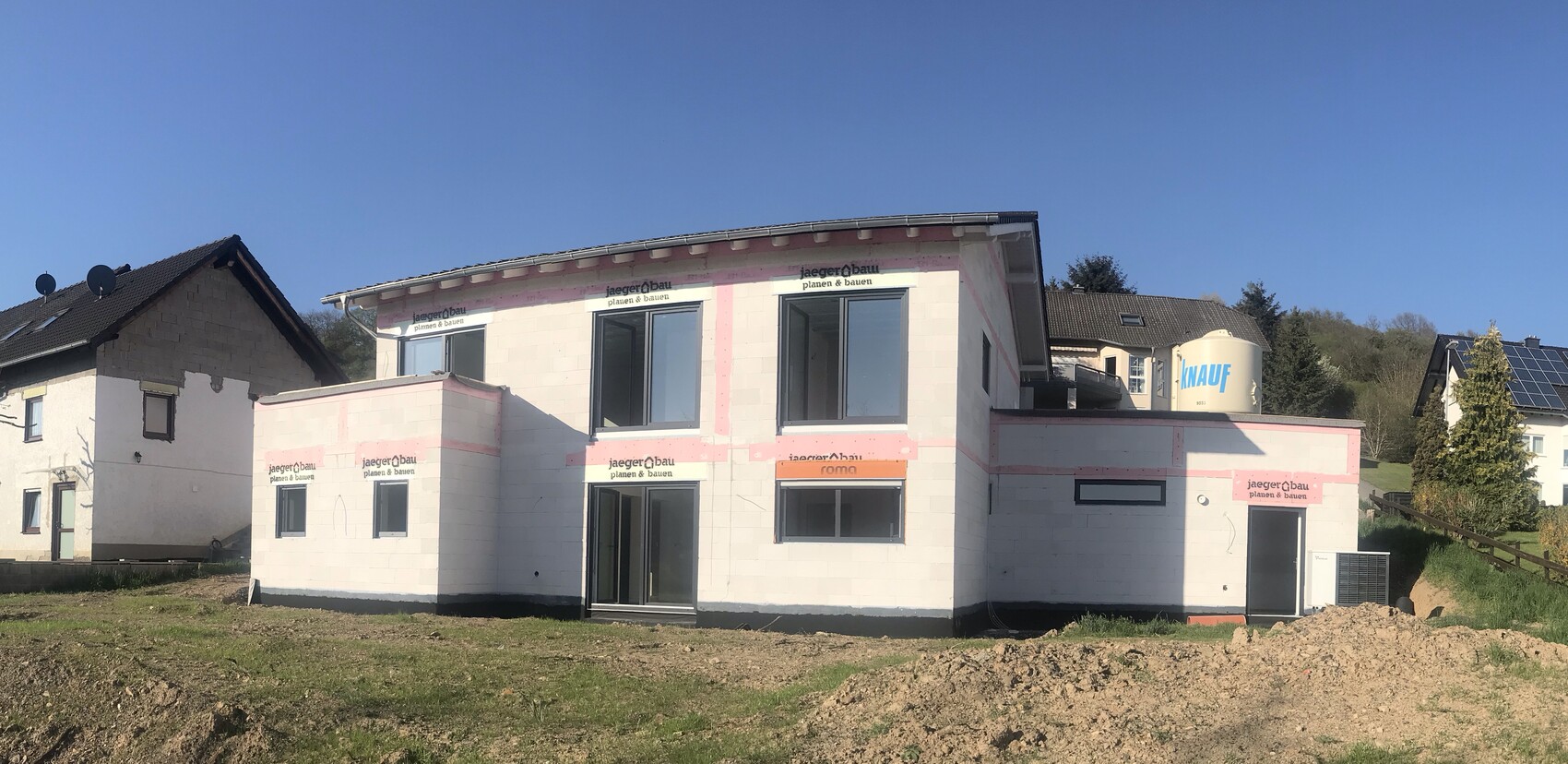
Should we assume that the large floor-to-ceiling windows are responsible for the heat gain? A photo of the south-facing side of the house is attached.
What would you do – always lower all the blinds as soon as sunlight is forecast? That seems quite annoying...
We have motorized blinds controlled by Somfy. Would you consider buying a sensor that automatically lowers the blinds at a certain temperature?
Thanks in advance for your replies.
I have a general question.
We moved into our new build four months ago. The living area on the ground floor has three large floor-to-ceiling windows facing south. We have underfloor heating and an air-to-water heat pump.
It provides a really comfortable temperature inside the house, but we have a problem – whenever the sun is shining in winter, even if it’s -2°C (28°F) outside, the temperature suddenly rises to 24°C (75°F) in the living room. It gets uncomfortably warm in here, and the underfloor heating can’t be turned down quickly.
Should we assume that the large floor-to-ceiling windows are responsible for the heat gain? A photo of the south-facing side of the house is attached.
What would you do – always lower all the blinds as soon as sunlight is forecast? That seems quite annoying...
We have motorized blinds controlled by Somfy. Would you consider buying a sensor that automatically lowers the blinds at a certain temperature?
Thanks in advance for your replies.
D
Daniel-Sp15 Dec 2019 20:17Hello
[/QUOTE]
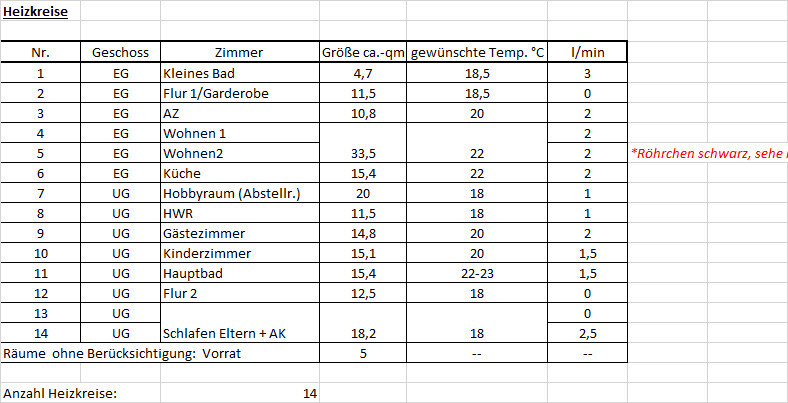
Since we don’t have information about the heating circuits (length, spacing), I would proceed as follows.
Set all circuits to maximum flow except for:
1. Small bathroom: This is likely a very short heating circuit, with a risk of thermal short-circuiting, so start with 0.3 - 0.5 liters per minute (l/min). When the infrared thermometer arrives, please measure the return temperature—it should be roughly the same as the return of the other heating circuits. If it is higher, reduce the flow further; if it is lower, increase the flow slightly.
2. Utility room: Usually less heat is desired here. I suggest fully opening the valve, then close the flow meter by half a turn, with further adjustments after the house has stabilized. It will probably require less flow later on.
3. Master bedroom and dressing room: Limit flow right away—start with 1 liter per minute (l/min) for the bedroom and 0.75 liters per minute (l/min) for the dressing room (or 0.75-0.5 l/min). When you have the thermometer, check the two return temperatures and balance them by adjusting flow.
4. Set all, absolutely all ERR valves to maximum (unless the actuators have been removed).
5. Heat the hallway as well, otherwise it will draw heat away from other rooms (bathroom!) and you need its flow to reach the minimum required volume flow.
6. When the infrared thermometer arrives, measure the return temperature of each heating circuit. If there are significant differences, readjust flow (except where noted above).
7. Monitor room temperatures in parallel (also necessary due to lack of information about the underfloor heating).
Always remember that even small adjustments to one flow meter affect the flow in the other heating circuits!
For safety, note how many turns each heating circuit valve is currently closed. That way, you can always return to the previous settings. Also record every change you make and its effect on room temperature—this lets you revert to an earlier setting at any time. Record the original setting of the bypass valve installed by the heating installer so you can also revert it if needed. Since you are now close to the minimum volume flow, opening the heating circuits should provide enough flow, allowing you to slowly close it.
It will probably be too warm at first. Don’t panic or try to reduce temperature by adjusting the ERR valves; instead, lower the heating curve. After each change, wait about 24 hours, possibly longer after the initial adjustment because the screed is not yet evenly warmed throughout the house (rooms currently at zero flow). Depending on the building’s energy standard, you may end up with settings like 29/22/0 or even lower. This will save you a lot of money.
Once you have found the correct heating curve, you can slightly reduce flow—and thus heat input—in some rooms using the flow meters, but be cautious. Always keep an eye on the total volume flow. It should be at least 1600 liters per hour (26.6 l/min) (minimum flow of the heat interface station, see technical data), preferably 2000 liters per hour (33.3 l/min), although you may not achieve this.
The bathroom with many exterior walls will be problematic. You might need to preheat it with the electric towel radiator about half an hour before planned use, then turn it off again. A room used maybe half an hour to an hour per day should not be the reference room and run at high temperature 24/7. That just wastes money.
I would first set a target core temperature for the house—for now, apply it to all rooms except the bedrooms and utility room. Once you reach this temperature everywhere, the first hydraulic balancing is done. Then proceed with the thermal balancing, gradually limiting those rooms that should be cooler.
Once thermal balancing is complete at the latest, consider removing the actuators and disconnecting power. This will save electricity and prevent an untrained user from disrupting your thermal balancing.
If you implement points 1-5, feel free to share the achieved flow rates here.
Have fun and have a nice evening
Daniel
[/QUOTE]
Since we don’t have information about the heating circuits (length, spacing), I would proceed as follows.
Set all circuits to maximum flow except for:
1. Small bathroom: This is likely a very short heating circuit, with a risk of thermal short-circuiting, so start with 0.3 - 0.5 liters per minute (l/min). When the infrared thermometer arrives, please measure the return temperature—it should be roughly the same as the return of the other heating circuits. If it is higher, reduce the flow further; if it is lower, increase the flow slightly.
2. Utility room: Usually less heat is desired here. I suggest fully opening the valve, then close the flow meter by half a turn, with further adjustments after the house has stabilized. It will probably require less flow later on.
3. Master bedroom and dressing room: Limit flow right away—start with 1 liter per minute (l/min) for the bedroom and 0.75 liters per minute (l/min) for the dressing room (or 0.75-0.5 l/min). When you have the thermometer, check the two return temperatures and balance them by adjusting flow.
4. Set all, absolutely all ERR valves to maximum (unless the actuators have been removed).
5. Heat the hallway as well, otherwise it will draw heat away from other rooms (bathroom!) and you need its flow to reach the minimum required volume flow.
6. When the infrared thermometer arrives, measure the return temperature of each heating circuit. If there are significant differences, readjust flow (except where noted above).
7. Monitor room temperatures in parallel (also necessary due to lack of information about the underfloor heating).
Always remember that even small adjustments to one flow meter affect the flow in the other heating circuits!
For safety, note how many turns each heating circuit valve is currently closed. That way, you can always return to the previous settings. Also record every change you make and its effect on room temperature—this lets you revert to an earlier setting at any time. Record the original setting of the bypass valve installed by the heating installer so you can also revert it if needed. Since you are now close to the minimum volume flow, opening the heating circuits should provide enough flow, allowing you to slowly close it.
It will probably be too warm at first. Don’t panic or try to reduce temperature by adjusting the ERR valves; instead, lower the heating curve. After each change, wait about 24 hours, possibly longer after the initial adjustment because the screed is not yet evenly warmed throughout the house (rooms currently at zero flow). Depending on the building’s energy standard, you may end up with settings like 29/22/0 or even lower. This will save you a lot of money.
Once you have found the correct heating curve, you can slightly reduce flow—and thus heat input—in some rooms using the flow meters, but be cautious. Always keep an eye on the total volume flow. It should be at least 1600 liters per hour (26.6 l/min) (minimum flow of the heat interface station, see technical data), preferably 2000 liters per hour (33.3 l/min), although you may not achieve this.
The bathroom with many exterior walls will be problematic. You might need to preheat it with the electric towel radiator about half an hour before planned use, then turn it off again. A room used maybe half an hour to an hour per day should not be the reference room and run at high temperature 24/7. That just wastes money.
I would first set a target core temperature for the house—for now, apply it to all rooms except the bedrooms and utility room. Once you reach this temperature everywhere, the first hydraulic balancing is done. Then proceed with the thermal balancing, gradually limiting those rooms that should be cooler.
Once thermal balancing is complete at the latest, consider removing the actuators and disconnecting power. This will save electricity and prevent an untrained user from disrupting your thermal balancing.
If you implement points 1-5, feel free to share the achieved flow rates here.
Have fun and have a nice evening
Daniel
 chewbacca12316 Dec 2019 06:55
Daniel-Sp schrieb:
Hey, good morning, thank you very much for the detailed suggestion. Yesterday, I set the heating curve to 30 22.5 0, all errors to reduction on, and this morning it was quite hot, see attachment.
Hallways almost 23 degrees Celsius (73°F), which is extreme. But the bathroom only 21.1 degrees Celsius (70°F).
I haven’t adjusted anything at the heating circuit manifolds yet.
I’m now trying 29 22.0 0.
The heating technician will come again this week to show me how to adjust the heating circuit manifolds and set them according to your suggestion. I’ll report back then.
Best regards
Can the total volumetric flow rate actually be too high? For heating efficiency, it might not be a problem, but on the other hand, there is the power consumption of the circulation pump and possibly flow noise.
What exactly is the risk of a thermal short circuit? Distortion of the return flow measurement?
What exactly is the risk of a thermal short circuit? Distortion of the return flow measurement?
D
Daniel-Sp16 Dec 2019 07:50Then the temperature difference between the supply and return becomes too small, and the heat pump does not operate as efficiently.
Hmm, the risk is certainly that the heat pump might end the heating cycle too quickly due to a return temperature that is too high. This could cause rapid cycling. On the other hand, a smaller temperature difference in the supply line is actually desirable. Presumably, there is no universal right or wrong answer?!

Daniel-Sp schrieb:
1. Small bathroom, here you can expect a very short heating circuit, and there is a risk of thermal short-circuiting. So start with a flow rate of 0.3 - 0.5 l/min (0.06 - 0.11 gallons per minute). When the infrared thermometer is available, please measure the return temperature; it should be about the same as the return temperature of the other heating circuits. If it is higher, you need to reduce the flow further; if it is lower, you should increase it slightly.
I have to interrupt here. Isn’t it actually the other way around? With the small surface area, where the shower is probably excluded, you have to heat the entire room. Now you lower the flow rate. This means that, on average, you have a lower temperature in the circuit. As a result, you probably won’t reach a comfortable room temperature and will have to raise the heating curve. Then the other rooms become too warm again, and you reduce their flow rates. The consequence: different return temperatures again. Do you have a temperature sensor on every return line? Otherwise, the water in the heating manifold would mix anyway.
In my case, the rooms where I want the highest temperatures (bathrooms and living room) are turned up fully.
This probably also depends on the heating system. For me, the return temperature does not matter at all at the heating system. My system is controlled only by the supply temperature.
Similar topics