
ᐅ Underfloor heating with an air-to-water heat pump. House gets too warm when the sun is shining.
Created on: 4 Dec 2019 14:18
C
chewbacca123
Hello everyone,
I have a general question.
We moved into our new build four months ago. The living area on the ground floor has three large floor-to-ceiling windows facing south. We have underfloor heating and an air-to-water heat pump.
It provides a really comfortable temperature inside the house, but we have a problem – whenever the sun is shining in winter, even if it’s -2°C (28°F) outside, the temperature suddenly rises to 24°C (75°F) in the living room. It gets uncomfortably warm in here, and the underfloor heating can’t be turned down quickly.
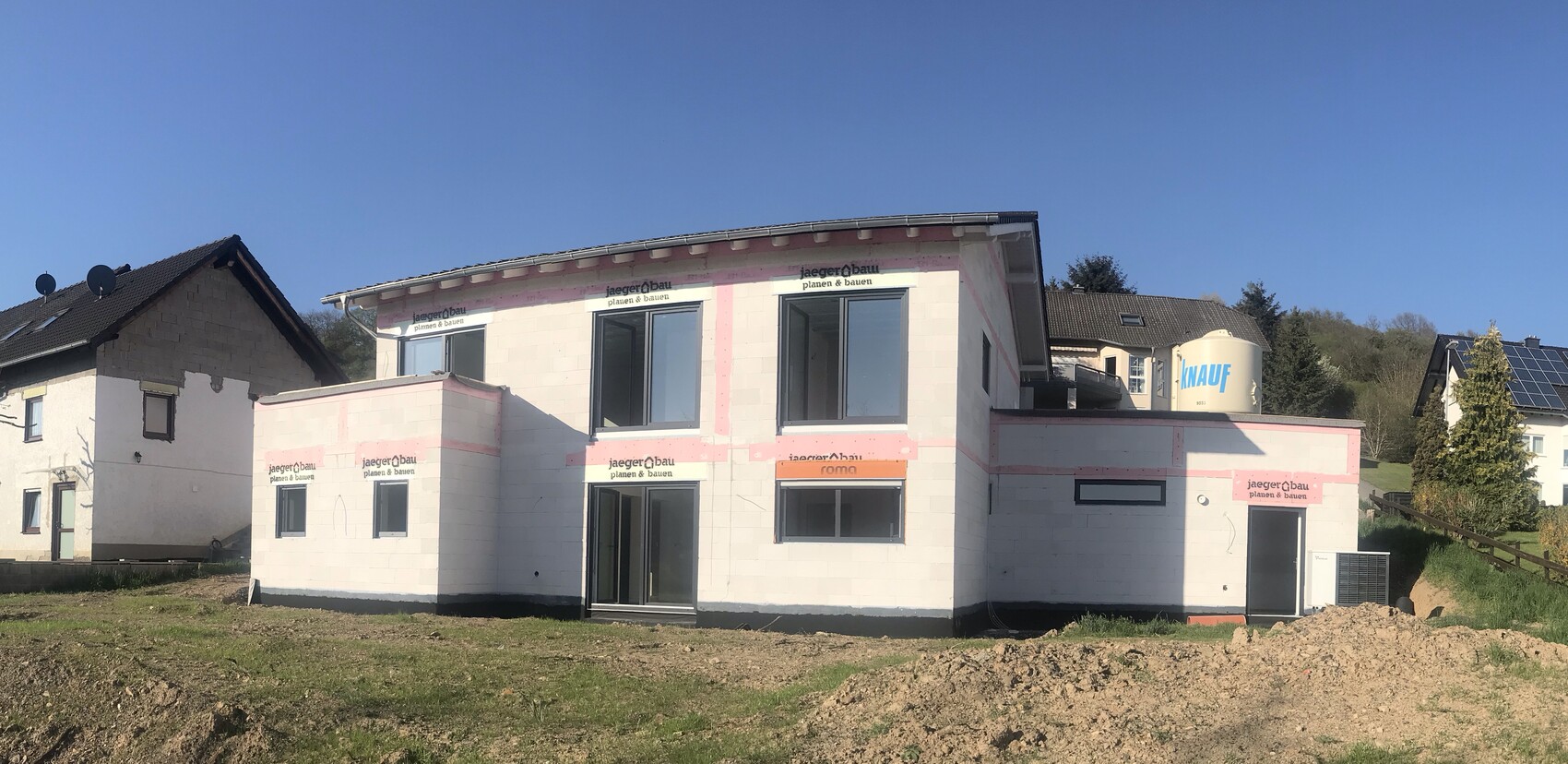
Should we assume that the large floor-to-ceiling windows are responsible for the heat gain? A photo of the south-facing side of the house is attached.
What would you do – always lower all the blinds as soon as sunlight is forecast? That seems quite annoying...
We have motorized blinds controlled by Somfy. Would you consider buying a sensor that automatically lowers the blinds at a certain temperature?
Thanks in advance for your replies.
I have a general question.
We moved into our new build four months ago. The living area on the ground floor has three large floor-to-ceiling windows facing south. We have underfloor heating and an air-to-water heat pump.
It provides a really comfortable temperature inside the house, but we have a problem – whenever the sun is shining in winter, even if it’s -2°C (28°F) outside, the temperature suddenly rises to 24°C (75°F) in the living room. It gets uncomfortably warm in here, and the underfloor heating can’t be turned down quickly.
Should we assume that the large floor-to-ceiling windows are responsible for the heat gain? A photo of the south-facing side of the house is attached.
What would you do – always lower all the blinds as soon as sunlight is forecast? That seems quite annoying...
We have motorized blinds controlled by Somfy. Would you consider buying a sensor that automatically lowers the blinds at a certain temperature?
Thanks in advance for your replies.
 chewbacca12313 Dec 2019 17:14
Daniel-Sp schrieb:
Could you please list all rooms per floor, including the size of each room and the number of heating loops?
Do you have underfloor heating only in the bathrooms?
If you don’t mind, floor plans of the floors would be helpful as well.
The heating installer should be able to tell you the model of the heat pump. The heating capacity of the heat pump and the heating demand of the house are important.
What is your current total flow rate?
More information would be great.Sure, no problem. Floor plan images attached. The hobby room is in the basement under the carport. It also has underfloor heating. All rooms have 1 heating loop except the living/kitchen area, which has 3, and the bedroom/dressing room, which has 2.
In the main bathroom, we also have an electric towel warmer.
Where can I find the total flow rate?
D
Daniel-Sp13 Dec 2019 17:37Total flow rate = sum of all heating circuits, simply add the readings from the flow tubes on the hydraulic separator. Then compare again with the flow rate specified by the heat pump.
Under settings - information - inputs (I think)
The tubes from the living room look quite cloudy...
Under settings - information - inputs (I think)
The tubes from the living room look quite cloudy...
D
Daniel-Sp13 Dec 2019 19:17I’m a bit confused. Is the bedroom/kids’ room on the upper floor? What’s below the bathroom then?
It’s good that you have an electric towel warmer in the bathroom and that it’s not connected to the heat pump. That way, you can add heat independently if needed.
Otherwise, I’m thinking: one heating circuit per room, which means an average of 14sqm (150 sq ft) per circuit? That either means a large pipe spacing or heating circuits over 100m (330 ft) in length. I’d have to calculate it when the kids are sleeping.
Both options would be inconvenient. Long heating circuits cause a high pressure drop from the supply to the return flow. Wide pipe spacing means lower heating output per square meter. Neither is ideal.
Two heating circuits in the bedroom over 18sqm (195 sq ft) naturally provide significantly more heating output than one heating circuit over 15sqm (160 sq ft) in the bathroom. Plus, the bathroom has many exterior walls. That already explains why the bedroom is too warm and the bathroom too cold.
Did the heating engineer provide a calculation to base this on? They should give you that.
But it is what it is. Now you have to decide whether to leave everything as the heating engineer set it up, in which case the heat pump will probably cycle frequently and be broken by 2030 at the latest, or to take matters into your own hands.
It’s complicated at first but ultimately not rocket science. You just need patience for the first few weeks, then it’s just fine-tuning. I know, with a child it’s hard to find time and peace, and when the child sleeps you can’t do much yourself either.
I can support you.
By the way, where is the house located?
It’s good that you have an electric towel warmer in the bathroom and that it’s not connected to the heat pump. That way, you can add heat independently if needed.
Otherwise, I’m thinking: one heating circuit per room, which means an average of 14sqm (150 sq ft) per circuit? That either means a large pipe spacing or heating circuits over 100m (330 ft) in length. I’d have to calculate it when the kids are sleeping.
Both options would be inconvenient. Long heating circuits cause a high pressure drop from the supply to the return flow. Wide pipe spacing means lower heating output per square meter. Neither is ideal.
Two heating circuits in the bedroom over 18sqm (195 sq ft) naturally provide significantly more heating output than one heating circuit over 15sqm (160 sq ft) in the bathroom. Plus, the bathroom has many exterior walls. That already explains why the bedroom is too warm and the bathroom too cold.
Did the heating engineer provide a calculation to base this on? They should give you that.
But it is what it is. Now you have to decide whether to leave everything as the heating engineer set it up, in which case the heat pump will probably cycle frequently and be broken by 2030 at the latest, or to take matters into your own hands.
It’s complicated at first but ultimately not rocket science. You just need patience for the first few weeks, then it’s just fine-tuning. I know, with a child it’s hard to find time and peace, and when the child sleeps you can’t do much yourself either.
I can support you.
By the way, where is the house located?
D
Daniel-Sp13 Dec 2019 19:20Do you have a sloped site?
chewbacca12313 Dec 2019 19:50Daniel-Sp schrieb:
Hey, we built on a slope. The ground floor has the living, dining, and storage areas, the entrance zone, and a small shower toilet.
In the basement are the main bathroom, parents' bedroom, child's bedroom, guest room, and utility room. We also have the cellar space under the carport, which we use as a storage room.
Above the bathroom is partly the balcony, the corner that extends out.
I will write to the heating engineer directly to ask if he can send me the calculation of the heating circuits. I’m curious about that...
It’s really kind of you, all of you, to support me. For me, this is honestly like rocket science; I’ve had zero experience with this until now, and I find it really complicated. :-(
But I’m getting there, thanks to your help and that of everyone else.
Similar topics