
ᐅ Underfloor heating with an air-to-water heat pump. House gets too warm when the sun is shining.
Created on: 4 Dec 2019 14:18
C
chewbacca123
Hello everyone,
I have a general question.
We moved into our new build four months ago. The living area on the ground floor has three large floor-to-ceiling windows facing south. We have underfloor heating and an air-to-water heat pump.
It provides a really comfortable temperature inside the house, but we have a problem – whenever the sun is shining in winter, even if it’s -2°C (28°F) outside, the temperature suddenly rises to 24°C (75°F) in the living room. It gets uncomfortably warm in here, and the underfloor heating can’t be turned down quickly.
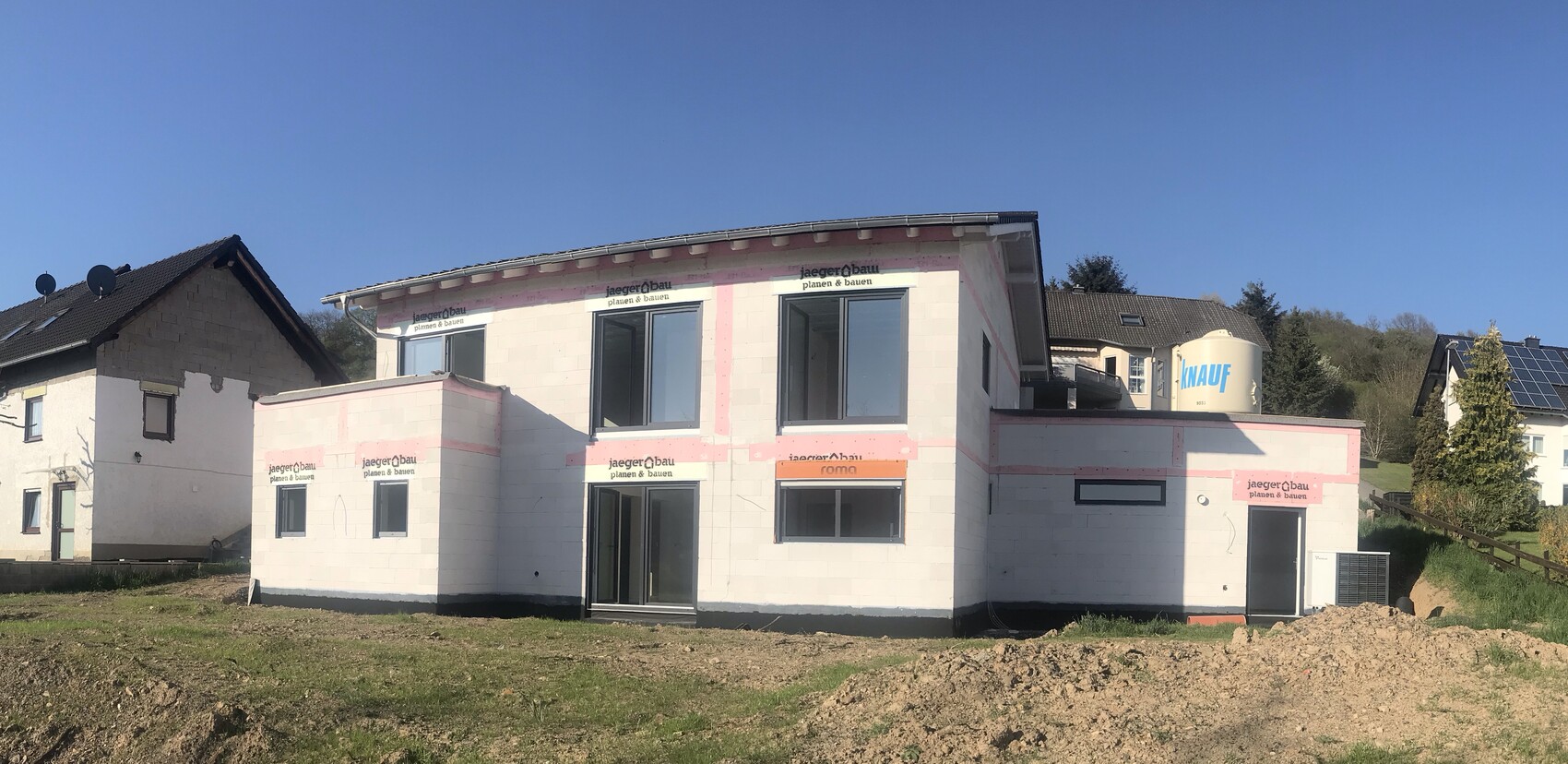
Should we assume that the large floor-to-ceiling windows are responsible for the heat gain? A photo of the south-facing side of the house is attached.
What would you do – always lower all the blinds as soon as sunlight is forecast? That seems quite annoying...
We have motorized blinds controlled by Somfy. Would you consider buying a sensor that automatically lowers the blinds at a certain temperature?
Thanks in advance for your replies.
I have a general question.
We moved into our new build four months ago. The living area on the ground floor has three large floor-to-ceiling windows facing south. We have underfloor heating and an air-to-water heat pump.
It provides a really comfortable temperature inside the house, but we have a problem – whenever the sun is shining in winter, even if it’s -2°C (28°F) outside, the temperature suddenly rises to 24°C (75°F) in the living room. It gets uncomfortably warm in here, and the underfloor heating can’t be turned down quickly.
Should we assume that the large floor-to-ceiling windows are responsible for the heat gain? A photo of the south-facing side of the house is attached.
What would you do – always lower all the blinds as soon as sunlight is forecast? That seems quite annoying...
We have motorized blinds controlled by Somfy. Would you consider buying a sensor that automatically lowers the blinds at a certain temperature?
Thanks in advance for your replies.
 chewbacca12310 Dec 2019 19:08
D
Daniel-Sp10 Dec 2019 19:08Then you need to measure the return temperatures at the central heating valve (CHV) using a small infrared thermometer. Short circuits have higher return temperatures than long circuits. However, you must fully open all heating circuits to allow maximum flow, and the bypass valve should be closed. This way, you can identify not only the short circuits but also see on the flow meters the maximum flow your hydraulic system can provide and whether it is sufficient to reach the nominal volume flow of your heat pump.
So, if after yesterday’s visit the system is still cycling frequently and the house isn’t warming up, you need to do the following:
1. Open all circuits fully, close the bypass valve, and measure the total flow.
(The bedroom can be throttled again later once the hydraulic balance is correct, the heating curve is set properly, and the heat pump no longer cycles frequently). If the flow is too high, the pump performance can be reduced.
2. Gradually balance circuits with a rapid increase in return temperature or higher return temperatures until all have approximately the same return temperature. This balances your underfloor heating hydraulically. The heat pump should then stop cycling frequently.
3. Adjust the heating curve until the indoor temperature is comfortable.
4. Now, individual circuits can be throttled to lower the temperature in specific rooms (e.g., the bedroom). Always keep an eye on the total flow, as the minimum volume flow must be maintained.
5. For now, this completes the process. In the following winters, only fine-tuning may be necessary.
If you can shorten the heating circuit lengths, the whole process will be easier...
Bathrooms are almost always critical when a higher temperature is required. Retrofitting additional heating surface is not possible. So, you have to decide: either install an electric radiator for demand-based short-term heating or raise the heating curve with a decline in efficiency. In the long run, the electric radiator is usually the more economical option. But maybe your bathrooms don’t need this.
Greetings from Hamburg
So, if after yesterday’s visit the system is still cycling frequently and the house isn’t warming up, you need to do the following:
1. Open all circuits fully, close the bypass valve, and measure the total flow.
(The bedroom can be throttled again later once the hydraulic balance is correct, the heating curve is set properly, and the heat pump no longer cycles frequently). If the flow is too high, the pump performance can be reduced.
2. Gradually balance circuits with a rapid increase in return temperature or higher return temperatures until all have approximately the same return temperature. This balances your underfloor heating hydraulically. The heat pump should then stop cycling frequently.
3. Adjust the heating curve until the indoor temperature is comfortable.
4. Now, individual circuits can be throttled to lower the temperature in specific rooms (e.g., the bedroom). Always keep an eye on the total flow, as the minimum volume flow must be maintained.
5. For now, this completes the process. In the following winters, only fine-tuning may be necessary.
If you can shorten the heating circuit lengths, the whole process will be easier...
Bathrooms are almost always critical when a higher temperature is required. Retrofitting additional heating surface is not possible. So, you have to decide: either install an electric radiator for demand-based short-term heating or raise the heating curve with a decline in efficiency. In the long run, the electric radiator is usually the more economical option. But maybe your bathrooms don’t need this.
Greetings from Hamburg
D
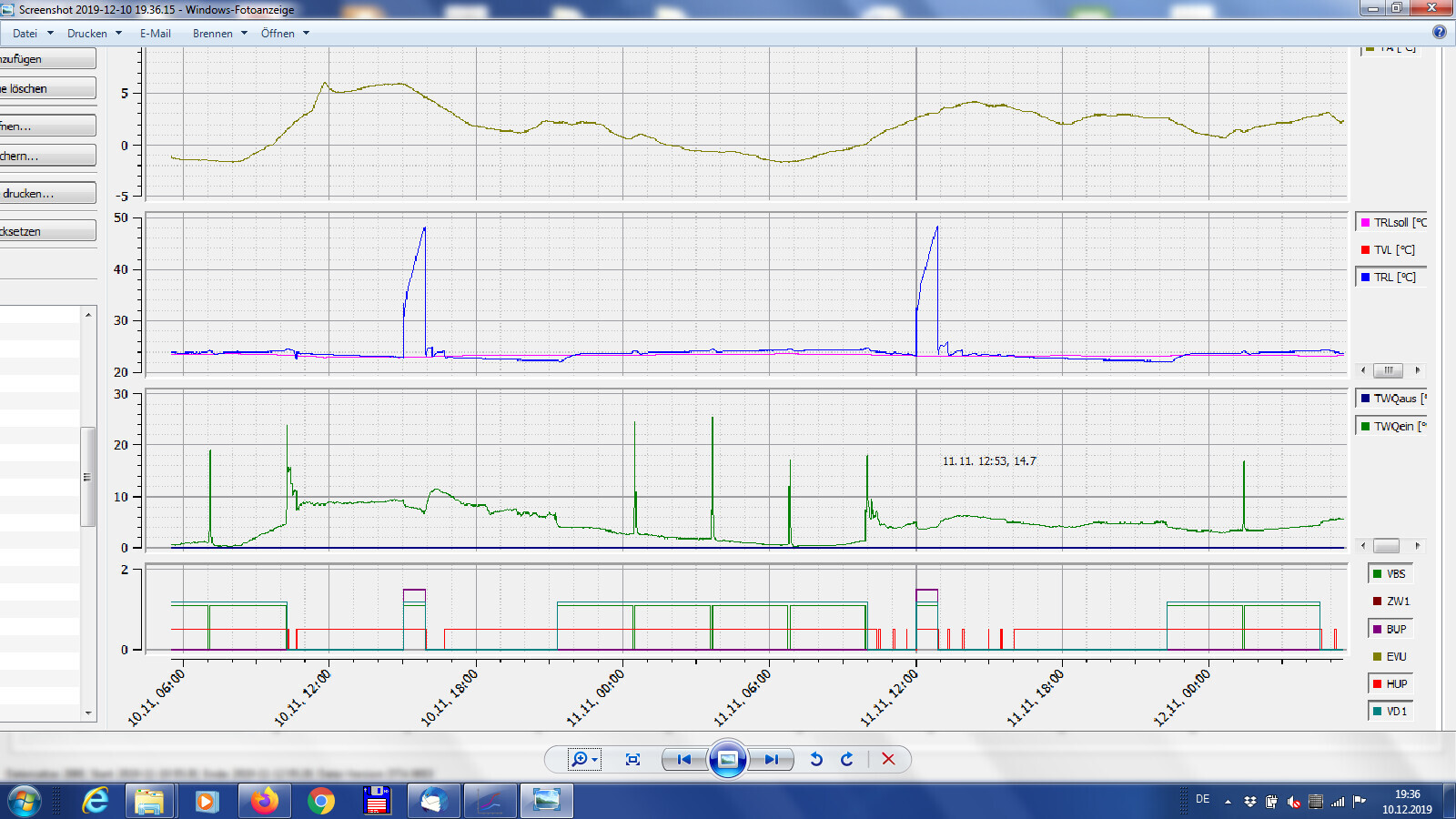
Daniel-Sp10 Dec 2019 19:44If the heat pump is operating well, you should see a pattern like this.
The compressor starts and runs for several hours during heating mode, only interrupted by defrost cycles, while the return temperature slowly increases. If the return temperature TRL exceeds the target return temperature TRLsoll plus a hysteresis, the compressor stops and restarts when TRL falls below TRLsoll minus the hysteresis. Domestic hot water is produced once a day.
Compressor is VD1
HUP is the heating circulation pump (it also runs when the compressor is off to regulate the screed temperature)
TRLsoll is the target return temperature
TRL is the actual return temperature
BUP is the domestic hot water pump
Sorry for the poor quality, couldn’t do better on short notice.
The compressor starts and runs for several hours during heating mode, only interrupted by defrost cycles, while the return temperature slowly increases. If the return temperature TRL exceeds the target return temperature TRLsoll plus a hysteresis, the compressor stops and restarts when TRL falls below TRLsoll minus the hysteresis. Domestic hot water is produced once a day.
Compressor is VD1
HUP is the heating circulation pump (it also runs when the compressor is off to regulate the screed temperature)
TRLsoll is the target return temperature
TRL is the actual return temperature
BUP is the domestic hot water pump
Sorry for the poor quality, couldn’t do better on short notice.
D
Daniel-Sp10 Dec 2019 20:09I have hidden that... It’s already confusing enough.
D
Daniel-Sp10 Dec 2019 22:39@chewbacca123
Could you try visualizing the curves with Opendta and then upload the image here? I'm interested in the behavior of the return flow during the heating phase as well as the runtime per compressor start.
Regards
Could you try visualizing the curves with Opendta and then upload the image here? I'm interested in the behavior of the return flow during the heating phase as well as the runtime per compressor start.
Regards
Similar topics