
ᐅ Underfloor heating with an air-to-water heat pump. House gets too warm when the sun is shining.
Created on: 4 Dec 2019 14:18
C
chewbacca123
Hello everyone,
I have a general question.
We moved into our new build four months ago. The living area on the ground floor has three large floor-to-ceiling windows facing south. We have underfloor heating and an air-to-water heat pump.
It provides a really comfortable temperature inside the house, but we have a problem – whenever the sun is shining in winter, even if it’s -2°C (28°F) outside, the temperature suddenly rises to 24°C (75°F) in the living room. It gets uncomfortably warm in here, and the underfloor heating can’t be turned down quickly.
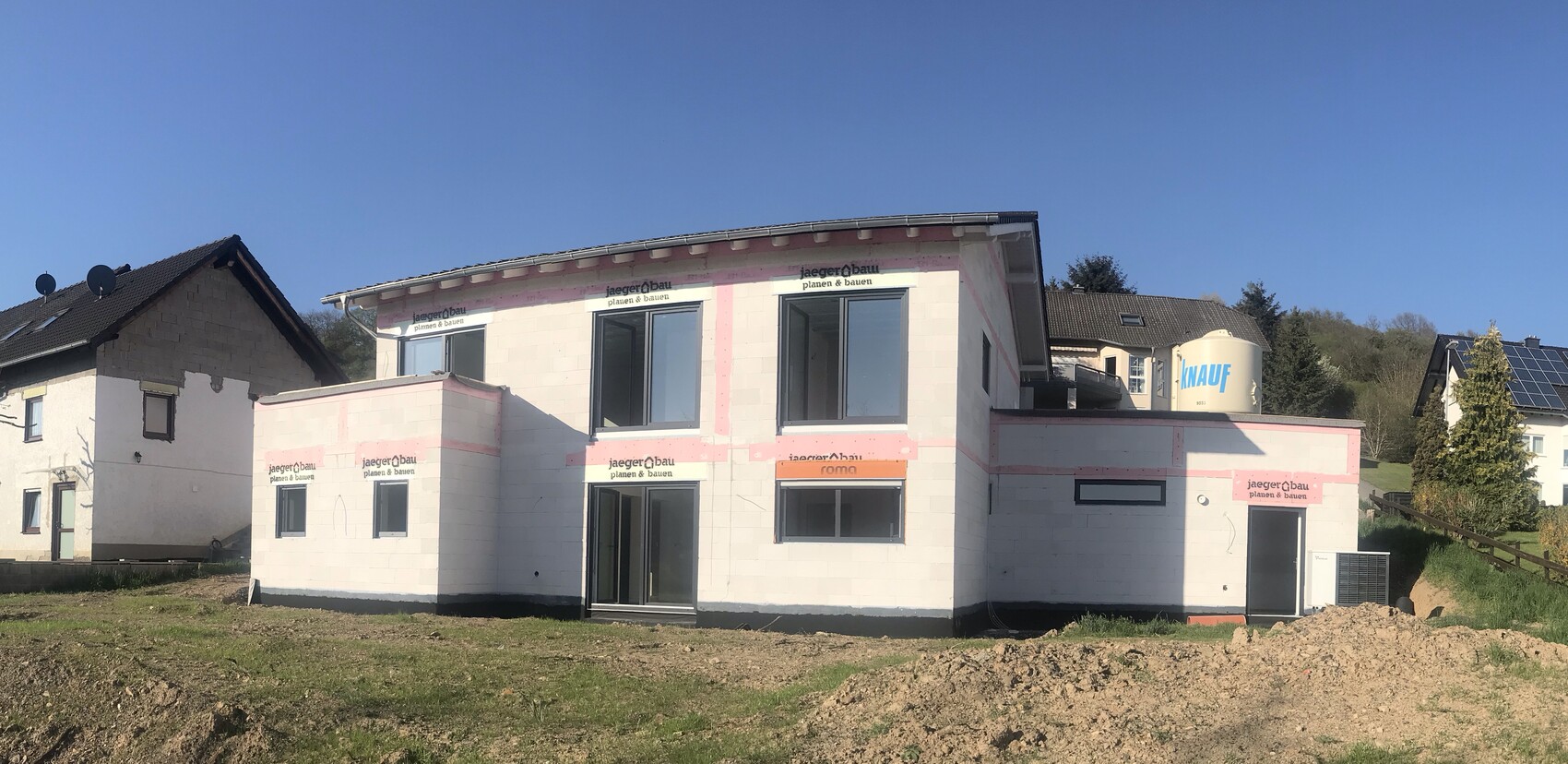
Should we assume that the large floor-to-ceiling windows are responsible for the heat gain? A photo of the south-facing side of the house is attached.
What would you do – always lower all the blinds as soon as sunlight is forecast? That seems quite annoying...
We have motorized blinds controlled by Somfy. Would you consider buying a sensor that automatically lowers the blinds at a certain temperature?
Thanks in advance for your replies.
I have a general question.
We moved into our new build four months ago. The living area on the ground floor has three large floor-to-ceiling windows facing south. We have underfloor heating and an air-to-water heat pump.
It provides a really comfortable temperature inside the house, but we have a problem – whenever the sun is shining in winter, even if it’s -2°C (28°F) outside, the temperature suddenly rises to 24°C (75°F) in the living room. It gets uncomfortably warm in here, and the underfloor heating can’t be turned down quickly.
Should we assume that the large floor-to-ceiling windows are responsible for the heat gain? A photo of the south-facing side of the house is attached.
What would you do – always lower all the blinds as soon as sunlight is forecast? That seems quite annoying...
We have motorized blinds controlled by Somfy. Would you consider buying a sensor that automatically lowers the blinds at a certain temperature?
Thanks in advance for your replies.
D
Daniel-Sp10 Dec 2019 05:09Hello,
have you been shown the bypass valve?
You could run a current dta and csv today and make them available. You can view the dta yourself using the program opendta (freeware), which allows you to see all important parameters in one graph over the last 48 hours. If everything is correct, you should see a clear difference before and after the heating technician’s visit. Did you receive documentation for the individual heating circuits?
Looking forward to your update.
have you been shown the bypass valve?
You could run a current dta and csv today and make them available. You can view the dta yourself using the program opendta (freeware), which allows you to see all important parameters in one graph over the last 48 hours. If everything is correct, you should see a clear difference before and after the heating technician’s visit. Did you receive documentation for the individual heating circuits?
Looking forward to your update.
 chewbacca12310 Dec 2019 08:03
Daniel-Sp schrieb:
Hello,
have you been shown the bypass valve?
You could generate a current DTA and CSV file this evening and share them. You can also view the DTA file yourself using the free program opendta, which lets you see all important parameters in a graph for the last 48 hours. If everything is correct, you should notice a clear difference before and after the heating engineer's visit. Did you receive documentation for the individual heating circuits?
Looking forward to it. Good morning,
He showed me the bypass valve, which is located behind the casing. I will definitely extract data again this evening. This morning, however, it felt a bit too cold in the bathroom, so I increased the temperature by another 0.5°C (0.9°F). Our installer also adjusted the individual heating circuits again. Ideally, more heat should reach the bathroom, while less should go to the bedroom because we rarely use the heating there. But this morning it was still quite chilly.
I hope there will be some improvement by this evening.
I don’t yet understand the graph—how can I link this freeware to my system?
D
Daniel-Sp10 Dec 2019 08:59You transfer the data to a USB drive, then you can view it with opendta. Apparently, there is also an option to retrieve the data from opendta directly over the network from the heat pump, but I have not yet connected my heat pump to the network and cannot comment on that.
Do you now know the lengths of all the heating circuits?
Do you now know the lengths of all the heating circuits?
chewbacca12310 Dec 2019 11:47Daniel-Sp schrieb:
You export the data to a USB drive, then you can view it with opendta. Apparently, there is also an option to retrieve the data directly from the heat pump over the network via opendta, but I haven’t connected my heat pump to the network yet, so I can’t comment on that.
Do you already know the lengths of all the heating circuits? Our system is not connected to the network yet either; the smart solution probably costs extra, right?
Okay, I’ll try that. The data will definitely be available in Excel later this evening.
I don’t know the lengths offhand, but I should be able to check them in the control boxes, right?
D
Daniel-Sp10 Dec 2019 15:16Actually, there should be a room-by-room heating load calculation based on which the underfloor heating is designed for each room. A good heating installer provides these documents without being asked. Ideally, there is also a record of the actual installed pipe length. Calculations and reality always differ. My heating installer noted the pipe lengths in the manifold (HKV). Some just install them by guesswork...
chewbacca12310 Dec 2019 16:38Daniel-Sp schrieb:
There should actually be a heat load calculation for each room, which is used to design the underfloor heating for each individual space. A good heating installer provides these documents without being asked. Ideally, there is also documentation of the actual installed pipe length. Calculations and reality always differ. My heating installer noted the pipe lengths on the heating circuit valve.
Some just install it by guesswork...Unfortunately, we did not receive anything like that :-(Similar topics