
ᐅ Underfloor heating with an air-to-water heat pump. House gets too warm when the sun is shining.
Created on: 4 Dec 2019 14:18
C
chewbacca123
Hello everyone,
I have a general question.
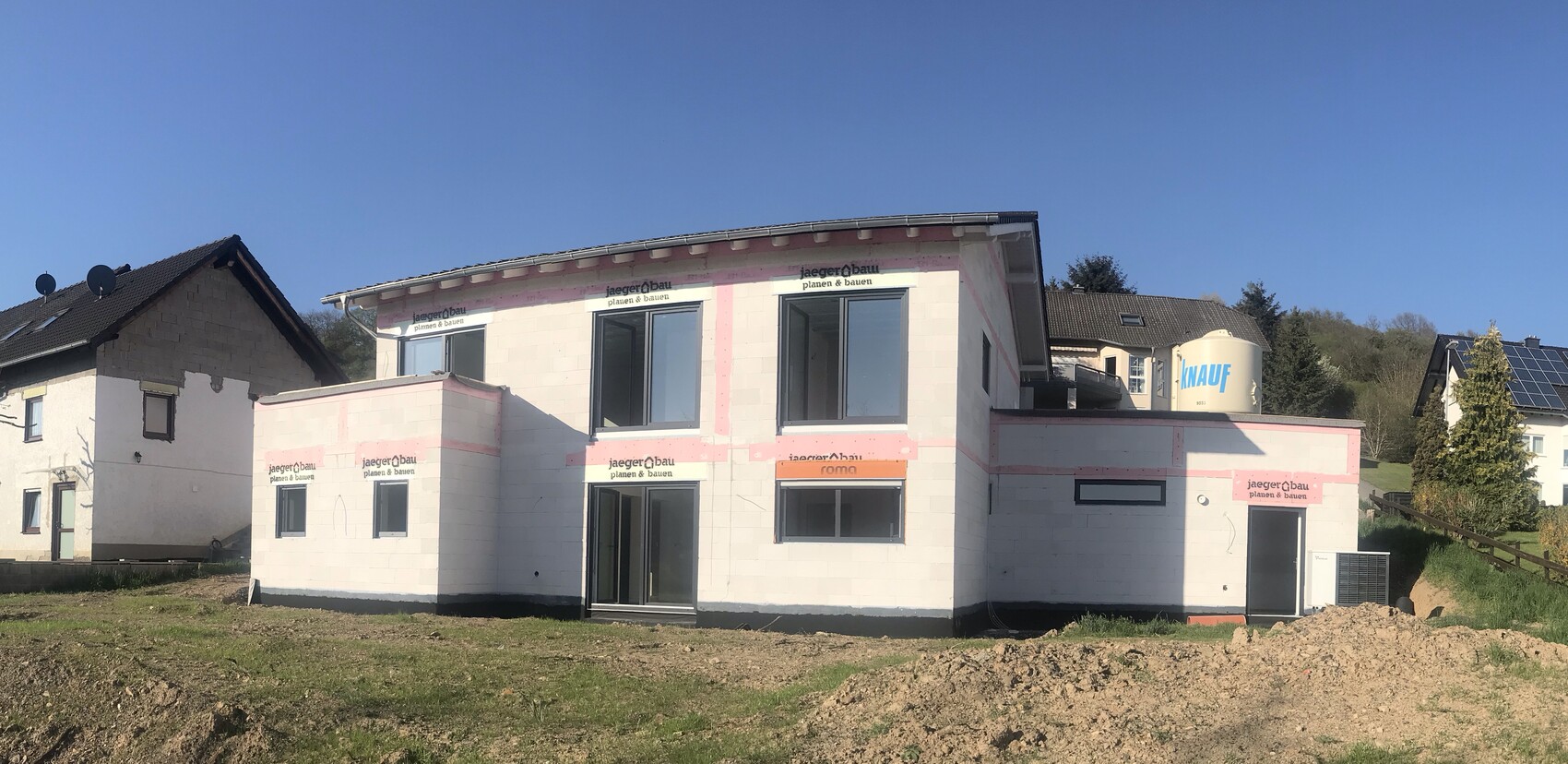
We moved into our new build four months ago. The living area on the ground floor has three large floor-to-ceiling windows facing south. We have underfloor heating and an air-to-water heat pump.
It provides a really comfortable temperature inside the house, but we have a problem – whenever the sun is shining in winter, even if it’s -2°C (28°F) outside, the temperature suddenly rises to 24°C (75°F) in the living room. It gets uncomfortably warm in here, and the underfloor heating can’t be turned down quickly.
Should we assume that the large floor-to-ceiling windows are responsible for the heat gain? A photo of the south-facing side of the house is attached.
What would you do – always lower all the blinds as soon as sunlight is forecast? That seems quite annoying...
We have motorized blinds controlled by Somfy. Would you consider buying a sensor that automatically lowers the blinds at a certain temperature?
Thanks in advance for your replies.
I have a general question.
We moved into our new build four months ago. The living area on the ground floor has three large floor-to-ceiling windows facing south. We have underfloor heating and an air-to-water heat pump.
It provides a really comfortable temperature inside the house, but we have a problem – whenever the sun is shining in winter, even if it’s -2°C (28°F) outside, the temperature suddenly rises to 24°C (75°F) in the living room. It gets uncomfortably warm in here, and the underfloor heating can’t be turned down quickly.
Should we assume that the large floor-to-ceiling windows are responsible for the heat gain? A photo of the south-facing side of the house is attached.
What would you do – always lower all the blinds as soon as sunlight is forecast? That seems quite annoying...
We have motorized blinds controlled by Somfy. Would you consider buying a sensor that automatically lowers the blinds at a certain temperature?
Thanks in advance for your replies.

Yes, I’m still working through the settings. Unfortunately, I wasn’t able to be there during the initial startup. I’d rather not ask the installer himself ;-) and the IdM customer service technician already said he’s happy to come by again when he’s nearby. Until then, it’s better to keep an eye on it yourself :p
I just wanted to know if this is basically normal. It doesn’t seem to be common practice, though. I’ve already read about individual values like the heating activation time and the compressor minimum run time... it’s possible that one of these settings is responsible for this...
I just wanted to know if this is basically normal. It doesn’t seem to be common practice, though. I’ve already read about individual values like the heating activation time and the compressor minimum run time... it’s possible that one of these settings is responsible for this...
D
Daniel-Sp11 Jan 2021 16:17There was also a forced pause after hot water generation with AI/Novelan, which was fixed with a software update.
T
T_im_Norden11 Jan 2021 16:30@Bookstar
Why don’t you start a thread about your system so we can take a look at it, or Daniel if he has a similar setup.
Why don’t you start a thread about your system so we can take a look at it, or Daniel if he has a similar setup.
Bookstar schrieb:
Our situation is completely escalating right now. At minus 8 degrees Celsius (17.6°F), we need 38 kWh of electricity daily. The system has automatically lowered the domestic hot water temperature from 48 to 44 degrees Celsius (118°F to 111°F). It can’t produce any more at the outside temperature.
Sometimes I really wish we still had the gas heating, especially in winter 🙁A heating source that is (largely) independent of outside temperatures would definitely be practical, wouldn’t it? ;-)
T_im_Norden schrieb:
Let it run continuously; what you save by lowering the temperature you have to reheat later.
Because of the thermal inertia of underfloor heating alone, it’s pointless.The required heat load doesn’t change, but it is warmer outside during the day, which improves efficiency.
However, I would raise the temperature during the day rather than lowering it significantly at night.
guckuck2 schrieb:
A heat source that is (largely) independent of outside temperatures would certainly be practical, right? ;-)You mean plutonium?! Definitely 😎Just triggered the hot water again at minus 6 degrees Celsius (21°F). It ran smoothly, and the system was done after 45 minutes. I checked the electricity consumption; it used 3 kWh of power to raise the temperature from 38°C (100°F) to 48°C (118°F). I think that’s acceptable.