
ᐅ Underfloor heating with an air-to-water heat pump. House gets too warm when the sun is shining.
Created on: 4 Dec 2019 14:18
C
chewbacca123
Hello everyone,
I have a general question.
We moved into our new build four months ago. The living area on the ground floor has three large floor-to-ceiling windows facing south. We have underfloor heating and an air-to-water heat pump.
It provides a really comfortable temperature inside the house, but we have a problem – whenever the sun is shining in winter, even if it’s -2°C (28°F) outside, the temperature suddenly rises to 24°C (75°F) in the living room. It gets uncomfortably warm in here, and the underfloor heating can’t be turned down quickly.
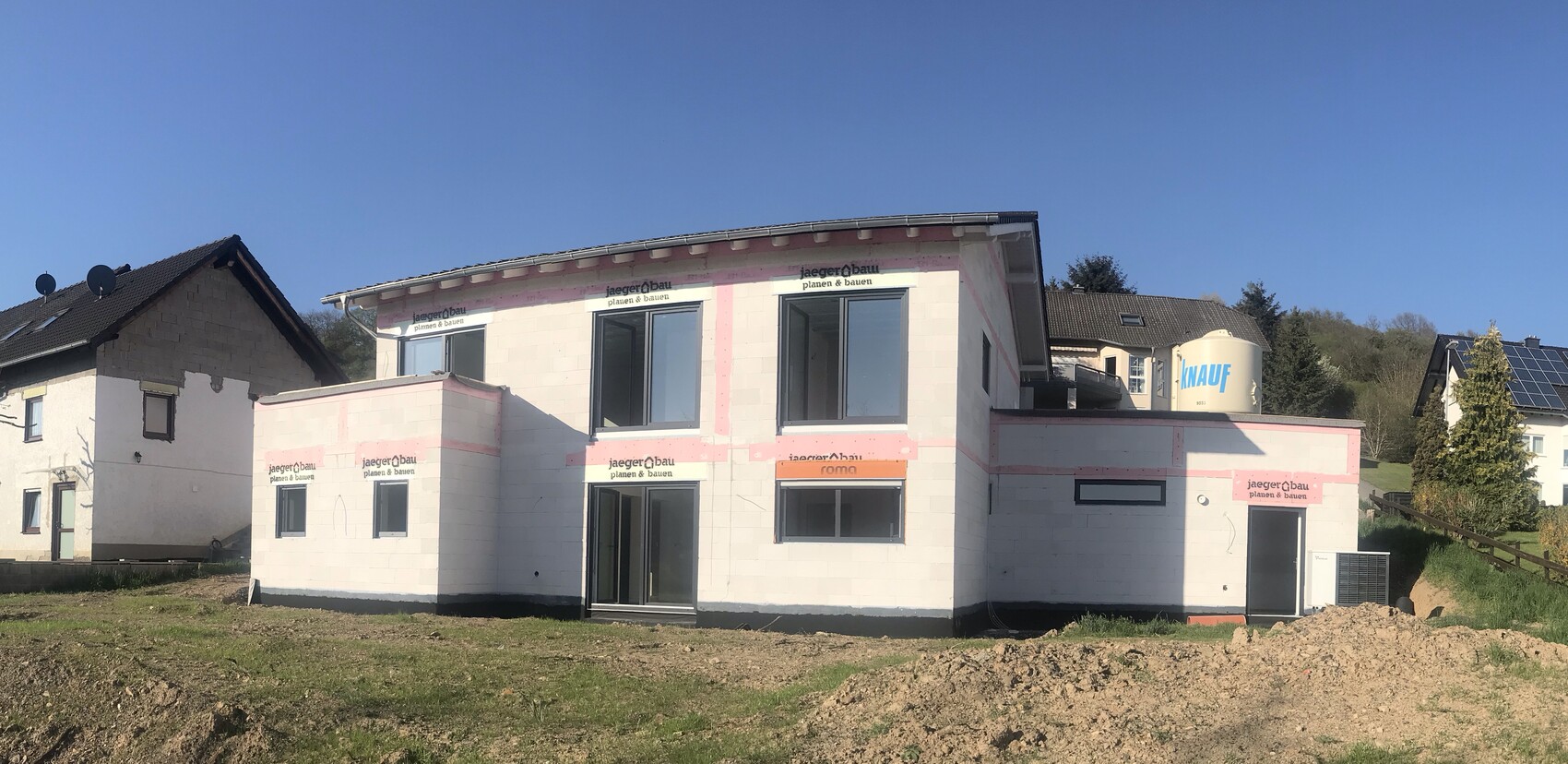
Should we assume that the large floor-to-ceiling windows are responsible for the heat gain? A photo of the south-facing side of the house is attached.
What would you do – always lower all the blinds as soon as sunlight is forecast? That seems quite annoying...
We have motorized blinds controlled by Somfy. Would you consider buying a sensor that automatically lowers the blinds at a certain temperature?
Thanks in advance for your replies.
I have a general question.
We moved into our new build four months ago. The living area on the ground floor has three large floor-to-ceiling windows facing south. We have underfloor heating and an air-to-water heat pump.
It provides a really comfortable temperature inside the house, but we have a problem – whenever the sun is shining in winter, even if it’s -2°C (28°F) outside, the temperature suddenly rises to 24°C (75°F) in the living room. It gets uncomfortably warm in here, and the underfloor heating can’t be turned down quickly.
Should we assume that the large floor-to-ceiling windows are responsible for the heat gain? A photo of the south-facing side of the house is attached.
What would you do – always lower all the blinds as soon as sunlight is forecast? That seems quite annoying...
We have motorized blinds controlled by Somfy. Would you consider buying a sensor that automatically lowers the blinds at a certain temperature?
Thanks in advance for your replies.
face26 schrieb:
I believe there are different theories on this. I’m now testing a modulation approach: lowering the setpoint by 1 degree at night and raising it by 1 degree during the day.
You probably won’t notice the nighttime setback in room temperatures, so that assumption is reasonable. However, your screed will still cool down. This means you face the "problem" the next morning that restarting the heating requires more energy to bring the screed back up to temperature. The question is what’s more efficient—I’ve often read that reheating can sometimes consume more energy than what you save by turning the heating off at night.
Maybe try it gradually. For example, just reduce the heat output? Does your pump have a night mode or something similar? Testing only makes sense if you’re not also making changes to other settings at the same time. I heat with gas but also once tested turning it off at night and then reheating the screed.
=> Running the heating continuously turns out to be cheaper overall than switching it off for 6 hours at night and then reheating... and of course much more comfortable.
FF2677 schrieb:
I do heat with gas, but I also tested turning it off at night and then reheating the screed.
=> Keeping the heating running continuously is ultimately cheaper than turning it off for 6 hours at night and then reheating... and of course much more comfortable.Ok. Do you really mean completely off, like completely off?I was thinking more of lowering the return flow target temperature by 0.5–1 degrees so the heat pump would run less or for a shorter time.
R
RotorMotor11 Jan 2021 12:12FF2677 schrieb:
I heat with gas but have also tested turning it off at night and then reheating the screed.
=> Keeping the heating running continuously is ultimately cheaper than turning it off for 6 hours at night and reheating afterwards... and obviously much more comfortable. With gas, it’s quite clear—there’s no benefit in turning it off.
It’s different with an air-to-water heat pump.
These benefit from higher outdoor temperatures as well as, if available, using their own photovoltaic electricity.
N
nordanney11 Jan 2021 12:13Zaba12 schrieb:
I was rather thinking about lowering the return set temperature by 0.5–1 degree so that the heat pump has to run/hear for a shorter time. With this, in a new build, you should almost be able to "turn it off." It doesn’t cool down that quickly.
T
T_im_Norden11 Jan 2021 12:13Let it run continuously; what you save by lowering the temperature you have to heat up again afterward.
Due to the thermal inertia of the underfloor heating alone, this is pointless.
Due to the thermal inertia of the underfloor heating alone, this is pointless.
RotorMotor schrieb:
With gas, it’s pretty clear there’s no real advantage, right?
It’s different with air-to-water heat pumps.
They benefit both from higher outdoor temperatures and, if available, using their own photovoltaic electricity. Well, it’s not that clear to me.
There will be a cutoff time when it makes sense to turn the heating off completely. For example, if you work from 6 a.m. to 6 p.m. and only want it warm from 6 p.m. to 10 p.m. You could test whether turning the heating off for 20 hours a day is worthwhile or not.
It’s similar to start/stop systems in cars. If the engine is off for only half a second, you don’t save anything because you have to overcome inertia and friction again when restarting. But if the engine has been off for, say, 10 seconds, then it’s worth it.
You have to find that breakpoint for each system.
In our case, turning the heating off for 6 hours wasn’t worth it.
Similar topics