
ᐅ Underfloor heating with an air-to-water heat pump. House gets too warm when the sun is shining.
Created on: 4 Dec 2019 14:18
C
chewbacca123
Hello everyone,
I have a general question.
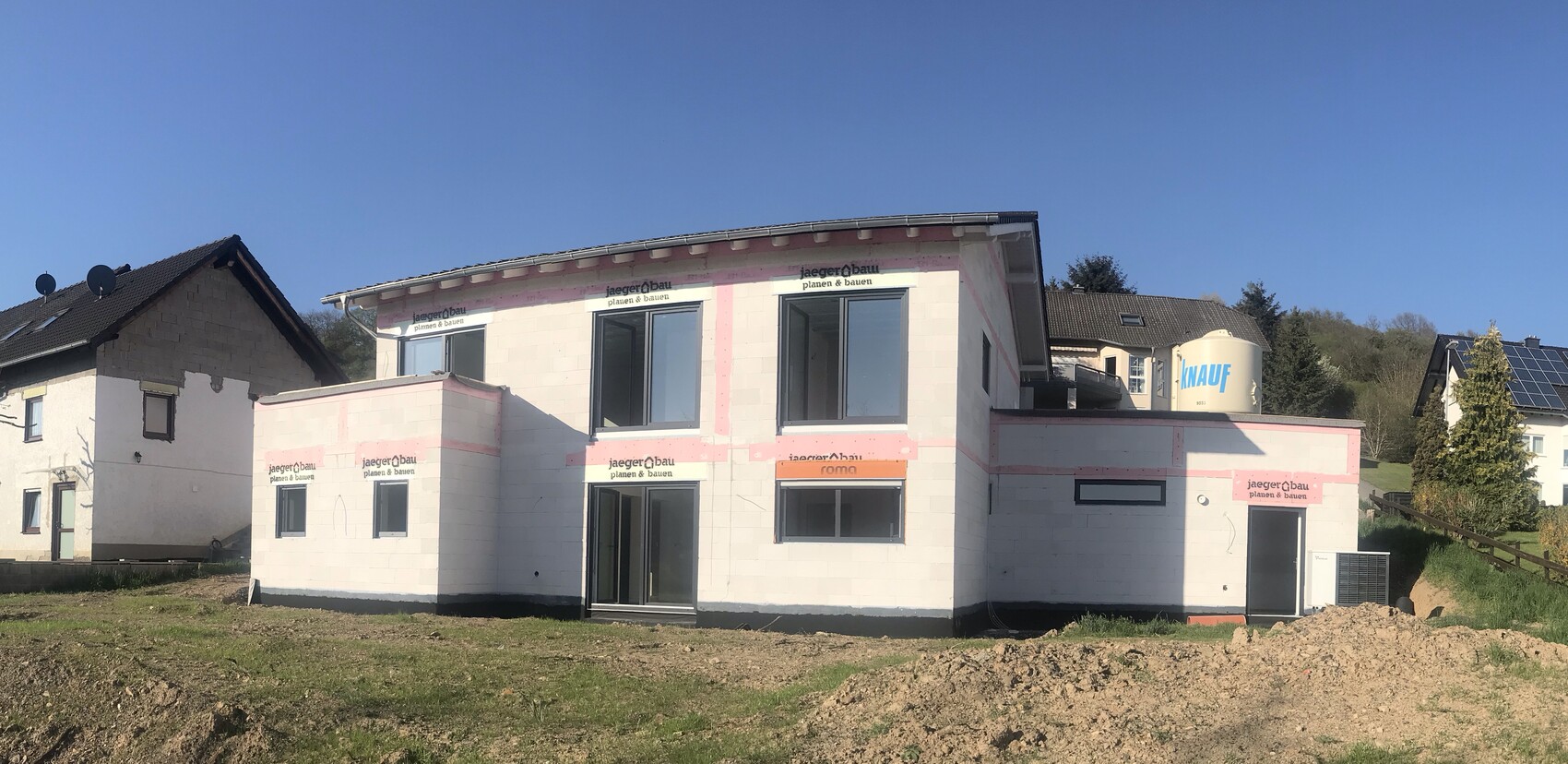
We moved into our new build four months ago. The living area on the ground floor has three large floor-to-ceiling windows facing south. We have underfloor heating and an air-to-water heat pump.
It provides a really comfortable temperature inside the house, but we have a problem – whenever the sun is shining in winter, even if it’s -2°C (28°F) outside, the temperature suddenly rises to 24°C (75°F) in the living room. It gets uncomfortably warm in here, and the underfloor heating can’t be turned down quickly.
Should we assume that the large floor-to-ceiling windows are responsible for the heat gain? A photo of the south-facing side of the house is attached.
What would you do – always lower all the blinds as soon as sunlight is forecast? That seems quite annoying...
We have motorized blinds controlled by Somfy. Would you consider buying a sensor that automatically lowers the blinds at a certain temperature?
Thanks in advance for your replies.
I have a general question.
We moved into our new build four months ago. The living area on the ground floor has three large floor-to-ceiling windows facing south. We have underfloor heating and an air-to-water heat pump.
It provides a really comfortable temperature inside the house, but we have a problem – whenever the sun is shining in winter, even if it’s -2°C (28°F) outside, the temperature suddenly rises to 24°C (75°F) in the living room. It gets uncomfortably warm in here, and the underfloor heating can’t be turned down quickly.
Should we assume that the large floor-to-ceiling windows are responsible for the heat gain? A photo of the south-facing side of the house is attached.
What would you do – always lower all the blinds as soon as sunlight is forecast? That seems quite annoying...
We have motorized blinds controlled by Somfy. Would you consider buying a sensor that automatically lowers the blinds at a certain temperature?
Thanks in advance for your replies.

chewbacca123 schrieb:
A brief update on the behavior of my heat pump: after readjusting the settings with the help of Daniel-SP, I was able to reduce the compressor starts by half, from 40 to 20 within 48 hours—about 10 per day.
This is already very satisfying, especially since the temperature is much colder now compared to a few days ago. Last night it was -7°C (19°F).
The pump now runs for much longer continuous periods. Great!
My heating curve is set at 29-22-0 and is keeping the rooms comfortably warm; we even managed to reach 21°C (70°F) in the bathroom. We have to be satisfied with that. Comfortably warm and 21 degrees, however, seem somewhat contradictory. But these are personal feelings.
At these temperatures, a nighttime shutdown would probably be advisable, right? At least, that's what I noticed. My heat pump started twice yesterday: once at 11 a.m. at -2°C (28°F), running for about 3 hours, and then again from 11 p.m. at -6°C (21°F), running for 6.5 hours.
Quite a mess. In my opinion, not very practical. It feels like the house temperature doesn’t drop quickly enough to not be able to run around 10 a.m.
Or am I wrong?
Quite a mess. In my opinion, not very practical. It feels like the house temperature doesn’t drop quickly enough to not be able to run around 10 a.m.
Or am I wrong?

Zaba12 schrieb:
Or?
I think there are different theories on that. I'm going to test it now (with modulation) by setting the target temperature 1 degree lower at night and 1 degree higher during the day.
You probably won’t notice the night setback on room temperatures much, so that assumption is correct. However, your screed will still cool down. So in the morning, you have the "problem" that when you turn the heating back on, more energy is needed to reheat the screed. The question is what is more effective; I've often read that reheating can sometimes consume more energy than what you save by turning it off at night.
Maybe try it gradually. So just throttle it down? Does your pump have a night mode or something similar? Of course, testing only makes sense if you are not simultaneously changing other settings.
seat88 schrieb:
Comfortably warm and 21 degrees Celsius (70°F) contradict each other. But those are personal feelings.Exactly, upstairs we also always have something around 19.x degrees Celsius (67.x°F) to 21.x degrees Celsius (70.x°F). No one yells that they are cold upstairs.
...you wimps :-D
face26 schrieb:
I believe there are different theories about this. I’m going to test (though modulating) reducing the target temperature by 1 degree at night and increasing it by 1 degree during the day.
You probably won’t notice the nighttime setback in room temperatures, so that reasoning is correct. However, your screed floor will still cool down. This means you’ll have the “problem” the next morning that more energy is needed to reheat the screed once you turn the heating back on. The question is which is more efficient. I’ve often read that reheating can sometimes use more energy than you save by turning off at night.
Maybe try it “step by step.” So only reduced power output? Does your pump have a night mode or something similar? Of course, testing only makes sense if you’re not also changing other settings at the same time. I saw an option to set a nighttime setback on the heating curve. It’s currently set to 0, but I might try it soon, once I’m confident that the heat pump is running smoothly with the lower heating curve and the new flow rates.
Because today I’m going into the second heating cycle in the evening, and then it will be -4°C (25°F) or colder again.
Similar topics