
ᐅ Uncertainties regarding size, planning is otherwise mostly complete.
Created on: 28 Jan 2016 08:54
Z
Zwark
Good morning!
We are about to finalize the planning for our single-family house; we want to build 1.5 stories with a knee wall of 150 cm (59 inches), keeping it as compact as possible. So far, we have been very satisfied with the design from the planner of the construction company, but now that I’m working on the interior layout, the combined living-dining-kitchen area feels a bit cramped. We definitely want a seating corner in the dining area, but I’m afraid that might be difficult to fit (kitchen + seating area). Now I’m considering whether we should generally enlarge the house so everything fits comfortably (from 10.13 x 9 m (33.3 x 29.5 ft) to 11 x 9.5 m (36 x 31 ft)). Maybe someone here has some helpful tips?
The house has a basement, the clear room height in the living areas is 260 cm (102 inches), and a pitched roof with dormer and a 35° slope is planned. The plot is about 900 m² (9700 sq ft), with a 3-meter (10 ft) setback required from the neighbors. Two parking spaces (carport) at the front by the street are included in the plan. Thank you very much and best regards
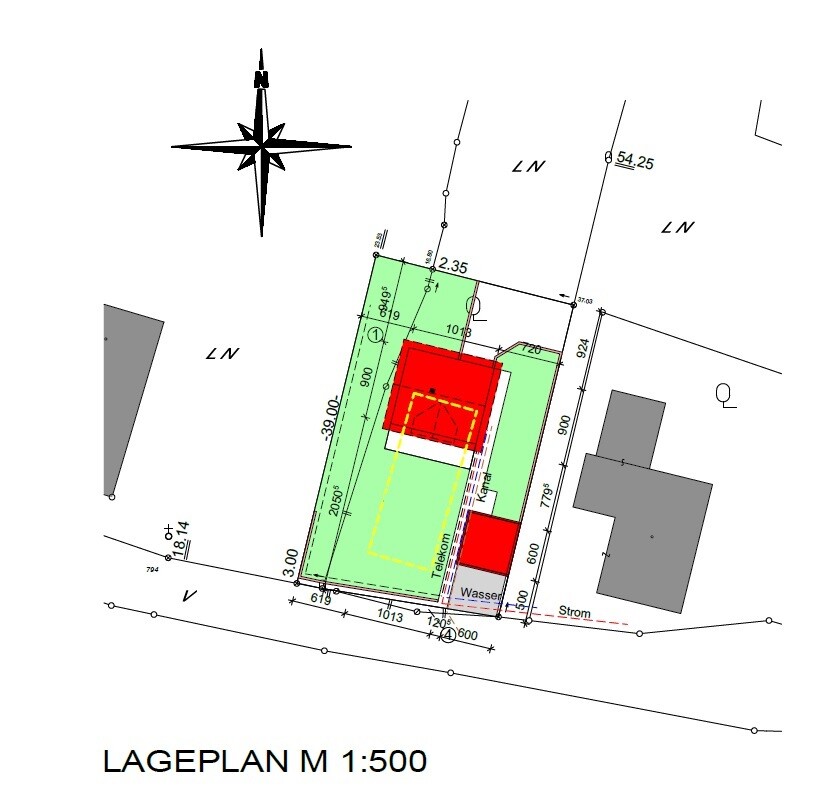

We are about to finalize the planning for our single-family house; we want to build 1.5 stories with a knee wall of 150 cm (59 inches), keeping it as compact as possible. So far, we have been very satisfied with the design from the planner of the construction company, but now that I’m working on the interior layout, the combined living-dining-kitchen area feels a bit cramped. We definitely want a seating corner in the dining area, but I’m afraid that might be difficult to fit (kitchen + seating area). Now I’m considering whether we should generally enlarge the house so everything fits comfortably (from 10.13 x 9 m (33.3 x 29.5 ft) to 11 x 9.5 m (36 x 31 ft)). Maybe someone here has some helpful tips?
The house has a basement, the clear room height in the living areas is 260 cm (102 inches), and a pitched roof with dormer and a 35° slope is planned. The plot is about 900 m² (9700 sq ft), with a 3-meter (10 ft) setback required from the neighbors. Two parking spaces (carport) at the front by the street are included in the plan. Thank you very much and best regards

Always a bit bigger than necessary...
Why settle for 100 hp when 120 will do? A few extra cents for fuel consumption don't matter, same with higher insurance costs. Or a 65-inch TV instead of a 55-inch... This is what you call excessiveness, which will eventually catch up.
@Grym Have you already started building or still planning the floor plan?
Why settle for 100 hp when 120 will do? A few extra cents for fuel consumption don't matter, same with higher insurance costs. Or a 65-inch TV instead of a 55-inch... This is what you call excessiveness, which will eventually catch up.
@Grym Have you already started building or still planning the floor plan?
ypg schrieb:
You live in your numbers That depends; some things are better handled with numbers, others more by intuition. When it comes to the statement that house X consumes (significantly) more than house Y, I prefer to rely on the numbers.
And yes and no: certainly, a flat surface is quicker to clean than niches and corners. Still, there is a difference between 100 sqm (1,076 sq ft) and 200 sqm (2,153 sq ft), because the time factor must also be considered.
You are very well-read, but one should always judge for oneself whether something is just wishful thinking or if there could be some truth to a claim. Your one-sided lectures lag far behind and have become boring by now. I would appreciate it if someone had a counterargument, so it wouldn’t stay a one-sided lecture.
Sebastian79 schrieb:
Construction costs are higher—significantly so with an additional 70 sqm (750 sq ft). Then the people from Rheinau-Linx must have miscalculated or had something to give away. I think if you build 700–800 houses per year and have been in the business for 55 years, you can still make a miscalculation occasionally. Probably, they just averaged the prices of their standard houses. They offer 68 sqm (732 sq ft) extra for 44,000 EUR, emphasizing the additional space.
Higher costs for electricity, heating, insurance, and property tax are there as well. Electricity—no.
Heating—see above (60 to 120 EUR).
Insurance and property tax could be.
But honestly, I never said that maintenance costs are exactly the same. However, the total annual amount is negligible.
What probably bothers most people here is your almost condescending tone about people with smaller houses—implying how dumb they must be. Not at all. I even admire those living in real tiny houses (that is, 50 sqm (538 sq ft) or less). I just don’t think it’s right to build small just to save 10,000 or 20,000 EUR in the budget if you actually need more space.
Even months ago, you defended living just as small fiercely, and today Grym writes as if no other wisdom ever existed. The internet never forgets... I already said I have learned a lot.
If it were all so cheap and obvious, why would so few build larger? Because budgets are often very tight. 430,000 EUR for 120 sqm (1,292 sq ft) and done.
450,000 EUR would be enough for 165 sqm (1,776 sq ft), and the family actually wanted a third room and not to live crammed together—but with only 30,000 EUR in equity, there is eventually a limit.
Friends of ours had nearly 50 percent equity and still built before they turned 30. They built exactly as they envisioned, without making bad compromises.
Ultimately, it’s also a lifelong decision—many people don’t want a huge house later that stands emptier than it’s used. It’s not. If you don’t like it anymore, you sell it, likely with a good profit. Having a house for 20 to 25 years of family life and then a bungalow or maybe a city apartment for the next 25 years is fine, isn’t it? Why should I live in a house that’s too small for 25 years?
Guess how many have questioned our house size—why so big, who will clean it, and so on—it’s ultimately a personal decision that even someone like Count von Count should accept. That’s what I’m saying. But the argument that “big is expensive,” “big means more cleaning,” or “in 25 years it might be too big” are not convincing to me. What is 100 percent convincing to me is when someone says their house size is perfectly sufficient and nothing will be lacking in the next 20 years.
tomtom79 schrieb:
Always a bit bigger than necessary... Exactly.
Why have 100 hp when 120 hp will do? The few extra cents on fuel consumption don’t matter, same with higher insurance costs, or a 65-inch TV instead of a 55-inch... that’s called excess, which eventually balances out. A car with more horsepower can sometimes consume less fuel because you don’t have to push it to the limit as often.
And insurance costs have nothing to do with horsepower.
If the 55-inch TV costs 900 EUR and the 65-inch 950 EUR and it’s not too big, then certainly (just to keep prices analogous to house prices in this example).
@Grym Have you started building yet, or still working on the floor plan? Oh, just waiting for the site development. Nothing much will happen during winter anyway.
S
Sebastian798 Feb 2016 18:27Well, with an additional 70 m² (750 ft²), you also have electricity costs, since those square meters need to be used and illuminated. That’s where the limit lies in your theoretical consideration.
You don’t just increase the floor plan; with an extra 70 m² (750 ft²), you usually add additional rooms. Even just one more bathroom can be quite expensive...
And over 40,000 EUR is not a significant amount? Blessed is the planning phase, when you still wander around clueless with a lot of money . You can already see that you think 450,000 EUR and then 165 m² (1,775 ft²) — I haven’t paid that for much more square meters. But I definitely wouldn’t use myself as a benchmark—just like you shouldn’t.
You’re always talking about your big profit when selling—which usually only happens if you build in the “right” area. But in those areas, you also have to spend a lot upfront. And construction is usually more expensive there as well... large plots with large houses are even scarcer.
You’re so blinded—if I wanted to sell my house in 20 years, I might not even get back the construction costs without interest . And don’t believe that I’m an isolated case.
A single-family house is generally less suitable as an investment with profit expectations. Apartments or empty plots are more likely options for that...
You don’t just increase the floor plan; with an extra 70 m² (750 ft²), you usually add additional rooms. Even just one more bathroom can be quite expensive...
And over 40,000 EUR is not a significant amount? Blessed is the planning phase, when you still wander around clueless with a lot of money . You can already see that you think 450,000 EUR and then 165 m² (1,775 ft²) — I haven’t paid that for much more square meters. But I definitely wouldn’t use myself as a benchmark—just like you shouldn’t.
You’re always talking about your big profit when selling—which usually only happens if you build in the “right” area. But in those areas, you also have to spend a lot upfront. And construction is usually more expensive there as well... large plots with large houses are even scarcer.
You’re so blinded—if I wanted to sell my house in 20 years, I might not even get back the construction costs without interest . And don’t believe that I’m an isolated case.
A single-family house is generally less suitable as an investment with profit expectations. Apartments or empty plots are more likely options for that...
So, if you build bigger, you have the same number of corners, but you need to clean more area, possibly more windows, and it definitely takes longer, even if it might be less time per square meter. More free space naturally costs less per square meter in relative terms, but if you add another room, there are other costs, such as an additional door, more windows, extra electrical outlets and switches, a larger ventilation system, and heating system. So it really depends on how you divide those extra 20 square meters (215 square feet)—whether everything is slightly larger or if you create a new room.
Generally, more horsepower is also more expensive. Nowadays, small engines are not necessarily less efficient, and most of the time you only use a fraction of the power anyway. Larger engines are at a clear disadvantage because modern engines still require a certain amount of RPM to be efficient. But anyway, this isn’t about cars.
Generally, more horsepower is also more expensive. Nowadays, small engines are not necessarily less efficient, and most of the time you only use a fraction of the power anyway. Larger engines are at a clear disadvantage because modern engines still require a certain amount of RPM to be efficient. But anyway, this isn’t about cars.
Sebastian79 schrieb:
But with 70 sqm (750 square feet) more, you’ll also have higher electricity costs, since those square meters need to be used and lit. That’s the limitation of your theoretical perspective. Lighting accounts for only a small fraction of electricity costs. More important are appliances like PCs, TVs, ovens, cooktops, refrigerators, etc., and those don’t increase or decrease just because the living room is 15 sqm (160 square feet) larger or smaller.
You don’t just expand your floor plan; with 70 sqm (750 square feet), you usually add extra rooms. Even an additional bathroom costs a lot... I never said anything about expanding the floor plan. And even then, I wouldn’t first mention a bathroom, but rather a third bedroom, a home office, etc. — and these rooms don’t usually involve significant additional costs.
And over 40,000 EUR is not an amount? Planning phase is bliss, when you’re clueless and throwing money around . You can already see that you’re talking about 450,000 EUR and 165 sqm (1,775 square feet) — I didn’t pay that for significantly more sqm. But I wouldn’t take myself as a benchmark — just like you shouldn’t. My example clearly included the land. If I get 50% more living space for 10% higher total costs, that’s a good deal—provided I actually need that space. Of course, if you’re perfectly happy with 129 sqm (1,390 square feet), you don’t need to spend 10% more.
You always mention your fat profit on resale—that only happens if you build in the “right” area. But then you usually have to pay a lot upfront. And building there is often more expensive... big plots with large houses are even scarcer. I would always recommend the right area, yes. We’re building 3.5 km (2.2 miles) from the university and less than 5 km (3.1 miles) from the main train station. Public transport runs every 10 minutes during peak hours, yet it’s a very quiet location with no social hotspots. It’s less than a 20-minute bike ride to downtown on dedicated bike and pedestrian paths. The building plots were gone almost immediately, and we got one of the best. So if I assume I can sell the house easily in 20 years and get a good price, that’s just how it is. Then you can build again or move to the city center. We’ll see.
You’re so blinded—if I tried to sell my house in 20 years, I might not even get back the construction costs without interest. And don’t think I’m an isolated case. I don’t know that. Is it really far outside the city or what?
A detached single-family home is less suitable as an investment with profit intentions. More likely apartments or empty plots... A detached single-family home isn’t an investment, but you also shouldn’t tie yourself to one for life, thinking you’ll never get rid of it. When we’re older and just two again, the house might be too big; eventually, the garden itself will probably become a problem. I definitely don’t want to be tied to this house and location permanently, but for the next years and likely decades, the place and house size are well suited. In that respect, I sometimes think the American attitude toward houses is better: they are functional assets that can be bought and sold. They should suit your CURRENT life situation, not the one 20 years from now.
Similar topics