
ᐅ Uncertainties regarding size, planning is otherwise mostly complete.
Created on: 28 Jan 2016 08:54
Z
Zwark
Good morning!
We are about to finalize the planning for our single-family house; we want to build 1.5 stories with a knee wall of 150 cm (59 inches), keeping it as compact as possible. So far, we have been very satisfied with the design from the planner of the construction company, but now that I’m working on the interior layout, the combined living-dining-kitchen area feels a bit cramped. We definitely want a seating corner in the dining area, but I’m afraid that might be difficult to fit (kitchen + seating area). Now I’m considering whether we should generally enlarge the house so everything fits comfortably (from 10.13 x 9 m (33.3 x 29.5 ft) to 11 x 9.5 m (36 x 31 ft)). Maybe someone here has some helpful tips?
The house has a basement, the clear room height in the living areas is 260 cm (102 inches), and a pitched roof with dormer and a 35° slope is planned. The plot is about 900 m² (9700 sq ft), with a 3-meter (10 ft) setback required from the neighbors. Two parking spaces (carport) at the front by the street are included in the plan. Thank you very much and best regards
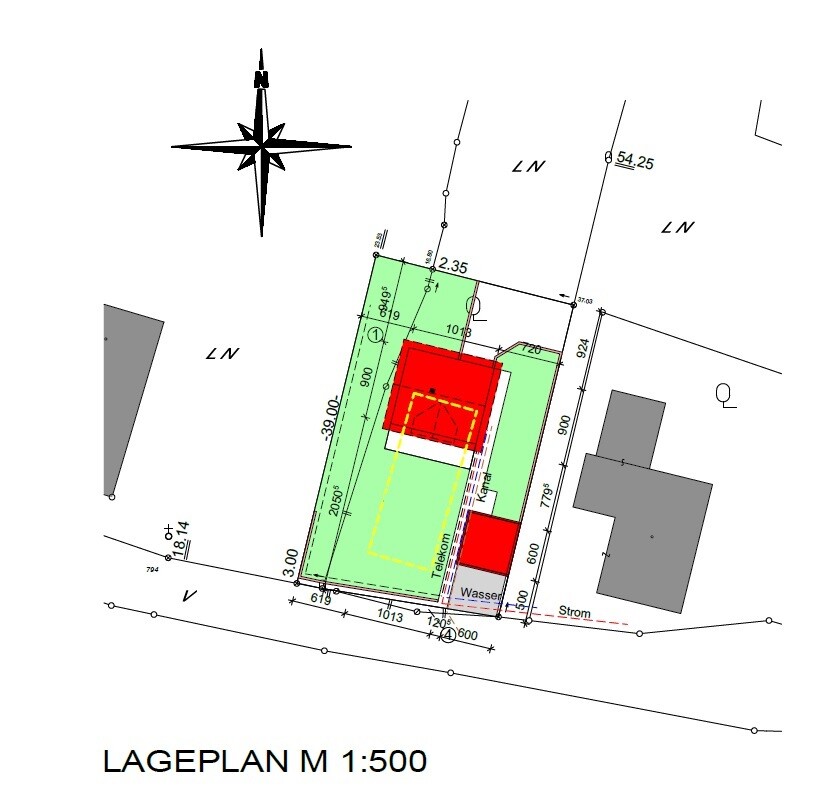

We are about to finalize the planning for our single-family house; we want to build 1.5 stories with a knee wall of 150 cm (59 inches), keeping it as compact as possible. So far, we have been very satisfied with the design from the planner of the construction company, but now that I’m working on the interior layout, the combined living-dining-kitchen area feels a bit cramped. We definitely want a seating corner in the dining area, but I’m afraid that might be difficult to fit (kitchen + seating area). Now I’m considering whether we should generally enlarge the house so everything fits comfortably (from 10.13 x 9 m (33.3 x 29.5 ft) to 11 x 9.5 m (36 x 31 ft)). Maybe someone here has some helpful tips?
The house has a basement, the clear room height in the living areas is 260 cm (102 inches), and a pitched roof with dormer and a 35° slope is planned. The plot is about 900 m² (9700 sq ft), with a 3-meter (10 ft) setback required from the neighbors. Two parking spaces (carport) at the front by the street are included in the plan. Thank you very much and best regards
S
Sebastian7931 Jan 2016 16:55And which ones are there?
Double casement windows and dormers are not special features but standard components in a gable roof... I am not even talking about a captain’s house or similar.
Double casement windows and dormers are not special features but standard components in a gable roof... I am not even talking about a captain’s house or similar.
tomtom79 schrieb:
So you’re building a house with a larger footprint and intentionally with sloped ceilings to achieve the same living area as a full-height house. Respect, so you must have money to waste.
Do you know how living space is calculated?
Have you ever tried to buy a wardrobe for a room with sloped ceilings? Of course, it’s cheaper because there’s less wood... I hope you catch the irony In a more direct way: don’t you get it, shouting around here like that?
I know how living space is calculated, and thanks to planning, there is enough room in the upstairs spaces with sloped ceilings for wardrobes and so on.
And yes, I built bigger but with sloped ceilings. Building a house is expensive, so it should be exactly how I like it. And of course, without building a house, you would “have money to waste,” because that’s a luxury.
Dormers were no longer an option for us, unfortunately.
For the double casement windows, we should have chosen triple glazing – now water drips from them when temperatures drop below freezing – oh well.
They provide more than enough light, but it’s only for the utility room and bathroom.
For the double casement windows, we should have chosen triple glazing – now water drips from them when temperatures drop below freezing – oh well.
They provide more than enough light, but it’s only for the utility room and bathroom.
Bauexperte schrieb:
Hello,
As a business economist, you should know that there is a difference in cost calculation between pure merchandise trade and manufacturing trades. Your cost accounting is set far too low. It must include material procurement, production, and profit; if applicable, discounts or rebates. Besides, these costs vary across the country. That is why I used unit prices as final prices, which were provided to me by a construction company.
Example: I recently had the contract documents of a reputable provider from NRW on my desk for review. For a building measuring 11.80 x 11.80 meters (39 x 39 feet) with one full floor and a roof pitch of 38°, widening the house by 0.20 meters (8 inches) to 12.00 meters (39.5 feet) costs €11,400.00. I hope you warned your client that this could be a serious rip-off?
In my opinion, you are under the mistaken belief that _your_ taste applies to all homeowners. Not every homeowner likes perfectly straight walls, and not everyone prefers sloped ceilings. Therefore, it is pointless to discuss taste and supposed added value; it means something different to each person. To pick up the current topic again: in building zones here, where many or all options are permitted, pitched roofs are almost never built. It’s either two full stories without sloping ceilings or a bungalow without sloped ceilings. Buildings with roof slopes are generally only constructed where they are required. As has been pointed out here repeatedly, you hardly save any money with a few bricks less, and if dormers or similar elements are added, it can even become more expensive.
Also, hardly anyone builds flat roofs unless they have to, at least not here where it is often permitted. The hipped roof is the preferred style, although there are building zones where flat roofs are mandatory—and well, they often don’t look very appealing. It should be noted that such houses are often just box-shaped structures without roofs rather than elegant Bauhaus-style projects with projections, recesses, terraces, color schemes, and so on.
The box-shaped house remains practical—at least on paper.
Visually, opinions may vary—square floor plans can often be challenging.
There is definitely a certain stylistic aspect to it. Without any decorative elements or accents in orange, Tuscan yellow, or pink, I wouldn’t be drawn to it at all.
With an interesting facade design, brickwork, an inviting entrance, or cantilevered sections, I don’t find it so bad at all.
Even simple urban villas can be made appealing with a nice stone bed, a carport, a harmonious terrace, and so on.
Check out the house pictures thread; there are some really interesting examples there.
Visually, opinions may vary—square floor plans can often be challenging.
There is definitely a certain stylistic aspect to it. Without any decorative elements or accents in orange, Tuscan yellow, or pink, I wouldn’t be drawn to it at all.
With an interesting facade design, brickwork, an inviting entrance, or cantilevered sections, I don’t find it so bad at all.
Even simple urban villas can be made appealing with a nice stone bed, a carport, a harmonious terrace, and so on.
Check out the house pictures thread; there are some really interesting examples there.
Similar topics