
ᐅ Two-family house with two full stories, designed as a multigenerational home, plus an attic suitable for conversion
Created on: 14 Nov 2019 18:29
L
light-leicht
Hello everyone,
I am in the early stages of planning our house. Initial contact has already been made with the architect, but the floor plan sketch was created by me.
The main priority for me is a large living/dining area including an open kitchen on the south side. I would like to have a double garage, but I have decided against it because my lot is simply too narrow (20m (65.6 ft)).
I would like to share my first sketch with you and would appreciate any feedback!
The first floor should have the same layout.
Attached is the completed questionnaire.
Development plan / restrictions
Lot size: 614m2 (6610 sq ft)
Slope: Yes, from north to south about 150cm (59 inches)
Floor area ratio (FAR): 0.5
Plot ratio
Building setback, building line, and boundary: Building setbacks 3m (10 ft) north and 3m (10 ft) south
Edge development: none
Number of parking spaces: minimum one parking space per 60m2 (645 sq ft) of living area
Number of floors: three
Roof shape: no specifications
Architectural style: no specifications
Orientation: no specifications
Maximum height / limits: no specifications
Homeowner requirements
Modern, gable roof, (two-family house + expandable attic)
No basement, two full floors
Number of residents, ground floor: 2 x 35 years + 2 years + baby ? / first floor: 2 x 60 years + 65 years (parents)
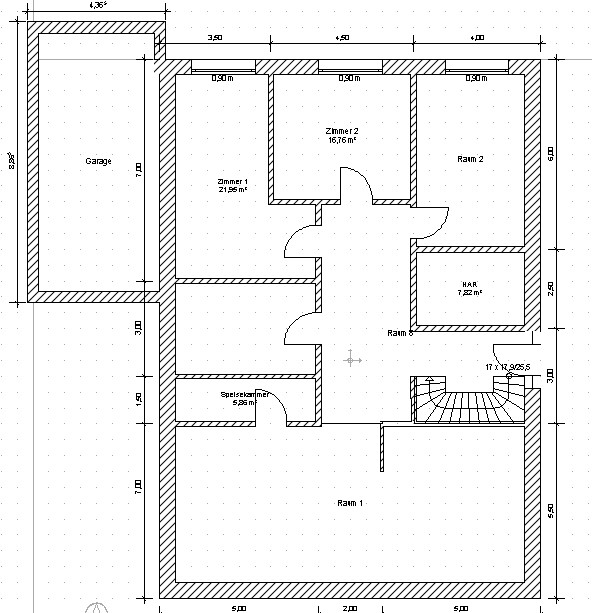
Space requirements on the ground floor: 4-room apartment, first floor: 4-room apartment
Guests per year: 5
Open architecture
Modern construction style
Open kitchen with cooking island
Number of dining seats: 12
No fireplace
Small balcony above the garage
Single garage
House design
Who designed the plan:
- Do-it-Yourself
What do you like most? Large living/dining area. Why? Because of the open design
What don’t you like? Garage not accessible from the kitchen. Why? Because the bathroom needs to have a window
Cost estimate according to the architect/planner: 600,000 €
Personal price limit for the house, including fixtures and fittings: 400,000 €
Preferred heating system: Central gas boiler
If you have to give up anything, which details/extensions:
- Can you do without: ?
- Cannot do without: Garage
Thank you in advance for all your feedback!
I am in the early stages of planning our house. Initial contact has already been made with the architect, but the floor plan sketch was created by me.
The main priority for me is a large living/dining area including an open kitchen on the south side. I would like to have a double garage, but I have decided against it because my lot is simply too narrow (20m (65.6 ft)).
I would like to share my first sketch with you and would appreciate any feedback!
The first floor should have the same layout.
Attached is the completed questionnaire.
Development plan / restrictions
Lot size: 614m2 (6610 sq ft)
Slope: Yes, from north to south about 150cm (59 inches)
Floor area ratio (FAR): 0.5
Plot ratio
Building setback, building line, and boundary: Building setbacks 3m (10 ft) north and 3m (10 ft) south
Edge development: none
Number of parking spaces: minimum one parking space per 60m2 (645 sq ft) of living area
Number of floors: three
Roof shape: no specifications
Architectural style: no specifications
Orientation: no specifications
Maximum height / limits: no specifications
Homeowner requirements
Modern, gable roof, (two-family house + expandable attic)
No basement, two full floors
Number of residents, ground floor: 2 x 35 years + 2 years + baby ? / first floor: 2 x 60 years + 65 years (parents)
Space requirements on the ground floor: 4-room apartment, first floor: 4-room apartment
Guests per year: 5
Open architecture
Modern construction style
Open kitchen with cooking island
Number of dining seats: 12
No fireplace
Small balcony above the garage
Single garage
House design
Who designed the plan:
- Do-it-Yourself
What do you like most? Large living/dining area. Why? Because of the open design
What don’t you like? Garage not accessible from the kitchen. Why? Because the bathroom needs to have a window
Cost estimate according to the architect/planner: 600,000 €
Personal price limit for the house, including fixtures and fittings: 400,000 €
Preferred heating system: Central gas boiler
If you have to give up anything, which details/extensions:
- Can you do without: ?
- Cannot do without: Garage
Thank you in advance for all your feedback!

I really loved using tracing paper during the planning phase! You can get a roll for just a few euros in most stationery stores. Back then, we skimped and bought the cheaper (and thinner) paper. Nowadays, I would go for the more expensive roll, but that’s just a side note.
It’s great for brainstorming because you don’t have to keep erasing and wishing you had your original idea back after several new sketches—you simply lay a new sheet of tracing paper over the base plan for each new version.
So, I highly recommend keeping a roll of tracing paper on hand.
By the way, we have about a 130cm (51 inches) slope from the back left to the front right, which gave us two basement rooms with natural daylight. These rooms could be even more suitable as regular living space if we had excavated more at the front and there wasn’t a balcony above (which wasn’t necessary for us). Just a thought on how you can make good use of a sloping site.
It’s great for brainstorming because you don’t have to keep erasing and wishing you had your original idea back after several new sketches—you simply lay a new sheet of tracing paper over the base plan for each new version.
So, I highly recommend keeping a roll of tracing paper on hand.
By the way, we have about a 130cm (51 inches) slope from the back left to the front right, which gave us two basement rooms with natural daylight. These rooms could be even more suitable as regular living space if we had excavated more at the front and there wasn’t a balcony above (which wasn’t necessary for us). Just a thought on how you can make good use of a sloping site.
J
j.bautsch19 Nov 2019 08:53Climbee schrieb:
Parchment paper rollI think you mean more likely tracing paper. Parchment is something different as far as I know (e.g., opaque).Climbee schrieb:
Or something like that – we just call it parchmentSame here. I took the wax paper from the roll and placed graph paper underneath. However, this was 30 years ago, but it worked perfectly.

Climbee schrieb:
I loved my roll of tracing paper during the planning phase!I think I only switched to the “drawing machine,” India ink, and the architect’s standard tracing paper when I was in eighth grade; before that, and for smaller or detail drawings, I used ordinary sandwich paper on a clipboard. For both, I don’t mind using the common term “parchment.” By the way, Wikipedia says:
Today's tracing paper, used as a medium for hand-drawn technical drawings, is also called parchment paper or simply parchment.
In the preliminary design stage, I recommend having the “courage” to resist perfectionism and to “unprofessionally” scribble with a ballpoint pen on almost any scrap paper. I deliberately don’t stick strictly to a scale here, even though with practice you tend to settle somewhere around “roughly 1:250 to 1:200.” I strongly suggest that when scribbling you
a. avoid using a ruler
b. don’t try to make line lengths precise to an exact point
c. don’t crumple up the paper because of unsuccessful line starts
d. leave incorrect lines as they are and simply draw their replacements somewhat thicker, crossing out sections if necessary.
If you follow this approach, you’ll more easily come to terms with the apparent inferiority of hand drawings compared to mouse-driven CAD drawings.
https://www.instagram.com/11antgmxde/
https://www.linkedin.com/company/bauen-jetzt/
Similar topics