
D
daniels8721 Apr 2016 09:40Hello!
We will have an open living/dining area on the ground floor, where the tiled floor is supposed to transition into parquet.
I have often seen wide transition strips made of aluminum or similar materials, but I don’t like that look.
I was told that this is necessary because the floors expand and contract due to the underfloor heating.
Does the gap really need to be so large that there is no other option? I feel that the tradespeople just need to work more precisely (but don’t want to), because of the visible edges.
If you search for "parquet tile transition" on Google Images, the 5th result shows a slim edge strip transition, which is how I'd like it to look.
How have you solved this?
Good luck,
daniels87
We will have an open living/dining area on the ground floor, where the tiled floor is supposed to transition into parquet.
I have often seen wide transition strips made of aluminum or similar materials, but I don’t like that look.
I was told that this is necessary because the floors expand and contract due to the underfloor heating.
Does the gap really need to be so large that there is no other option? I feel that the tradespeople just need to work more precisely (but don’t want to), because of the visible edges.
If you search for "parquet tile transition" on Google Images, the 5th result shows a slim edge strip transition, which is how I'd like it to look.
How have you solved this?
Good luck,
daniels87
N
nordanney21 Apr 2016 10:36This is how it looks for us (just with different wood):
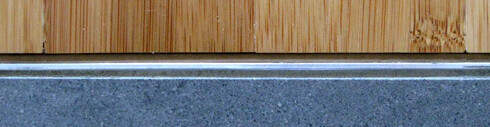
Tile – stainless steel strip – wood
However, the screed height must be suitable for this.
Tile – stainless steel strip – wood
However, the screed height must be suitable for this.
S
Sebastian7921 Apr 2016 16:30The picture is missing cork or silicone – as it is, it doesn’t look neat.
N
nordanney21 Apr 2016 17:12Sebastian79 schrieb:
The picture is missing cork or silicone – it doesn’t look nice like that. That’s not our floor either; I used the photo as an example. You can also use other types of profiles or borders.
This shows that transition strips do not necessarily have to be glued or screwed in, but that there are also elegant solutions available.
Similar topics