
D
DragonyxXL26 Jan 2017 10:35In recent months, we have assumed that we would install an electric towel radiator (HTHK) with a heating cartridge in both bathrooms. Yesterday, we spoke with our heating installer for the first time. He said that the locations we had planned are very unfavorable. In the smaller bathroom, he anticipated problems with the towel radiator rusting. Essentially, he saw issues with having an electrical outlet in the splash zone. He had no concerns about towel radiators connected to our ground source heat pump, as the supply temperatures are relatively low. He mentioned that in summer, the supply temperature would be quite low, for example around 35°C (95°F), and higher in winter, for example around 45°C (113°F).
The entire house has underfloor heating.
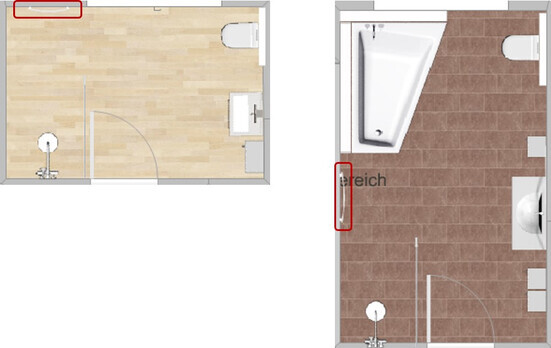
Bathroom 1:
Towel radiator between the shower exit and bathtub
Bathroom 2:
Towel radiator opposite the shower
Now for my questions:
1. Can towel radiators be mounted upside down?
2. Is it possible to plug towel radiators (with appropriate wall penetration) into an electrical outlet in an adjacent room (utility room)?
3. Do towel radiators function properly at low supply temperatures?
4. Can towel radiators rust?
5. Are towel radiators necessary? The heating output from the underfloor heating surface is sufficient for both bathrooms. There is often talk about transition periods, but doesn’t my bathroom always maintain 23°C (73°F) when I set it to that?
6. Do towels dry adequately without a heating function?
The entire house has underfloor heating.
Bathroom 1:
Towel radiator between the shower exit and bathtub
Bathroom 2:
Towel radiator opposite the shower
Now for my questions:
1. Can towel radiators be mounted upside down?
2. Is it possible to plug towel radiators (with appropriate wall penetration) into an electrical outlet in an adjacent room (utility room)?
3. Do towel radiators function properly at low supply temperatures?
4. Can towel radiators rust?
5. Are towel radiators necessary? The heating output from the underfloor heating surface is sufficient for both bathrooms. There is often talk about transition periods, but doesn’t my bathroom always maintain 23°C (73°F) when I set it to that?
6. Do towels dry adequately without a heating function?
Many questions to which I don't know the answers.
How many square meters are the bathrooms?
We don’t have any additional heating or towel warmers in our bathrooms.
Our guest toilet, about 5 sqm (54 sq ft), has heating pipes under the shower floor, making the room pleasantly warm. During the transitional seasons, we don’t turn on the heat; the temperature is sufficient.
What I want to say is: your floor areas seem adequate if the heating pipes are installed with a standard close spacing, including in the shower area.
Personally, I find towel warmers nice, but we were told that technically they are complicated due to the heating circuits... so we don’t have any. Also, they warm the towels, not the room!!!
We also dry towels on a rack or over a chair.
An alternative heating option would be infrared heaters: they are said to warm the room quickly and efficiently for a short period – just search online.
With four people, drying towels might take longer, so a towel warmer in the main bathroom could be an advantage. I believe I once saw some mounted upside down, but I am not sure.
For the electrical outlet, it would be a good alternative for you, as they can be installed outside the splash zone.
To be sure whether these units can be installed upside down, I recommend checking Google Images for these heaters to see if anyone has installed them the other way around.
How many square meters are the bathrooms?
We don’t have any additional heating or towel warmers in our bathrooms.
Our guest toilet, about 5 sqm (54 sq ft), has heating pipes under the shower floor, making the room pleasantly warm. During the transitional seasons, we don’t turn on the heat; the temperature is sufficient.
What I want to say is: your floor areas seem adequate if the heating pipes are installed with a standard close spacing, including in the shower area.
Personally, I find towel warmers nice, but we were told that technically they are complicated due to the heating circuits... so we don’t have any. Also, they warm the towels, not the room!!!
We also dry towels on a rack or over a chair.
An alternative heating option would be infrared heaters: they are said to warm the room quickly and efficiently for a short period – just search online.
With four people, drying towels might take longer, so a towel warmer in the main bathroom could be an advantage. I believe I once saw some mounted upside down, but I am not sure.
For the electrical outlet, it would be a good alternative for you, as they can be installed outside the splash zone.
To be sure whether these units can be installed upside down, I recommend checking Google Images for these heaters to see if anyone has installed them the other way around.

Hello,
I would consider the position unproblematic. However, you should use a fixed, splash-proof wiring instead of a socket outlet.
I would just connect it directly to the heater anyway. Currently, during winter, we run between 35 and 40°C (95 and 104°F) supply temperature, which is perfectly sufficient for the radiators. They are set to level 5, and that’s fine.
Even if you will have lower supply temperatures with the ground source heat pump (which I suspect), it should still have an effect.
I have never understood the argument that without the heating cartridges in the bathroom, it won’t get warm during the transition period. Yes, then the heating just stays on! You’re not installing a ground source heat pump for a lot of money just to heat with immersion heaters, are you!?
Best regards,
Andreas
I would consider the position unproblematic. However, you should use a fixed, splash-proof wiring instead of a socket outlet.
I would just connect it directly to the heater anyway. Currently, during winter, we run between 35 and 40°C (95 and 104°F) supply temperature, which is perfectly sufficient for the radiators. They are set to level 5, and that’s fine.
Even if you will have lower supply temperatures with the ground source heat pump (which I suspect), it should still have an effect.
I have never understood the argument that without the heating cartridges in the bathroom, it won’t get warm during the transition period. Yes, then the heating just stays on! You’re not installing a ground source heat pump for a lot of money just to heat with immersion heaters, are you!?
Best regards,
Andreas
@ypg
In our case, the underfloor heating system is not strictly necessary to get the bathroom warm. However, it is a very nice comfort for relatively manageable additional costs.
Warm towels are a real luxury!
It is also the only place in the house where we can quickly dry wet gloves and other damp clothing during winter. That is very valuable!
Best regards,
Andreas
In our case, the underfloor heating system is not strictly necessary to get the bathroom warm. However, it is a very nice comfort for relatively manageable additional costs.
Warm towels are a real luxury!
It is also the only place in the house where we can quickly dry wet gloves and other damp clothing during winter. That is very valuable!
Best regards,
Andreas
andimann schrieb:
I’ve never understood the argument that the bathroom won’t get warm during the transition period without the heating cartridges. Yes, then just keep the heating on! You’re not installing a ground source heat pump in your home for a fortune only to heat it with an immersion heater, are you?!?I don’t understand that either.
I also like it warm, but I’ve never been cold during the summer.
If it gets really cold in September, I’ll just turn on the heating.
However, the house is well insulated, so it can handle several days of cold weather.
Similar topics