
T
Träumerle7 Sep 2020 12:01Good day,
we are renovating a house from the late 1960s that still has the original radiators. To begin with: The floors are partly very high-quality and beautiful, and the storey construction/room height does not allow for the retrofitting of underfloor heating. Therefore, we will stick with radiators. My questions:
1) Is the efficiency of newer radiators significantly higher, making replacement advisable? For example, in the living room we would like to replace them for aesthetic reasons, but in some basement rooms we don’t mind the old look.
2) If the old radiators still look good “from the outside” (for example, no rusty spots), are they still in good condition?
3) If we replace (possibly some) radiators: I read in the BAFA criteria that only “low-temperature radiators / baseboard heaters in any design” are eligible for subsidies. The heating system will probably be a hybrid system (gas condensing boiler – air-to-water heat pump with photovoltaics). What should I consider if we want to qualify for funding for the radiators as well? Could I cause problems by combining components that are not compatible? I imagine this might be especially relevant for December-January, when the gas heating runs stronger and possibly the supply temperature is higher?
4) Mostly for aesthetic reasons: We have several wide/deep, low radiators. For the one in the hallway, we would like to install a wooden bench above it (with some distance and possibly holes) in the hallway window. What should we keep in mind?
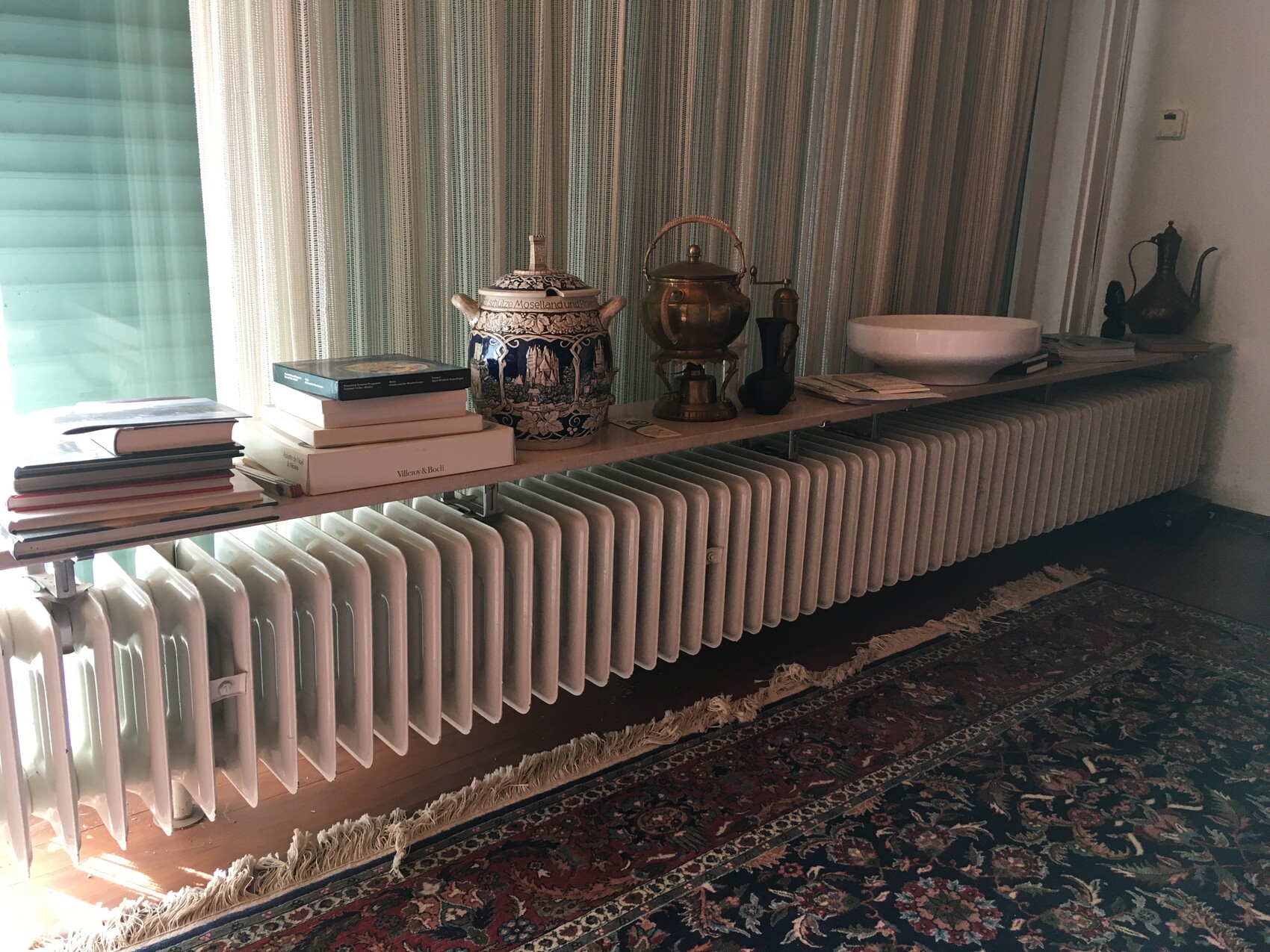
5) Above the radiator in the living room (see attached photo) there is currently a granite slab used as a shelf. However, it can slip, and overall I don’t find that a very “nice” solution. I would be grateful for suggestions and ideas! We have two small children, frequent guests, and hopefully many grandchildren later, so safety is important.
5) Behind several of the old radiators there is something like aluminum foil on the wall, presumably to reflect heat better into the room. Are there any more attractive and sensible solutions that serve the same purpose?
As you can tell, I don’t have much experience yet. Therefore, I would be sincerely grateful for any advice, suggestions, or tips.
Best regards,
Träumerle
we are renovating a house from the late 1960s that still has the original radiators. To begin with: The floors are partly very high-quality and beautiful, and the storey construction/room height does not allow for the retrofitting of underfloor heating. Therefore, we will stick with radiators. My questions:
1) Is the efficiency of newer radiators significantly higher, making replacement advisable? For example, in the living room we would like to replace them for aesthetic reasons, but in some basement rooms we don’t mind the old look.
2) If the old radiators still look good “from the outside” (for example, no rusty spots), are they still in good condition?
3) If we replace (possibly some) radiators: I read in the BAFA criteria that only “low-temperature radiators / baseboard heaters in any design” are eligible for subsidies. The heating system will probably be a hybrid system (gas condensing boiler – air-to-water heat pump with photovoltaics). What should I consider if we want to qualify for funding for the radiators as well? Could I cause problems by combining components that are not compatible? I imagine this might be especially relevant for December-January, when the gas heating runs stronger and possibly the supply temperature is higher?
4) Mostly for aesthetic reasons: We have several wide/deep, low radiators. For the one in the hallway, we would like to install a wooden bench above it (with some distance and possibly holes) in the hallway window. What should we keep in mind?
5) Above the radiator in the living room (see attached photo) there is currently a granite slab used as a shelf. However, it can slip, and overall I don’t find that a very “nice” solution. I would be grateful for suggestions and ideas! We have two small children, frequent guests, and hopefully many grandchildren later, so safety is important.
5) Behind several of the old radiators there is something like aluminum foil on the wall, presumably to reflect heat better into the room. Are there any more attractive and sensible solutions that serve the same purpose?
As you can tell, I don’t have much experience yet. Therefore, I would be sincerely grateful for any advice, suggestions, or tips.
Best regards,
Träumerle
N
nordanney7 Sep 2020 12:15Träumerle schrieb:
also, the construction method/floor-to-ceiling height does not allow for the retrofitting of underfloor heating.Is that really the case? At that time, floating screed with a build-up height of 70-80mm (3-3 inches) was often used. That is more than sufficient (with insulation, for example, at the basement ceiling).Regarding the radiators: the old ones were designed for boiling hot water, while modern radiators work with significantly lower supply temperatures. Even a heat pump is enough for that. In general, the old radiators were built to last and will continue to serve their purpose.
What suits you best largely depends on the building’s heating load and your further renovation measures. Do you have an energy consultant involved? There are substantial subsidies from KfW, including for the screed and floor coverings. Radiators come in all shapes and types; maybe the one in front of the window could be replaced with one mounted on the wall—vertically instead of horizontally as before.
T
Träumerle7 Sep 2020 12:21Thank you for your response!
Yes, we have already consulted an energy advisor and a heating engineer. That is how we came up with the idea of a hybrid heating system. The building’s heating load has not been finally determined yet. In principle, the house is very well insulated upwards, but rather insufficiently insulated on the outside. A more detailed assessment is still pending.
I would also prefer a tall, flat radiator on the right side of the wall. But how would the pipes be routed there without damaging the hardwood floor?
Yes, we have already consulted an energy advisor and a heating engineer. That is how we came up with the idea of a hybrid heating system. The building’s heating load has not been finally determined yet. In principle, the house is very well insulated upwards, but rather insufficiently insulated on the outside. A more detailed assessment is still pending.
I would also prefer a tall, flat radiator on the right side of the wall. But how would the pipes be routed there without damaging the hardwood floor?
N
nordanney7 Sep 2020 12:34Träumerle schrieb:
But how do you route the cables there without damaging the hardwood floor?Oh, so the connection is currently on the left. Then basically like in a cable duct along the floor. Or you bring a new cable up the wall from the basement.Similar topics