
J
Jürgen 12344 Jul 2023 16:34Hello, our tiler justifies the way he installed the tile on the front side of the bathtub by saying it has to be installed at an angle according to a DIN standard.
Has anyone ever heard of this?
I could understand if the tile on the front side is installed so that standing water flows back into the tub, but tilting it outward so that water runs down the outside of the tub doesn’t make any sense to me.
Does anyone have a reliable statement on this?
Thank you!
Has anyone ever heard of this?
I could understand if the tile on the front side is installed so that standing water flows back into the tub, but tilting it outward so that water runs down the outside of the tub doesn’t make any sense to me.
Does anyone have a reliable statement on this?
Thank you!

To my knowledge, there is no DIN standard that covers this.
Not even in DIN 18157 "Execution of coverings and coatings using the thin-bed method," parts 1 to 3.
The technical bulletins from the relevant trade associations for "ceramic tiles and slabs" also do not specify anything regarding bathtubs and related bevels. Ask the tiler or the contractor which DIN standard they are referring to and where it states this.
What should be considered, however, is that when draining (this also applies to floor areas in showers), water must drain independently into the designated floor drain. But even this—similar to commercial kitchens—is not a mandatory requirement, rather a contractual agreement.
----------------
Regards, KlaRa
Not even in DIN 18157 "Execution of coverings and coatings using the thin-bed method," parts 1 to 3.
The technical bulletins from the relevant trade associations for "ceramic tiles and slabs" also do not specify anything regarding bathtubs and related bevels. Ask the tiler or the contractor which DIN standard they are referring to and where it states this.
What should be considered, however, is that when draining (this also applies to floor areas in showers), water must drain independently into the designated floor drain. But even this—similar to commercial kitchens—is not a mandatory requirement, rather a contractual agreement.
----------------
Regards, KlaRa
Jürgen 1234 schrieb:
That they could be installed at the end so that standing water drains into the tub thereAt the end? Or do you mean the top side? A photo often helps!J
Jürgen 12344 Jul 2023 22:26Hello,
Here is the photo. The bear tile has not been installed yet.
If you look at the picture, it was installed sloping downwards to the right.
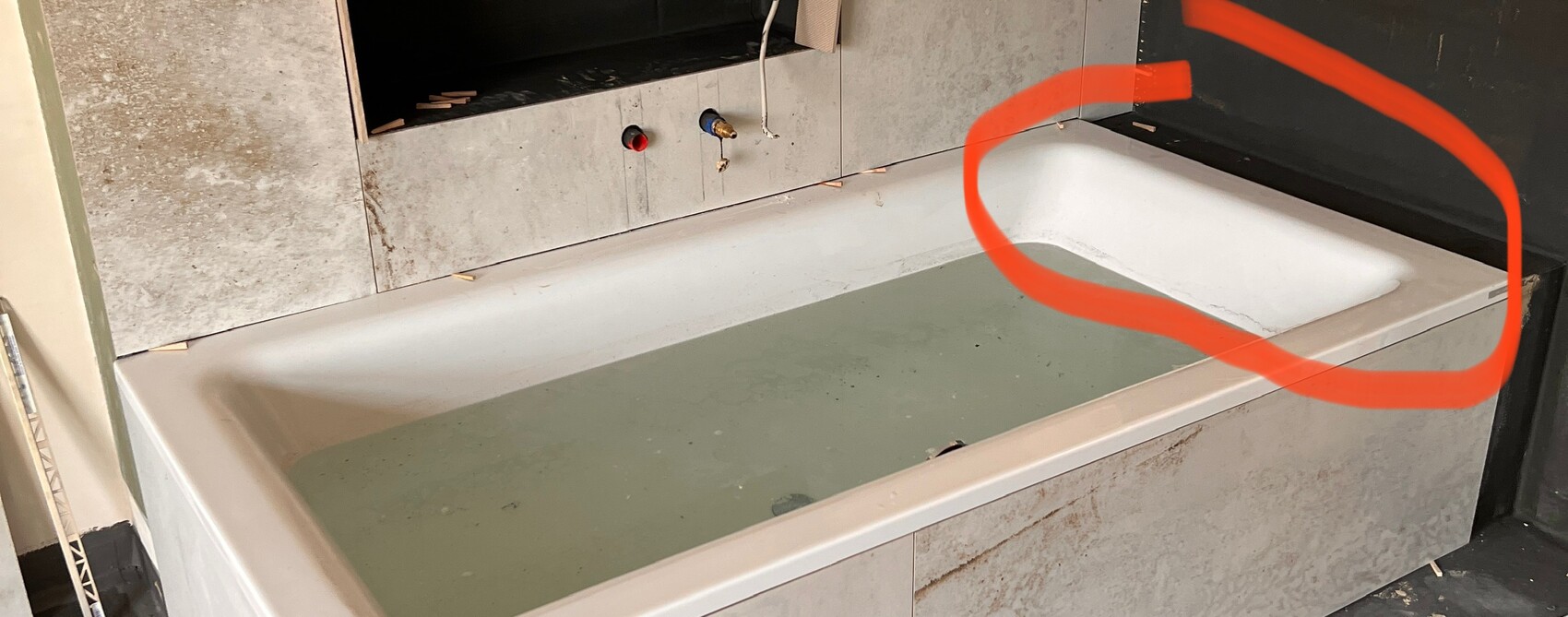
Here is the photo. The bear tile has not been installed yet.
If you look at the picture, it was installed sloping downwards to the right.
After seeing the photo, the situation is clearly quite different from what I had previously imagined!
After his preliminary inspection of the substrate, the tile installer accepts the surface prepared by the preceding trade.
If this surface is, for example, uneven so that he would theoretically have to incorporate this into his scope of work, he must raise his concerns.
It is then the responsibility of the client (from the preceding trade) to instruct the responsible contractor to carry out the necessary corrections.
If the tile installer accepts a defective substrate in this case, he is liable for the fault originating from the preceding trade, because he inspected it and apparently accepted the substrate as sufficiently level or properly angled.
However, if, for example, the building is an existing structure with what we might call a "very unusual" room and wall geometry, and it is not possible for the tile installer to lay tiles without visual impairments (functionality must always be ensured!), he should have the client confirm the continuation of work in writing after notifying them.
To summarize:
From a distance and without knowledge of the local conditions, we cannot clearly assess which aspects need to be considered.
However, my point remains that no technical standards cover such specific details as may exist here!
Best regards, KlaRa
After his preliminary inspection of the substrate, the tile installer accepts the surface prepared by the preceding trade.
If this surface is, for example, uneven so that he would theoretically have to incorporate this into his scope of work, he must raise his concerns.
It is then the responsibility of the client (from the preceding trade) to instruct the responsible contractor to carry out the necessary corrections.
If the tile installer accepts a defective substrate in this case, he is liable for the fault originating from the preceding trade, because he inspected it and apparently accepted the substrate as sufficiently level or properly angled.
However, if, for example, the building is an existing structure with what we might call a "very unusual" room and wall geometry, and it is not possible for the tile installer to lay tiles without visual impairments (functionality must always be ensured!), he should have the client confirm the continuation of work in writing after notifying them.
To summarize:
From a distance and without knowledge of the local conditions, we cannot clearly assess which aspects need to be considered.
However, my point remains that no technical standards cover such specific details as may exist here!
Best regards, KlaRa
J
Jürgen 12345 Jul 2023 09:44Thanks first of all for the response.
It is important to know that there is no regulation as he claims.
It is important to know that there is no regulation as he claims.
Similar topics