
Dear Forum,
We have now been living in our newly built house (town villa) for 8 years. The bathroom on the upper floor has always felt much too cold to some family members, no matter how we adjust the heating. We have already considered various solutions and are currently using an electric supplementary heater.
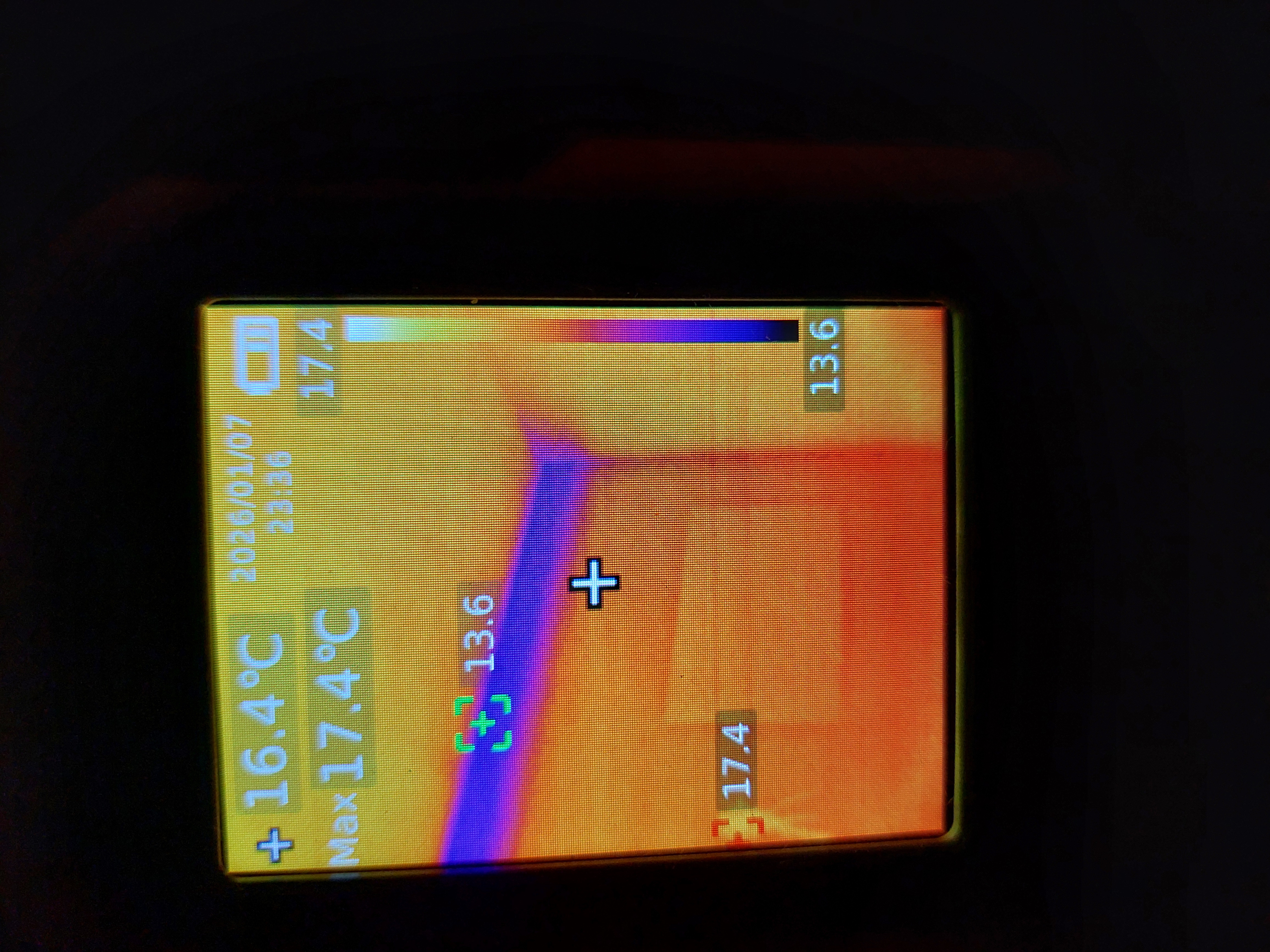
However, I wanted to get to the bottom of the cause and got myself a thermal imaging camera. It clearly shows that the wall-to-ceiling junction around all exterior walls is about 3-4 degrees Celsius (5-7 degrees Fahrenheit) colder than the rest of the exterior wall, see picture:
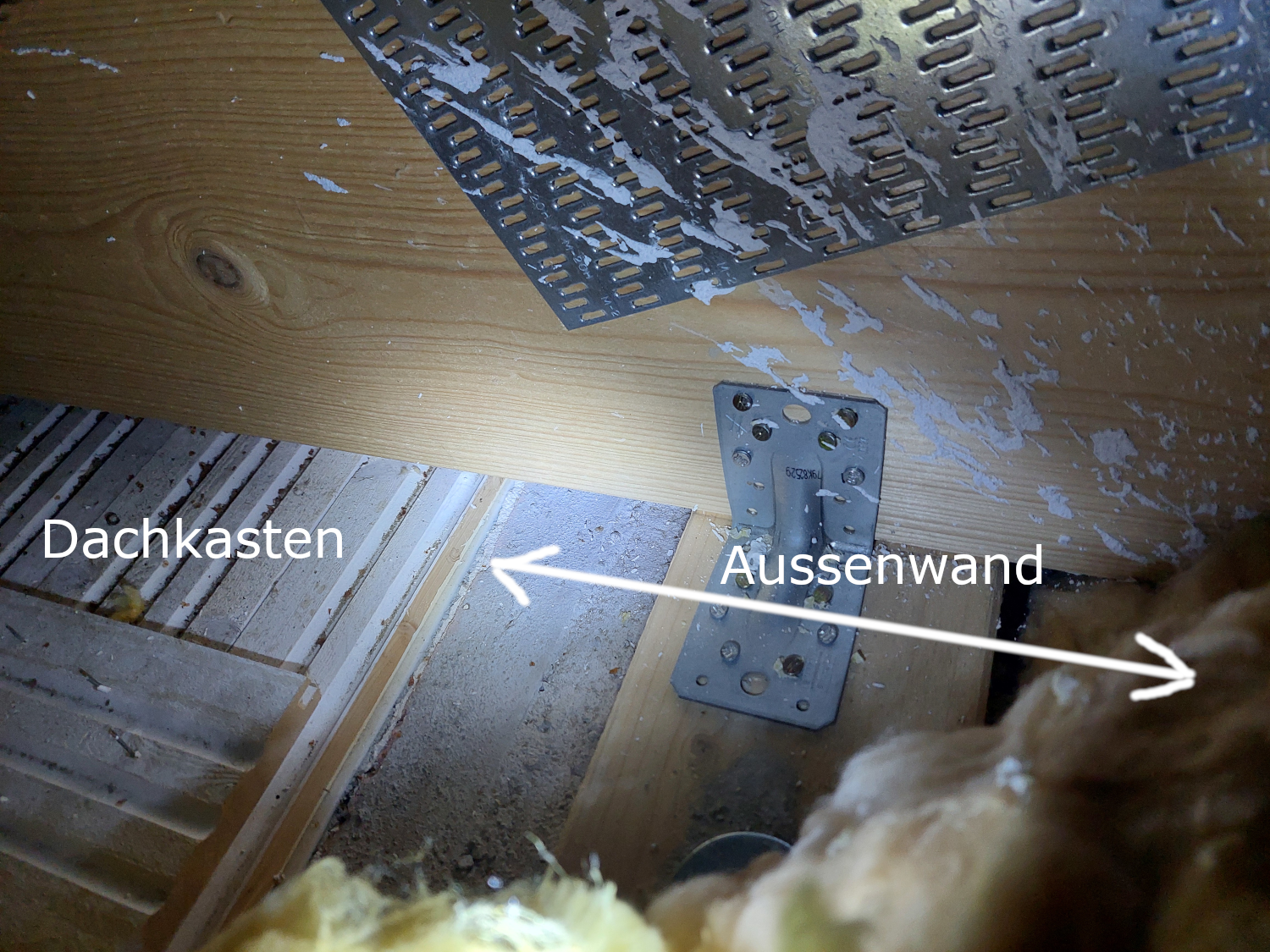
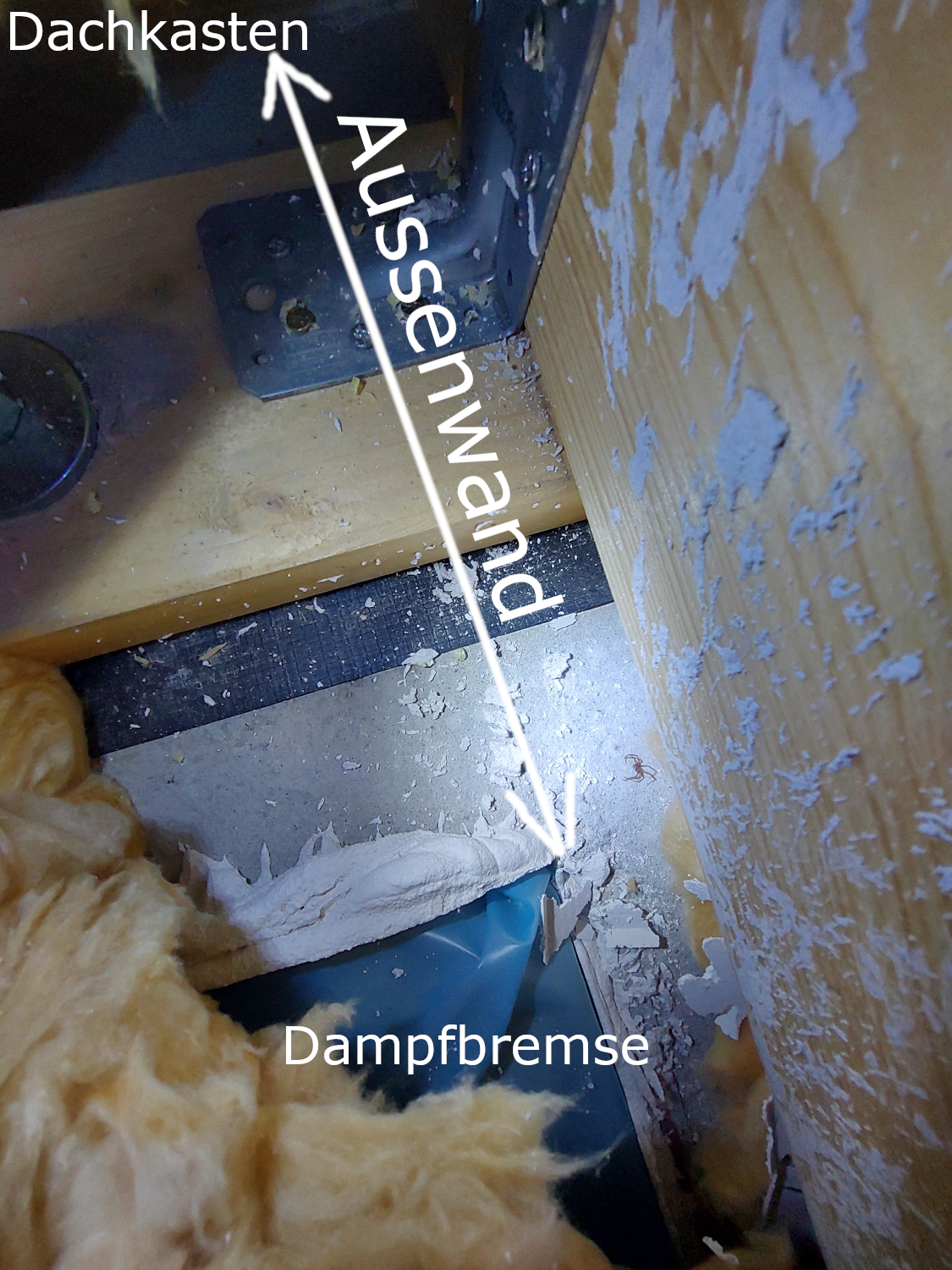
Then I went up to the attic to check the insulation. The insulation wool is placed between the ceiling joists and rests on the exterior wall (36 cm (14 inches) aerated concrete block, lambda 0.1). This means the insulation wool rests on the top edge of the exterior wall and is exposed on the side to cold air circulating in the roof cavity. Additionally, a wooden beam lies on the exterior wall, serving as the support for the ceiling joists. This means the insulation is not flush with the exterior wall but is slightly lifted by this wooden beam.
Here are two annotated pictures—I hope this is visible.
My question now is: Can this be done better to reduce the thermal bridge, especially in the bathroom? What measures are reasonable to take (i.e., what ideas should I present when consulting potential specialists)?
I am grateful for any ideas.
We have now been living in our newly built house (town villa) for 8 years. The bathroom on the upper floor has always felt much too cold to some family members, no matter how we adjust the heating. We have already considered various solutions and are currently using an electric supplementary heater.
However, I wanted to get to the bottom of the cause and got myself a thermal imaging camera. It clearly shows that the wall-to-ceiling junction around all exterior walls is about 3-4 degrees Celsius (5-7 degrees Fahrenheit) colder than the rest of the exterior wall, see picture:
Then I went up to the attic to check the insulation. The insulation wool is placed between the ceiling joists and rests on the exterior wall (36 cm (14 inches) aerated concrete block, lambda 0.1). This means the insulation wool rests on the top edge of the exterior wall and is exposed on the side to cold air circulating in the roof cavity. Additionally, a wooden beam lies on the exterior wall, serving as the support for the ceiling joists. This means the insulation is not flush with the exterior wall but is slightly lifted by this wooden beam.
Here are two annotated pictures—I hope this is visible.
My question now is: Can this be done better to reduce the thermal bridge, especially in the bathroom? What measures are reasonable to take (i.e., what ideas should I present when consulting potential specialists)?
I am grateful for any ideas.
As a follow-up on the topic of mold risk:
With our ventilation system, we maintain a fairly stable humidity level of 45% at 20°C (68°F) in the bathroom. If my calculations are correct, this corresponds to about 67% humidity at the wall surface (with a wall temperature of 13.6°C (56.5°F) and an outdoor temperature around -2°C (28°F)). I find this quite close to the critical limit for mold growth. Of course, this only applies when outdoor temperatures fall below freezing. The thermal bridge should still be eliminated!
Another update: I compared several room thermometers with an IR camera (i.e., measuring the surface temperature of the room thermometers), and the readings from the thermometers and the IR camera matched exactly. This makes me quite confident that the temperatures measured with the IR camera on the interior wall are fairly accurate.
With our ventilation system, we maintain a fairly stable humidity level of 45% at 20°C (68°F) in the bathroom. If my calculations are correct, this corresponds to about 67% humidity at the wall surface (with a wall temperature of 13.6°C (56.5°F) and an outdoor temperature around -2°C (28°F)). I find this quite close to the critical limit for mold growth. Of course, this only applies when outdoor temperatures fall below freezing. The thermal bridge should still be eliminated!
Another update: I compared several room thermometers with an IR camera (i.e., measuring the surface temperature of the room thermometers), and the readings from the thermometers and the IR camera matched exactly. This makes me quite confident that the temperatures measured with the IR camera on the interior wall are fairly accurate.
Yes, there is something poorly done here, to put it mildly: rubbish.
1. A wind barrier is missing (note: wind, not vapor!!). This should run vertically from the eaves upward. Its purpose is to prevent wind from blowing into your insulation, which, as you have already noticed, is indeed happening.
Attach a strip of wood on the left and right sides, then install a DWV board / hard fiberboard—whatever it may be—that is as high as your insulation, possibly a few centimeters (inches) higher. Seal any remaining gaps with some PU foam.
2. Your beam rests on the top plate. On those 5/6 cm (2–2.5 inches) outward, there was no insulation at all so far. Stuff insulation in there. Yes, I know, it may not be perfectly airtight in this area, or you might have to use more foam.
3. The insulation should not just be haphazardly placed on top, but cut out around the area of the top plate. Alternatively, cut fitting pieces and then place the insulation over them. Also, add insulation underneath the beam toward the inside.
1. A wind barrier is missing (note: wind, not vapor!!). This should run vertically from the eaves upward. Its purpose is to prevent wind from blowing into your insulation, which, as you have already noticed, is indeed happening.
Attach a strip of wood on the left and right sides, then install a DWV board / hard fiberboard—whatever it may be—that is as high as your insulation, possibly a few centimeters (inches) higher. Seal any remaining gaps with some PU foam.
2. Your beam rests on the top plate. On those 5/6 cm (2–2.5 inches) outward, there was no insulation at all so far. Stuff insulation in there. Yes, I know, it may not be perfectly airtight in this area, or you might have to use more foam.
3. The insulation should not just be haphazardly placed on top, but cut out around the area of the top plate. Alternatively, cut fitting pieces and then place the insulation over them. Also, add insulation underneath the beam toward the inside.
Hi Rübe1,
Thank you for that! I feel confident enough to try it myself and will test it over a few meters (yards) to see how well I can do.
Accurate measurements are probably only possible again in winter. Or maybe the reverse effect will happen in midsummer, when the attic reaches 60°C (140°F).
Thanks again!
Thank you for that! I feel confident enough to try it myself and will test it over a few meters (yards) to see how well I can do.
Accurate measurements are probably only possible again in winter. Or maybe the reverse effect will happen in midsummer, when the attic reaches 60°C (140°F).
Thanks again!
Similar topics