
ᐅ The hardwood flooring is warping in two places after refinishing.
Created on: 22 Oct 2025 09:38
B
bilo_67
Hello everyone,
I hope you can help me or offer some advice.
About five months ago, we bought an apartment. Around three weeks ago, the parquet flooring in the living room and kitchen started to noticeably warp in certain areas (there is underfloor heating installed).
Before the purchase, the floor was completely sanded and resealed.
The contractor now says that the damage is due to an installation error from about 15 years ago and therefore there is no warranty.
However, this doesn’t sound quite plausible to me, since both affected areas only started warping several months after his work and almost simultaneously. Could this possibly be related to the sanding and resealing?
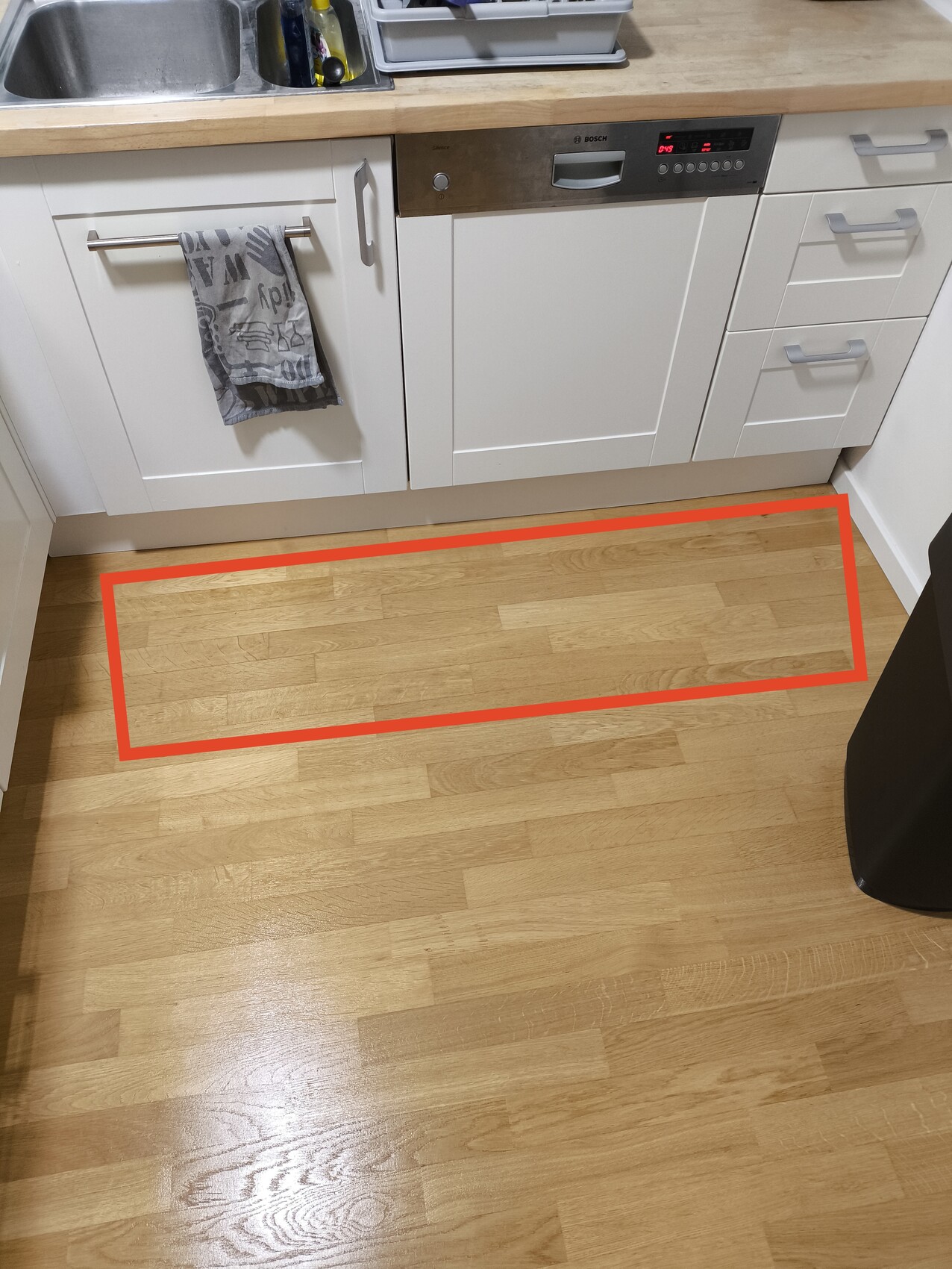
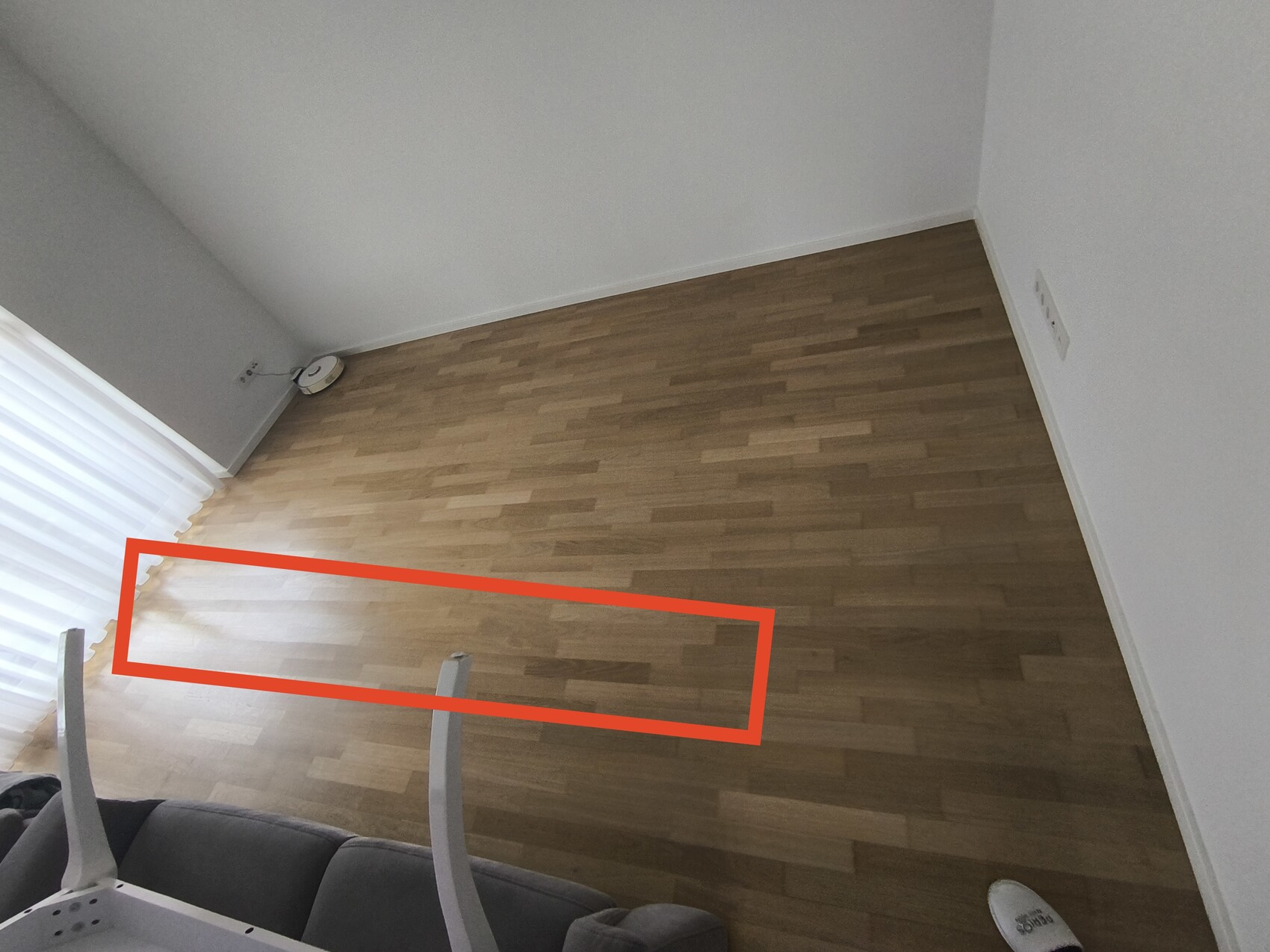
I have uploaded two photos of the affected areas.
The warping is not visible in the images, but I included the marked spots in case they are relevant.
What would you do in my situation?
Are such areas repairable, or is it really necessary – as is often suggested – to replace the entire floor?
Would you take action against the contractor, or could he be right?
Thanks in advance for your assessment!
I hope you can help me or offer some advice.
About five months ago, we bought an apartment. Around three weeks ago, the parquet flooring in the living room and kitchen started to noticeably warp in certain areas (there is underfloor heating installed).
Before the purchase, the floor was completely sanded and resealed.
The contractor now says that the damage is due to an installation error from about 15 years ago and therefore there is no warranty.
However, this doesn’t sound quite plausible to me, since both affected areas only started warping several months after his work and almost simultaneously. Could this possibly be related to the sanding and resealing?
I have uploaded two photos of the affected areas.
The warping is not visible in the images, but I included the marked spots in case they are relevant.
What would you do in my situation?
Are such areas repairable, or is it really necessary – as is often suggested – to replace the entire floor?
Would you take action against the contractor, or could he be right?
Thanks in advance for your assessment!
J
Jesse Custer23 Oct 2025 08:55I consider warping caused by sanding or painting unlikely.
Have you noticed any recent pressure losses in the underfloor heating?
Have you noticed any recent pressure losses in the underfloor heating?
Jesse Custer schrieb:
I consider a warp caused by sanding or painting unlikely.
Have you noticed any recent pressure drops in the underfloor heating? No, not really, but it hasn’t been fully turned on yet.
C
chand198626 Oct 2025 04:11bilo_67 schrieb:
We bought an apartment about five months ago. Around three weeks ago, the parquet flooring in the living room and kitchen started to noticeably warp in some areas. Quick question: How can you be sure that these warps didn’t already exist at the previous owner’s place depending on the season? Wood expands and contracts, so as of now, you don’t know if the warping is permanent.

@ bilo_67:
Making a prediction from a distance often comes with uncertainties regarding the accuracy.
In this case, however, I am almost certain that the floor is a floating parquet floor, meaning it is loosely installed.
Distortions like those visible in the photos by the markings never occur with a screed that has been smoothed and with glued floor panels on top.
Simply remove the trim strip below the kitchen unit. It is usually just clipped in place, so removal should be easy.
Was the new kitchen placed directly on the floor panels (which I suspect), and is the floor unable to expand on the opposite side?
This often happens when a continuous installation extends into the next room without an expansion joint.
The same applies to the living area—remove the skirting board on the wall without windows and take a look at the expansion gap.
For underfloor heating, this gap should be about 10mm (0.4 inches) wide when the floor panels are cooled.
If this is not the case, have the edge gap re-cut with a shadow gap saw.
--------------------------
Summary:
I do not believe the distortions are caused by water or moisture damage.
It is more likely that the floor covering is restricted and cannot expand, for example in the kitchen due to the heavy load of the kitchen units.
If necessary, a separation in the flooring could be created between the trim and the kitchen’s support legs (two cuts, removing excess strip-shaped parquet material to create an "emergency joint" behind the trim).
------------
Good luck: KlaRa
Making a prediction from a distance often comes with uncertainties regarding the accuracy.
In this case, however, I am almost certain that the floor is a floating parquet floor, meaning it is loosely installed.
Distortions like those visible in the photos by the markings never occur with a screed that has been smoothed and with glued floor panels on top.
Simply remove the trim strip below the kitchen unit. It is usually just clipped in place, so removal should be easy.
Was the new kitchen placed directly on the floor panels (which I suspect), and is the floor unable to expand on the opposite side?
This often happens when a continuous installation extends into the next room without an expansion joint.
The same applies to the living area—remove the skirting board on the wall without windows and take a look at the expansion gap.
For underfloor heating, this gap should be about 10mm (0.4 inches) wide when the floor panels are cooled.
If this is not the case, have the edge gap re-cut with a shadow gap saw.
--------------------------
Summary:
I do not believe the distortions are caused by water or moisture damage.
It is more likely that the floor covering is restricted and cannot expand, for example in the kitchen due to the heavy load of the kitchen units.
If necessary, a separation in the flooring could be created between the trim and the kitchen’s support legs (two cuts, removing excess strip-shaped parquet material to create an "emergency joint" behind the trim).
------------
Good luck: KlaRa
KlaRa schrieb:
@ bilo_67:
Making a prediction from a distance often involves uncertainty regarding the likelihood of the statement.
In this case, however, I am quite certain that it is a floating, i.e., loosely laid parquet floor.
Deformations like the ones visible in the photos through the markings never occur with a screeded subfloor and floor elements glued on top.
Simply remove the decorative trim below the kitchen units. This is usually just clipped in and should be easy to remove.
Was the new kitchen installed directly on the floor panels (which I suspect), and is the floor unable to expand on the opposite side?
This usually happens when the flooring extends continuously into the next room without an expansion joint.
The same applies to the living area: remove the baseboard on the wall without windows and check the movement joint.
With underfloor heating, this joint should be about 10mm (0.4 inches) wide when the floor panels are cooled down.
If it is not, have the perimeter joint trimmed with a shadow gap saw.
--------------------------
Summary:
I do not believe any water or moisture influence is causing the cupping.
It is more likely that the flooring is trapped and cannot expand, for example, in the kitchen due to the heavy load of the kitchen cabinets.
If necessary, one could create a separation in the flooring between the decorative trim and the support legs of the kitchen units (two cuts, remove the excess (strip-shaped) parquet material and thus create an "emergency joint" behind the trim).
------------
Good luck: KlaRa Hello KlaRa,
thank you very much for your feedback.
To be honest, I still don’t know if it is glued.
The facts “suggest” it might be glued: underfloor heating, continuous installation in all rooms, built in 2009.
But that doesn’t really prove anything. I can’t tell it from the knock test anyway.
I removed the kitchen trim and took a few photos. There’s still about half a fingertip’s width of space.
I also have a picture showing both spots in one photo.
But your theory about floating parquet has given me some hope. Maybe you can assess it better based on the pictures?
Thank you very much
Similar topics