
B
blackarrow19902 Apr 2021 14:59Hello
The building plot for our single-family house (living area 120 m2 (1,292 sq ft)) is small (400 m2 (4,306 sq ft)) and there is a height difference of 1 m (3.3 ft) over 15 m (49 ft), which corresponds to a slope of 6.6%. We are not planning a basement, and the question is what type of foundation we should use. Of course, the structural engineer will have to calculate everything in the end, but I would like to hear your experiences with sloped sites and get a sense of whether the slope will require significant additional investment.
If a retaining wall needs to be built, is a slab foundation necessary, or would strip footings be sufficient? Could strip footings also serve as the retaining wall?
Thank you.
The building plot for our single-family house (living area 120 m2 (1,292 sq ft)) is small (400 m2 (4,306 sq ft)) and there is a height difference of 1 m (3.3 ft) over 15 m (49 ft), which corresponds to a slope of 6.6%. We are not planning a basement, and the question is what type of foundation we should use. Of course, the structural engineer will have to calculate everything in the end, but I would like to hear your experiences with sloped sites and get a sense of whether the slope will require significant additional investment.
If a retaining wall needs to be built, is a slab foundation necessary, or would strip footings be sufficient? Could strip footings also serve as the retaining wall?
Thank you.
A height difference of 1 meter (3 feet) doesn’t sound like much. How much height difference is there exactly in the area where the house will be built? Of course, it also depends on the elevation at which the house is planned to be situated. Maybe you can provide more information on that.
Then, it probably also depends on the bearing capacity of the soil, and so on. Has a soil investigation been carried out yet?
Then, it probably also depends on the bearing capacity of the soil, and so on. Has a soil investigation been carried out yet?
B
blackarrow19902 Apr 2021 20:02Hello
The difference in elevation is linear and about 0.9m (3 feet) in the area where the house is located (14m (46 feet) length). We do not want to “bury” the house; it should be built at the highest point.
Topsoil:
Silt, slightly fine sandy
Slightly humus-rich, root-penetrated
Homogeneous zone E1
Class 1
Highly frost-sensitive
Loess:
Silt, slightly fine sandy;
Silt, slightly clayey to clayey, partly slightly fine sandy
Homogeneous zone E2
Class 4, locally Class 2
Highly frost-sensitive
The difference in elevation is linear and about 0.9m (3 feet) in the area where the house is located (14m (46 feet) length). We do not want to “bury” the house; it should be built at the highest point.
Topsoil:
Silt, slightly fine sandy
Slightly humus-rich, root-penetrated
Homogeneous zone E1
Class 1
Highly frost-sensitive
Loess:
Silt, slightly fine sandy;
Silt, slightly clayey to clayey, partly slightly fine sandy
Homogeneous zone E2
Class 4, locally Class 2
Highly frost-sensitive
K
knalltüte2 Apr 2021 20:12Well-founded answers will certainly depend on the location and orientation of the house as well as the planned outdoor areas. Why not provide more details...
What I learned during our construction phase is that “summer frost” can have much more severe consequences than simply needing to build on frost-free ground. Summer frost refers to the drying out of the deeper soil layers, resulting in a corresponding loss of (bearing) strength. Therefore, practically every homeowner can expect more excavation work, with or without a basement 🙄
What I learned during our construction phase is that “summer frost” can have much more severe consequences than simply needing to build on frost-free ground. Summer frost refers to the drying out of the deeper soil layers, resulting in a corresponding loss of (bearing) strength. Therefore, practically every homeowner can expect more excavation work, with or without a basement 🙄
B
blackarrow19905 Apr 2021 10:30Here is a small sketch of the orientation and slope.
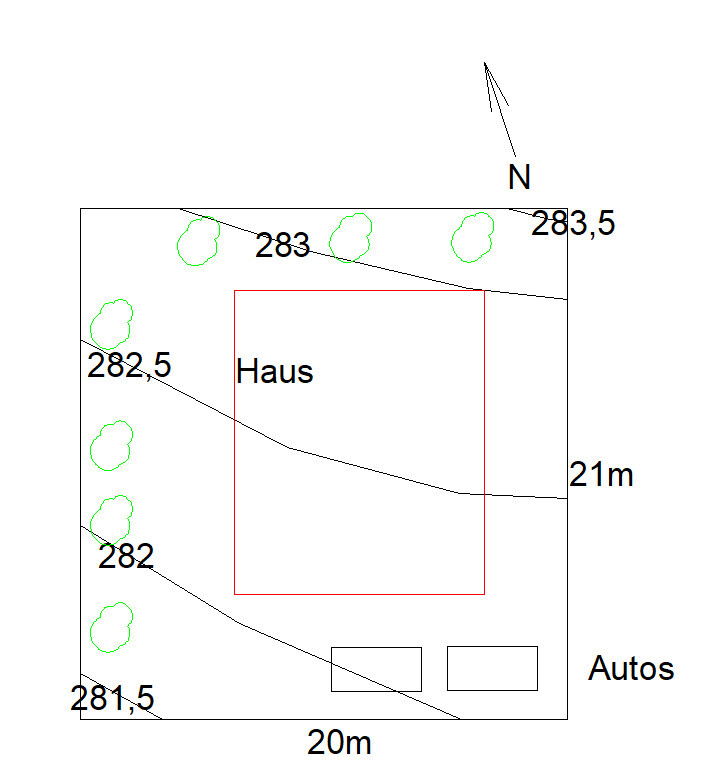

Can you make the house more elongated and rotate it clockwise? That way it would be built parallel to the contour lines.
In my opinion, this would fit better and you would have a larger area facing southwest. Besides, on a south-facing slope, it generally makes more sense to orient as many rooms as possible to the south (possibly with a valley view).
In my opinion, this would fit better and you would have a larger area facing southwest. Besides, on a south-facing slope, it generally makes more sense to orient as many rooms as possible to the south (possibly with a valley view).
Similar topics