
ᐅ Challenges for MEP planners: underfloor heating flow temperature and wastewater ventilation
Created on: 15 Jul 2022 10:22
P
Pacmansh
Hello,
we are at the beginning of the construction phase for our development project with the builder, and I am having some disagreements with the MEP planner. To be better prepared for the discussion, I would appreciate your assessment.
Point 1) Supply temperature of underfloor heating, new building, KfW55 standard, air-to-water heat pump
The supply temperature of the underfloor heating (end-terrace house on both floors) was stated to me as 40°C (104°F) after inquiry. This seems absurdly high to me. Additionally, I was informed that the surface temperature is designed to a maximum of 27°C (81°F) due to the flooring materials. Somehow, this does not seem consistent. When I asked about lowering the supply temperature, the response was: "A general reduction is not feasible with the underfloor heating without reducing the pipe spacing to an unacceptable level."
Do you have any ideas how I can respond to this in a reasonably professional way? Are there any documents or sources I could refer to, or information I should request?
Point 2) Wastewater venting
Contrary to earlier agreements, this has been planned in a rather unfavorable location. The reason given is "because the wastewater vent and the residential ventilation (exhaust air) must be routed over the roof with a certain separation according to flat roof guidelines." What distance should be maintained here? A quick online search only showed a 30cm (12 inches) distance to other building components. Basically, this is about the roof penetrations and their distance from each other, correct?
we are at the beginning of the construction phase for our development project with the builder, and I am having some disagreements with the MEP planner. To be better prepared for the discussion, I would appreciate your assessment.
Point 1) Supply temperature of underfloor heating, new building, KfW55 standard, air-to-water heat pump
The supply temperature of the underfloor heating (end-terrace house on both floors) was stated to me as 40°C (104°F) after inquiry. This seems absurdly high to me. Additionally, I was informed that the surface temperature is designed to a maximum of 27°C (81°F) due to the flooring materials. Somehow, this does not seem consistent. When I asked about lowering the supply temperature, the response was: "A general reduction is not feasible with the underfloor heating without reducing the pipe spacing to an unacceptable level."
Do you have any ideas how I can respond to this in a reasonably professional way? Are there any documents or sources I could refer to, or information I should request?
Point 2) Wastewater venting
Contrary to earlier agreements, this has been planned in a rather unfavorable location. The reason given is "because the wastewater vent and the residential ventilation (exhaust air) must be routed over the roof with a certain separation according to flat roof guidelines." What distance should be maintained here? A quick online search only showed a 30cm (12 inches) distance to other building components. Basically, this is about the roof penetrations and their distance from each other, correct?
driver55 schrieb:
Are “straws” actually being installed? What diameter and wall thickness do the heating loops have?
KfW55 and 38 degrees somehow don’t quite match up. Unfortunately, I have no information about that. See below regarding KfW55.
driver55 schrieb:
I would size the bathroom for 23°C (73°F) (down to -10°C (14°F)). Sounds reasonable. The planner is assuming an outdoor temperature of -16°C (3°F), and oddly, the bottleneck isn’t even the bathroom at the moment, for some reason.
Alessandro schrieb:
What is the total heating load for the building?
For KfW55, it shouldn’t exceed 35 W/m² (3.25 W/sq ft). According to a phone call, it is supposed to be 45 W/m² (4.2 W/sq ft). It should be noted that the building is not necessarily built to KfW55 standard; this was only communicated later because funding was applied for. However, the energy consultant mishandled it or submitted the documents too late (same engineering office). It is quite possible that the planning reverted back to the minimum standard according to the building energy regulations.
Alessandro schrieb:
Nowadays, all reputable heating manufacturers provide heating load and pipe layout calculations. I would have commissioned that myself if I had sufficient information. At this point, I don’t trust the MEP planner anymore. But since they were hired by the developer, I have to try to get the best possible outcome. The lady won’t provide me with a room-by-room heating load calculation, but the developer has promised I can get the documents. I have now requested them through the developer in the hope this will bring more clarity.
A
Alessandro28 Sep 2022 12:32With this insulation standard, you will probably have to accept the high VLT values...
If you also have a buffer, which naturally needs to be overloaded by a few degrees Celsius, you will get even higher VLT :-(
Nevertheless, we are probably talking about a 10-15% increase in energy consumption over the heating season compared to a better insulation standard with lower VLT.
Depending on the size of the house, this may not be that critical.
Have you checked with your local utility company / energy supplier if there is a cheaper tariff for heat pumps?
Maybe a second meter for the heat pump could be worthwhile...
If you also have a buffer, which naturally needs to be overloaded by a few degrees Celsius, you will get even higher VLT :-(
Nevertheless, we are probably talking about a 10-15% increase in energy consumption over the heating season compared to a better insulation standard with lower VLT.
Depending on the size of the house, this may not be that critical.
Have you checked with your local utility company / energy supplier if there is a cheaper tariff for heat pumps?
Maybe a second meter for the heat pump could be worthwhile...
Correct, the net living area is approximately 145 m² (1,560 sq ft), which is not small. What matters more to me is that the underfloor heating is planned in a reasonably efficient way. The current design is more like "you can just turn down the thermostat if it gets too warm." I also have the feeling that the rooms don’t really fit together well, but I’m hoping for more information on that.
I checked the heat pump tariff, and it is possible. However, I roughly calculated that the additional meter rental makes the option less attractive. So for now, I decided against it. The electrical installation is not final yet. I will take another look at it.
I checked the heat pump tariff, and it is possible. However, I roughly calculated that the additional meter rental makes the option less attractive. So for now, I decided against it. The electrical installation is not final yet. I will take another look at it.
S
stjoob_at4 Oct 2022 08:28The classic issue with the bathroom. It almost always requires additional heating surfaces (walls/ceiling) or supplemental electric heating during winter.
Heating circuit lengths of 150 m (490 ft) seem too long to me, especially since there are circuits only a third of that length. I would accept a maximum difference of 30% between the longest and shortest circuit here.
ERR and buffer tanks should be removed anyway.
The whole room heating load thing is also funny, since it’s supposed to be the basis for the system design 😕
I’m curious whether the heat pump will also be oversized.
Heating circuit lengths of 150 m (490 ft) seem too long to me, especially since there are circuits only a third of that length. I would accept a maximum difference of 30% between the longest and shortest circuit here.
ERR and buffer tanks should be removed anyway.
The whole room heating load thing is also funny, since it’s supposed to be the basis for the system design 😕
I’m curious whether the heat pump will also be oversized.
I would have preferred to have the ERR and buffer installed outside as well, but then I would have had to hire someone myself and would have needed all the necessary data again for that. Most likely, I would have ended up taking responsibility for a heat pump that might arrive too late.
I tried to argue against the nonsense of the ERR, but here is a small example of the kind of nonsense I have to deal with: The picture shows the bedroom with a small walk-in closet (electrical planning has already been revised). The opening between the walk-in closet and the bedroom is about 1.20 m (4 feet) wide, without a door. The planner wanted to add a thermostat in the walk-in closet as well, because it would be nice to go from the cool bedroom into the warm closet.
Regarding the heat pump, I was told it is just slightly below the required size, so I still have hope.
I have not yet received the room-by-room heat load calculation, but I am still optimistic that it will work.
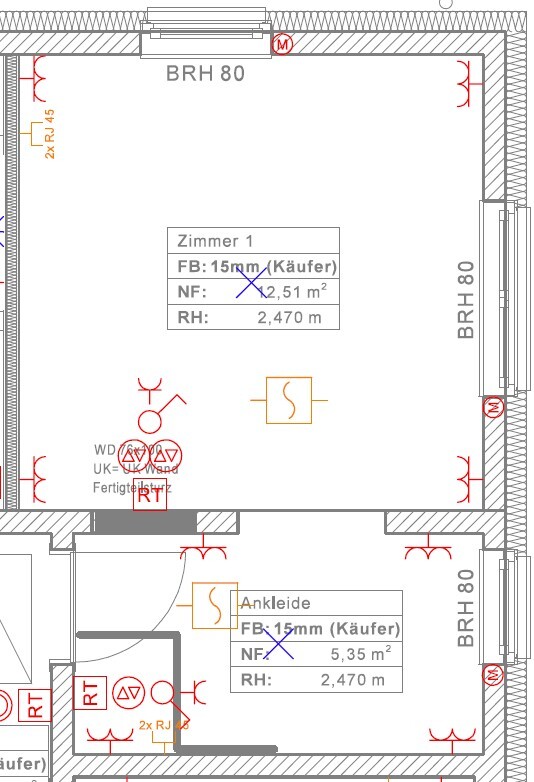
I tried to argue against the nonsense of the ERR, but here is a small example of the kind of nonsense I have to deal with: The picture shows the bedroom with a small walk-in closet (electrical planning has already been revised). The opening between the walk-in closet and the bedroom is about 1.20 m (4 feet) wide, without a door. The planner wanted to add a thermostat in the walk-in closet as well, because it would be nice to go from the cool bedroom into the warm closet.
Regarding the heat pump, I was told it is just slightly below the required size, so I still have hope.
I have not yet received the room-by-room heat load calculation, but I am still optimistic that it will work.
S
stjoob_at4 Oct 2022 10:54At least the ERR can be lowered or disconnected after installation. But you still have to pay for it 😉
Great logic from the planner— even with a door, you wouldn’t achieve significant temperature differences. The exterior walls have a much lower U-value than the interior walls. This is no longer like in an old building. Indoor temperatures even out much more.
Maybe you can still convince them to install only a small buffer tank in the return line for the heat pump’s defrost function, instead of a full heating buffer.
Great logic from the planner— even with a door, you wouldn’t achieve significant temperature differences. The exterior walls have a much lower U-value than the interior walls. This is no longer like in an old building. Indoor temperatures even out much more.
Maybe you can still convince them to install only a small buffer tank in the return line for the heat pump’s defrost function, instead of a full heating buffer.
Similar topics