
ᐅ Challenges for MEP planners: underfloor heating flow temperature and wastewater ventilation
Created on: 15 Jul 2022 10:22
P
Pacmansh
Hello,
we are at the beginning of the construction phase for our development project with the builder, and I am having some disagreements with the MEP planner. To be better prepared for the discussion, I would appreciate your assessment.
Point 1) Supply temperature of underfloor heating, new building, KfW55 standard, air-to-water heat pump
The supply temperature of the underfloor heating (end-terrace house on both floors) was stated to me as 40°C (104°F) after inquiry. This seems absurdly high to me. Additionally, I was informed that the surface temperature is designed to a maximum of 27°C (81°F) due to the flooring materials. Somehow, this does not seem consistent. When I asked about lowering the supply temperature, the response was: "A general reduction is not feasible with the underfloor heating without reducing the pipe spacing to an unacceptable level."
Do you have any ideas how I can respond to this in a reasonably professional way? Are there any documents or sources I could refer to, or information I should request?
Point 2) Wastewater venting
Contrary to earlier agreements, this has been planned in a rather unfavorable location. The reason given is "because the wastewater vent and the residential ventilation (exhaust air) must be routed over the roof with a certain separation according to flat roof guidelines." What distance should be maintained here? A quick online search only showed a 30cm (12 inches) distance to other building components. Basically, this is about the roof penetrations and their distance from each other, correct?
we are at the beginning of the construction phase for our development project with the builder, and I am having some disagreements with the MEP planner. To be better prepared for the discussion, I would appreciate your assessment.
Point 1) Supply temperature of underfloor heating, new building, KfW55 standard, air-to-water heat pump
The supply temperature of the underfloor heating (end-terrace house on both floors) was stated to me as 40°C (104°F) after inquiry. This seems absurdly high to me. Additionally, I was informed that the surface temperature is designed to a maximum of 27°C (81°F) due to the flooring materials. Somehow, this does not seem consistent. When I asked about lowering the supply temperature, the response was: "A general reduction is not feasible with the underfloor heating without reducing the pipe spacing to an unacceptable level."
Do you have any ideas how I can respond to this in a reasonably professional way? Are there any documents or sources I could refer to, or information I should request?
Point 2) Wastewater venting
Contrary to earlier agreements, this has been planned in a rather unfavorable location. The reason given is "because the wastewater vent and the residential ventilation (exhaust air) must be routed over the roof with a certain separation according to flat roof guidelines." What distance should be maintained here? A quick online search only showed a 30cm (12 inches) distance to other building components. Basically, this is about the roof penetrations and their distance from each other, correct?
The planner has so far mainly followed an approach that simplifies their work rather than prioritizing user comfort.
We have a new build here (end terrace house, KFW 55 standard, external thermal insulation composite system, no large window areas) and I am told that the technically minimal possible flow temperature for the underfloor heating on the ground floor and upper floor with an air-to-water heat pump is 40°C (104°F).
We have a new build here (end terrace house, KFW 55 standard, external thermal insulation composite system, no large window areas) and I am told that the technically minimal possible flow temperature for the underfloor heating on the ground floor and upper floor with an air-to-water heat pump is 40°C (104°F).
The following conditions make a lead time of 40 days realistic (also for KFW40):
- No electric bathroom heaters
- Parquet or carpet flooring
- No unheated attic space in the top floor
- Temperature difference greater than 4 degrees Celsius (7.2 degrees Fahrenheit)
- Not all rooms in the building are heated + high thermal conductivity of interior components (interior walls and ceilings)
- No electric bathroom heaters
- Parquet or carpet flooring
- No unheated attic space in the top floor
- Temperature difference greater than 4 degrees Celsius (7.2 degrees Fahrenheit)
- Not all rooms in the building are heated + high thermal conductivity of interior components (interior walls and ceilings)
@Smarti99 Thanks for the information.
Our situation:
- Electric towel rails in the bathroom
- Possibly designed for parquet flooring, but we do not want that.
- No attic space (flat roof)
- Temperature difference currently unknown
- All rooms heated (except hallway)
- Interior walls made of sand-lime brick or drywall
Our situation:
- Electric towel rails in the bathroom
- Possibly designed for parquet flooring, but we do not want that.
- No attic space (flat roof)
- Temperature difference currently unknown
- All rooms heated (except hallway)
- Interior walls made of sand-lime brick or drywall
Pacmansh schrieb:
We have a new build here (end terrace house, KfW 55 standard, external thermal insulation composite system, no large window areas), and I've been told that the technically lowest possible supply temperature for underfloor heating on the ground and upper floors with an air-to-water heat pump is 40 degrees Celsius (104°F). Who is spreading this nonsense?
Are you confusing minimum and maximum?
Please request the documentation/heating load calculation first (if that's even possible).
I have not received any documents yet, but at least there is a statement that a new planning status with more details should be available around mid-August. However, it seemed more like not much has been planned yet, and figures are just being thrown out there to say something. When I asked specific questions, the reaction was rather puzzled, and I was told that the exact details would have to be checked again in the documents. At least I have a commitment that I will be able to review the documents. I will also ask my building inspector to look at them with me. Maybe that will help the planners work a bit better.
Regarding the underfloor heating again: the only definitive statement I have received is that the current pipe spacing in the living areas is 10cm (4 inches). But even this does not at all align with the other boundary conditions.
For the second point about the wastewater ventilation, I have at least received the documents (so they have apparently already dealt with that). Unfortunately, to my regret, it makes sense. The terraced houses are staggered relative to each other, and if I want to route roof penetrations behind the shower wall upwards, it sits too close to the parapet. Specifically (see image): S15 and S16d need to have enough space between them, and there also needs to be clearance from the parapet.
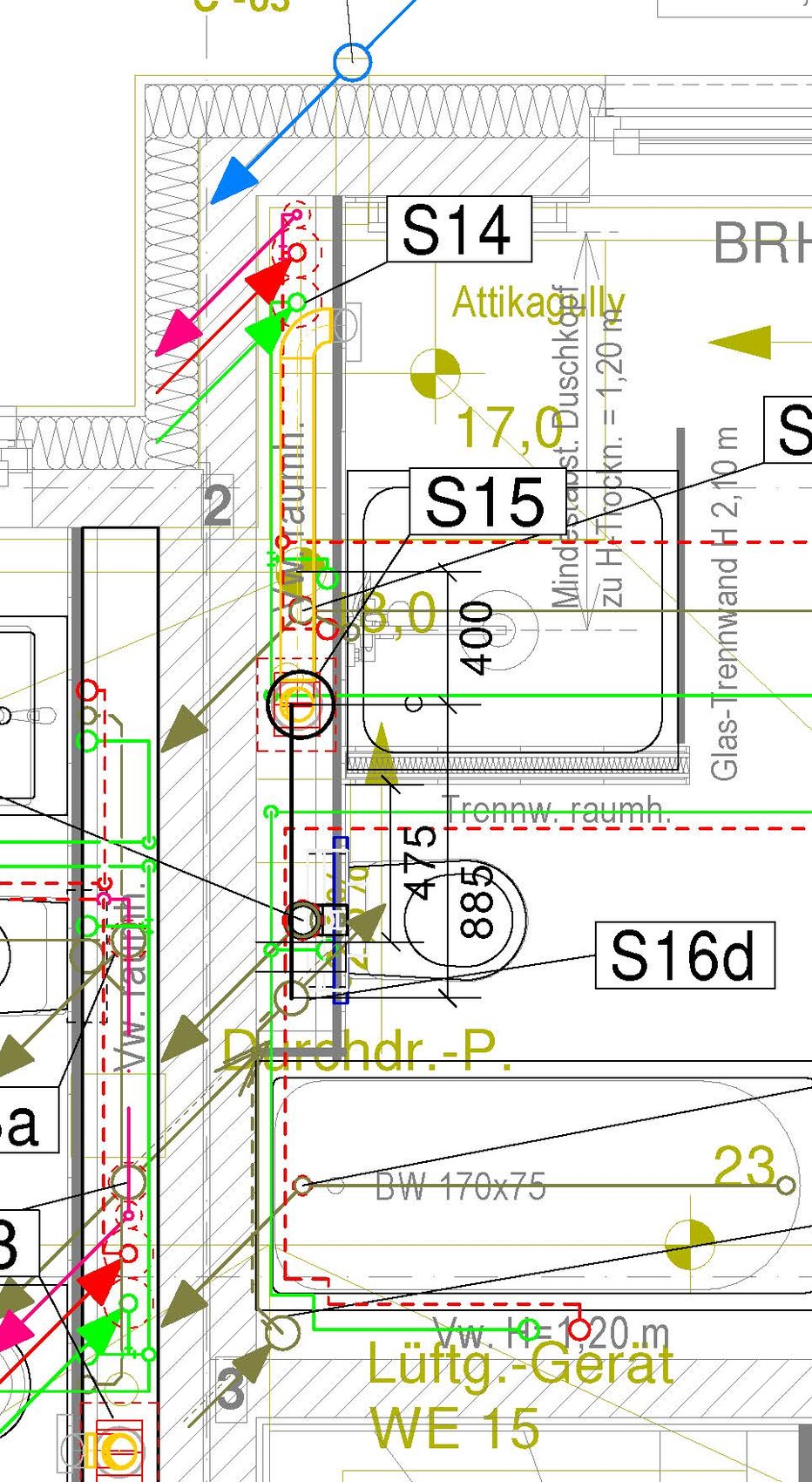
Regarding the underfloor heating again: the only definitive statement I have received is that the current pipe spacing in the living areas is 10cm (4 inches). But even this does not at all align with the other boundary conditions.
For the second point about the wastewater ventilation, I have at least received the documents (so they have apparently already dealt with that). Unfortunately, to my regret, it makes sense. The terraced houses are staggered relative to each other, and if I want to route roof penetrations behind the shower wall upwards, it sits too close to the parapet. Specifically (see image): S15 and S16d need to have enough space between them, and there also needs to be clearance from the parapet.
So, I have finally received more information. According to the HVAC planner, the situation is as follows:
- The bathroom will now be planned with a 5cm (2 inch) pipe spacing, but the supply temperature must be set at 40°C (104°F) to reach the target temperature of 24°C (75°F) in the bathroom. (Small area due to bathtub/shower, etc.)
- Since the supply temperature is 40°C (104°F), a pipe spacing of 20cm (8 inches) will be used in most of the other rooms.
I am not an expert, but somehow this doesn’t feel right to me. My suggestion was as follows:
- Keep the 5cm (2 inch) pipe spacing in the bathroom, if possible add some wall area (let’s see what’s feasible), and lower the target temperature in the calculation to 22–23°C (72–73°F).
- This should reduce the supply temperature and therefore allow for a smaller pipe spacing in the rest of the house as well (design at 20°C (68°F) in living spaces).
Ultimately, it’s the calculation parameter that changes, but this would allow for a smaller pipe spacing in the rest of the house. There is also an additional electric heater in the bathroom. Does this make sense, or am I just fooling myself because in the end I will have to raise the supply temperature again (for the bathroom) and throttle the flow in the rest of the house?
If I am to believe everything, I should receive documents for the heat load calculation (room-by-room) next week. The heating circuit lengths are expected to be between 70–90m (230–295 feet).
- The bathroom will now be planned with a 5cm (2 inch) pipe spacing, but the supply temperature must be set at 40°C (104°F) to reach the target temperature of 24°C (75°F) in the bathroom. (Small area due to bathtub/shower, etc.)
- Since the supply temperature is 40°C (104°F), a pipe spacing of 20cm (8 inches) will be used in most of the other rooms.
I am not an expert, but somehow this doesn’t feel right to me. My suggestion was as follows:
- Keep the 5cm (2 inch) pipe spacing in the bathroom, if possible add some wall area (let’s see what’s feasible), and lower the target temperature in the calculation to 22–23°C (72–73°F).
- This should reduce the supply temperature and therefore allow for a smaller pipe spacing in the rest of the house as well (design at 20°C (68°F) in living spaces).
Ultimately, it’s the calculation parameter that changes, but this would allow for a smaller pipe spacing in the rest of the house. There is also an additional electric heater in the bathroom. Does this make sense, or am I just fooling myself because in the end I will have to raise the supply temperature again (for the bathroom) and throttle the flow in the rest of the house?
If I am to believe everything, I should receive documents for the heat load calculation (room-by-room) next week. The heating circuit lengths are expected to be between 70–90m (230–295 feet).
Similar topics