
ᐅ Challenges for MEP planners: underfloor heating flow temperature and wastewater ventilation
Created on: 15 Jul 2022 10:22
P
Pacmansh
Hello,
we are at the beginning of the construction phase for our development project with the builder, and I am having some disagreements with the MEP planner. To be better prepared for the discussion, I would appreciate your assessment.
Point 1) Supply temperature of underfloor heating, new building, KfW55 standard, air-to-water heat pump
The supply temperature of the underfloor heating (end-terrace house on both floors) was stated to me as 40°C (104°F) after inquiry. This seems absurdly high to me. Additionally, I was informed that the surface temperature is designed to a maximum of 27°C (81°F) due to the flooring materials. Somehow, this does not seem consistent. When I asked about lowering the supply temperature, the response was: "A general reduction is not feasible with the underfloor heating without reducing the pipe spacing to an unacceptable level."
Do you have any ideas how I can respond to this in a reasonably professional way? Are there any documents or sources I could refer to, or information I should request?
Point 2) Wastewater venting
Contrary to earlier agreements, this has been planned in a rather unfavorable location. The reason given is "because the wastewater vent and the residential ventilation (exhaust air) must be routed over the roof with a certain separation according to flat roof guidelines." What distance should be maintained here? A quick online search only showed a 30cm (12 inches) distance to other building components. Basically, this is about the roof penetrations and their distance from each other, correct?
we are at the beginning of the construction phase for our development project with the builder, and I am having some disagreements with the MEP planner. To be better prepared for the discussion, I would appreciate your assessment.
Point 1) Supply temperature of underfloor heating, new building, KfW55 standard, air-to-water heat pump
The supply temperature of the underfloor heating (end-terrace house on both floors) was stated to me as 40°C (104°F) after inquiry. This seems absurdly high to me. Additionally, I was informed that the surface temperature is designed to a maximum of 27°C (81°F) due to the flooring materials. Somehow, this does not seem consistent. When I asked about lowering the supply temperature, the response was: "A general reduction is not feasible with the underfloor heating without reducing the pipe spacing to an unacceptable level."
Do you have any ideas how I can respond to this in a reasonably professional way? Are there any documents or sources I could refer to, or information I should request?
Point 2) Wastewater venting
Contrary to earlier agreements, this has been planned in a rather unfavorable location. The reason given is "because the wastewater vent and the residential ventilation (exhaust air) must be routed over the roof with a certain separation according to flat roof guidelines." What distance should be maintained here? A quick online search only showed a 30cm (12 inches) distance to other building components. Basically, this is about the roof penetrations and their distance from each other, correct?
No, no, it’s not that extreme. Previously, a central exhaust system with a fan on the roof was planned, with fresh air supplied through trickle vents in the window frames. Now, the exhaust system on the roof is no longer included, and individual exhaust fans are being installed instead. Energy-wise, that’s not ideal, I’m aware of that. But a controlled ventilation system was neither financially feasible nor possible with this developer’s setup. Heat recovery was never planned.
i_b_n_a_n schrieb:
Is it still possible to avoid this, or has the damage already been done?The roof solution might still be feasible, but it will be tight. My biggest concern is the noise level. In the utility room, it doesn’t matter much; in the kitchen, it is probably reasonably well shielded behind cabinets, but I’m not sure (there is enough fresh air supply). In the bathrooms, it’s difficult for me to assess.
So, we haven’t made progress on the ventilation topic, but the heating issue can more or less be considered finished. The underfloor heating has been installed, and today I walked through the house with the inspector. Overall, the inspector was very impressed with the workmanship and with the installation of the underfloor heating. The heating installers simply didn’t follow the plans and added an extra heating circuit both upstairs and downstairs. The spacing of the pipes also looks great, and the heating circuit manifolds all clearly show the lengths of each heating circuit. So, I finally know those as well. There is one heating circuit in the kitchen area with 116m (380 feet), another one with 97m (318 feet), and the rest are all under 90m (295 feet).
Here are three photos attached: one of the living/dining/kitchen area and the two bathrooms. I am very satisfied with the result and hope that you don’t have a significantly different view.
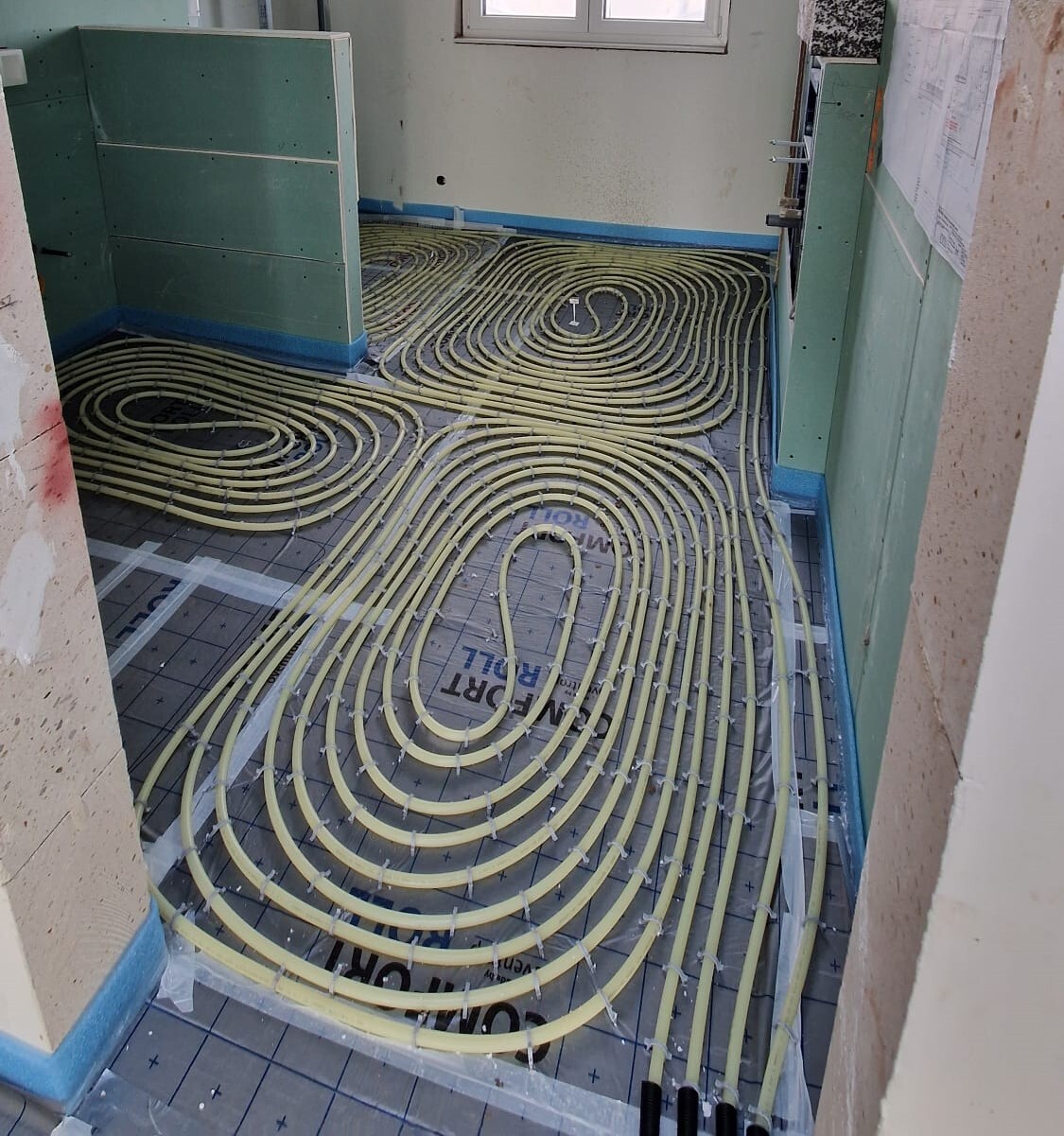
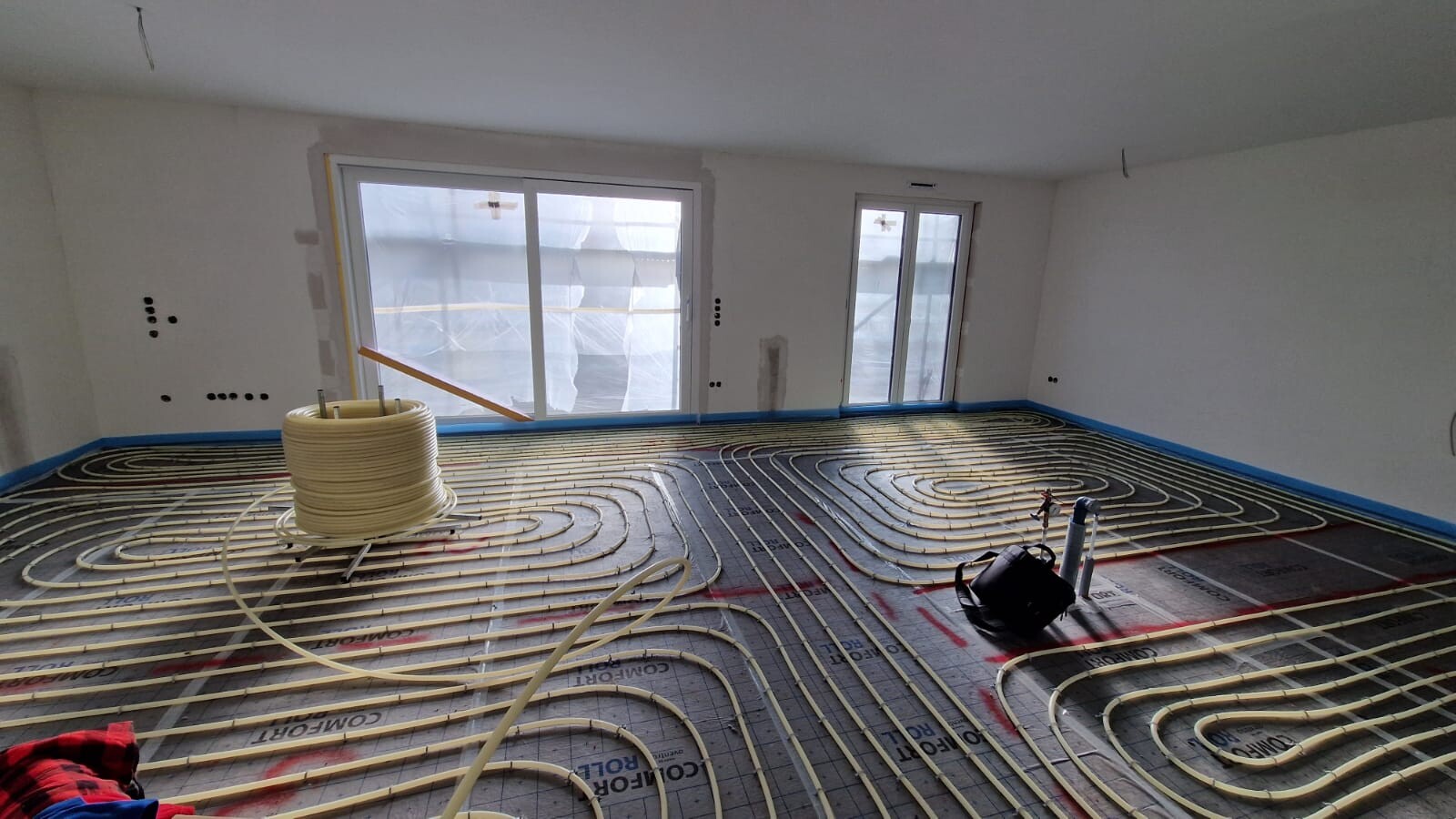
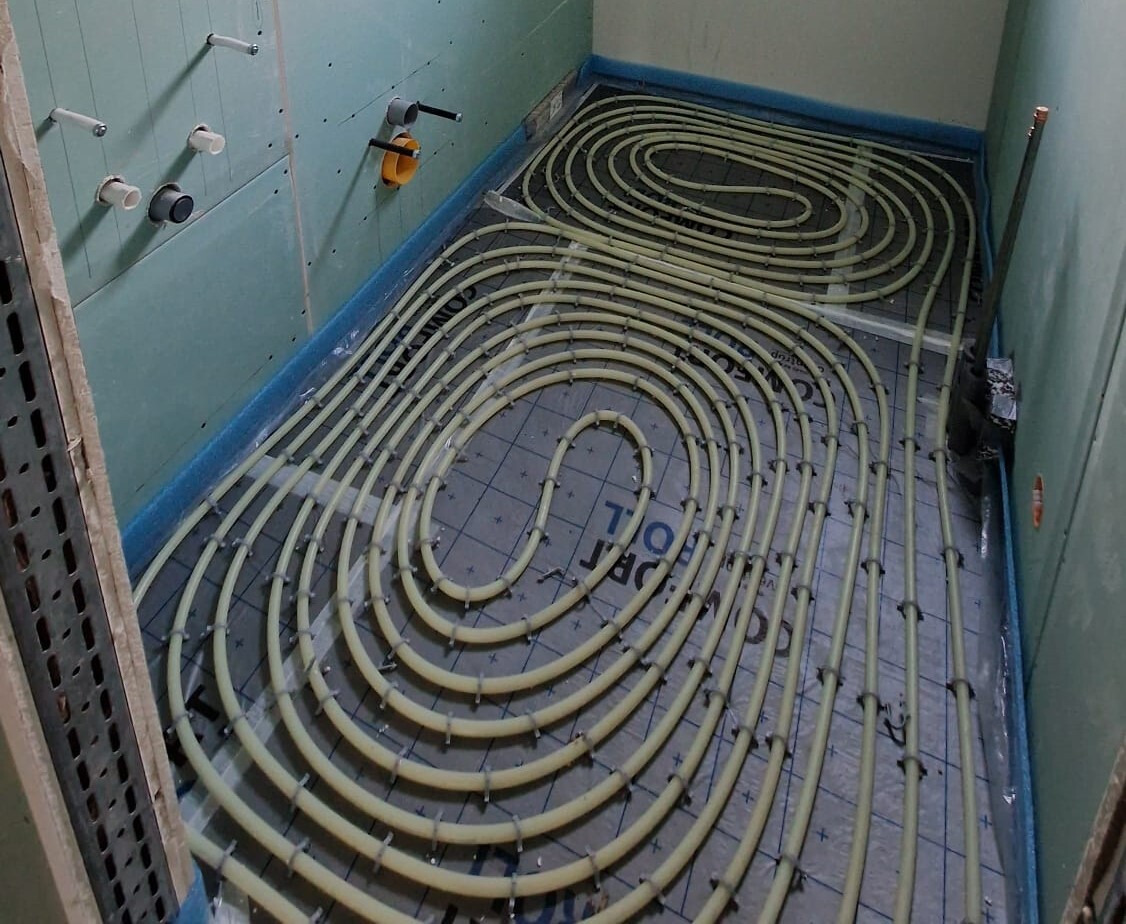
Here are three photos attached: one of the living/dining/kitchen area and the two bathrooms. I am very satisfied with the result and hope that you don’t have a significantly different view.
X
xMisterDx12 Dec 2022 23:35Pacmansh schrieb:
It is now at 36°C (97°F). But that’s with a correspondingly low temperature. It should actually be lower during the year, right?A bit late... but don’t worry. I am currently running the system in; for a few days now, the supply temperature has been held at 40°C (104°F), the outside temperature last night was -7°C (19°F), and inside the house it was a comfortable(?) 24°C (75°F).
The pipe spacing is a bit wider than yours, no polystyrene insulation on the exterior wall, just aerated concrete 36.5cm (14.4 inches).
And a supply temperature between 30 and 35°C (86 and 95°F) does not make the difference between a Porsche Cayenne or a Corsa for an air-to-water heat pump. There are studies on this... your installer’s opinion... well...
Who do you ask when you have a 40°C (104°F) fever? The medical assistant? Or the doctor?
Thank you for the feedback. Regarding the heating, I’m currently satisfied for now. We’ll see what temperature it ultimately reaches; the important thing is that there is the option to optimize it later. The 20°C (68°F) design temperature in the living areas is quite tight anyway. However, given the current spacing, it should not be a problem to achieve a higher temperature.
Another good example: the outdoor water tap was planned by the designer right in the middle of the wall on the terrace. Where furniture stands against the wall, where larch is used as decoration on the wall, and water then pools on the deck boards... And when you want to water the garden, you always have a hose running over the garden furniture. I noticed this “in time” (before the plumbing installation was completed).
End result: had to open the plastered wall, remove the pipes, close it up again, plaster (inside and outside), drill new holes in another spot on the finished plastered wall, chase the wall for pipes, lay water pipes, close the wall again and plaster. That cost me €300 and I was very annoyed at the planner. But if I had told the planner to design the water tap in a different location, he probably would have charged an additional €500 for planning work. And because of such idiots, the craftsmen have to do the work twice: it’s infuriating.
xMisterDx schrieb:Who is who to you? I was just worried that the planners would design something and the craftsmen would build exactly that. I did not expect a heating installer to say, “What nonsense is this? I’ll do it properly instead!” I might as well have skipped that hope in advance.
Who do you ask when you have a 40°C (104°F) fever? The medical assistant? Or the doctor?
Another good example: the outdoor water tap was planned by the designer right in the middle of the wall on the terrace. Where furniture stands against the wall, where larch is used as decoration on the wall, and water then pools on the deck boards... And when you want to water the garden, you always have a hose running over the garden furniture. I noticed this “in time” (before the plumbing installation was completed).
End result: had to open the plastered wall, remove the pipes, close it up again, plaster (inside and outside), drill new holes in another spot on the finished plastered wall, chase the wall for pipes, lay water pipes, close the wall again and plaster. That cost me €300 and I was very annoyed at the planner. But if I had told the planner to design the water tap in a different location, he probably would have charged an additional €500 for planning work. And because of such idiots, the craftsmen have to do the work twice: it’s infuriating.
T
Torti2022neu13 Dec 2022 10:53xMisterDx schrieb:
A bit late... but don’t worry. I’ve been heating up for a few days now, maintaining a flow temperature of 40°C (104°F). Last night, the outside temperature was -7°C (19°F), and inside the house it was a cozy (?) 24°C (75°F). However, that efficiency looks completely different. You don’t have an older building, do you?
For a new build, a flow temperature like that at these outside temperatures is a disaster – the heat pump isn’t to blame, but the planner who came up with such a setup.
Similar topics