
ᐅ Terraced House on a 240 sqm Plot – Fundamental Questions / Feasibility?
Created on: 11 Nov 2018 09:00
M
Mbk84
I have been following the forum for a while now, but this is my first post. After several years of searching in the Stuttgart metropolitan area, we suddenly have the opportunity to buy a relatively small plot of land on the edge of a new residential development.
Plot: 12m x 20m = 240sqm (2583 sqft); floor area ratio 0.4; max ridge height 9.5m (31 feet); max eaves height 6.0m (20 feet); roof pitch 35°-40°; 160,000 EUR
The plot can be built with a terraced house; to illustrate, I have attached the site plan.
To be able to roughly estimate the project overall, we have a few basic questions. Thank you very much in advance, your help would mean a lot to us!
1. Our budget is 560k. Is that realistic for a 135sqm house? Very roughly calculated: 170k for the plot, 50k for the basement, 300k for a solid masonry house from a builder (2,200 EUR per sqm x 135 sqm), 40k additional building costs. Is this estimate rather generous or tight? (We do have a buffer available.)
2. Does it make a big price difference whether we build 1.5 or 2.5 storeys?
3. Regarding the floor area ratio, is a 9x10m house plus a garage/parking space of 30sqm feasible? From what I understand, ancillary buildings may exceed the floor area ratio by 50%. 90sqm house < 0.4 x 240 + 30sqm < 0.5 x 0.4 x 240
Is there anything fundamental regarding costs for terraced houses that we might have overlooked?
Thank you very much in advance!
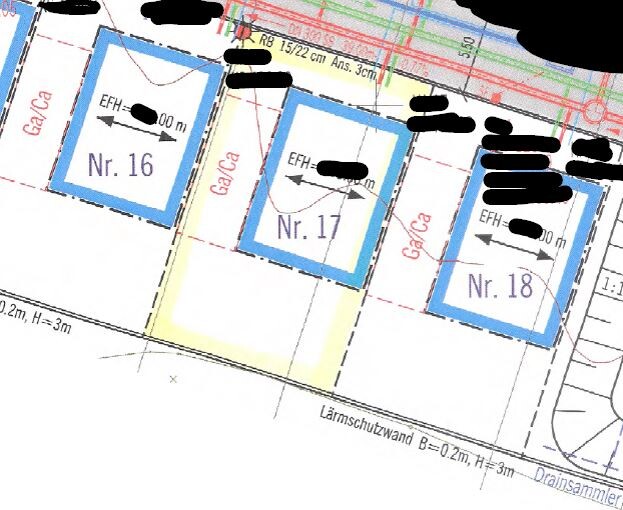
Plot: 12m x 20m = 240sqm (2583 sqft); floor area ratio 0.4; max ridge height 9.5m (31 feet); max eaves height 6.0m (20 feet); roof pitch 35°-40°; 160,000 EUR
The plot can be built with a terraced house; to illustrate, I have attached the site plan.
To be able to roughly estimate the project overall, we have a few basic questions. Thank you very much in advance, your help would mean a lot to us!
1. Our budget is 560k. Is that realistic for a 135sqm house? Very roughly calculated: 170k for the plot, 50k for the basement, 300k for a solid masonry house from a builder (2,200 EUR per sqm x 135 sqm), 40k additional building costs. Is this estimate rather generous or tight? (We do have a buffer available.)
2. Does it make a big price difference whether we build 1.5 or 2.5 storeys?
3. Regarding the floor area ratio, is a 9x10m house plus a garage/parking space of 30sqm feasible? From what I understand, ancillary buildings may exceed the floor area ratio by 50%. 90sqm house < 0.4 x 240 + 30sqm < 0.5 x 0.4 x 240
Is there anything fundamental regarding costs for terraced houses that we might have overlooked?
Thank you very much in advance!
Slava_S schrieb:
Yes. If everyone builds on the left boundary and the houses are connected by a shared structure, the last neighbor on the left no longer builds on the boundary to the next (left) property but connects to their shared structure on the right and forms the end of the row. This is then the last property that has to accept the "restriction" of having a house built up to its boundary.
I hope this explanation is not too complicated However, a row house development can also be easily designed as a closed ring or "block-style construction" so that only gardens are located inside. In that case, there are no "end houses."
Scout schrieb:
can be easily built as a closed ring or “block construction” so that only gardens are inside Yes, if the development plan allows it. I didn’t read that here, since the closure is made by a detached house.
My point was that the (last) detached house plot definitely belongs to the row since it has a required restriction on one side. It’s not common for a detached house plot to allow a party wall with more than 30m² (323 sq ft) of wall surface area (WS).
Here, 3-4 houses in a row are common.
The question is naturally also directed to everyone:
Do you think special sound insulation measures are necessary for a terraced house, or are these usually standard?
The plan is to use 24cm (9.5 inches) calcium silicate bricks with 12cm (4.7 inches) insulation on the wall bordering the neighbor.
However, 36cm (14 inches) aerated concrete blocks might also be an option, since only the neighbor’s driveway and garage are located on the boundary wall.
The neighbor’s house is 6m (20 feet) away.
This way, there would be no change of brick type in the external wall...
Do you think special sound insulation measures are necessary for a terraced house, or are these usually standard?
The plan is to use 24cm (9.5 inches) calcium silicate bricks with 12cm (4.7 inches) insulation on the wall bordering the neighbor.
However, 36cm (14 inches) aerated concrete blocks might also be an option, since only the neighbor’s driveway and garage are located on the boundary wall.
The neighbor’s house is 6m (20 feet) away.
This way, there would be no change of brick type in the external wall...

Hello @Pumukel, in our case, because of the proximity to a road, we had to install soundproof windows on one side anyway. I believe we used sound insulation class 3 there, although this has nothing to do with the issue of a row house.
From the neighbor's side, where no soundproof windows or special wall constructions were installed, we don’t hear anything at all. I don’t think any special measures are necessary there. In our case, the distance to the neighboring house is only 4 meters (13 feet).
What was somewhat “special” (and later caused us some additional costs) was that the boundary wall to the neighboring property had to be constructed as a fire protection wall. Our wall assembly consists of 14 cm (5.5 inches) of concrete (Liapor) plus 17 cm (6.7 inches) of external thermal insulation composite system (ETICS). This means that on the boundary side, the insulation had to be made of non-combustible mineral wool and extend a few centimeters “around the corner.” Also, on the roof, the rafters were not allowed to extend to the outer edge of the fire wall.
From the neighbor's side, where no soundproof windows or special wall constructions were installed, we don’t hear anything at all. I don’t think any special measures are necessary there. In our case, the distance to the neighboring house is only 4 meters (13 feet).
What was somewhat “special” (and later caused us some additional costs) was that the boundary wall to the neighboring property had to be constructed as a fire protection wall. Our wall assembly consists of 14 cm (5.5 inches) of concrete (Liapor) plus 17 cm (6.7 inches) of external thermal insulation composite system (ETICS). This means that on the boundary side, the insulation had to be made of non-combustible mineral wool and extend a few centimeters “around the corner.” Also, on the roof, the rafters were not allowed to extend to the outer edge of the fire wall.
Similar topics