
Our terrace, built in 1985, needs renovation this summer. The tiles are now in a poor condition, meaning they are cracked, frost-damaged, and partly detached. Therefore, something new is needed.
The current structure from top to bottom is as follows:
1. Tiles
2. Screed
3. Thin membrane
4. Concrete slab
meaning there is no drainage layer. The membrane is very thin and probably only serves to separate the screed from the concrete slab.
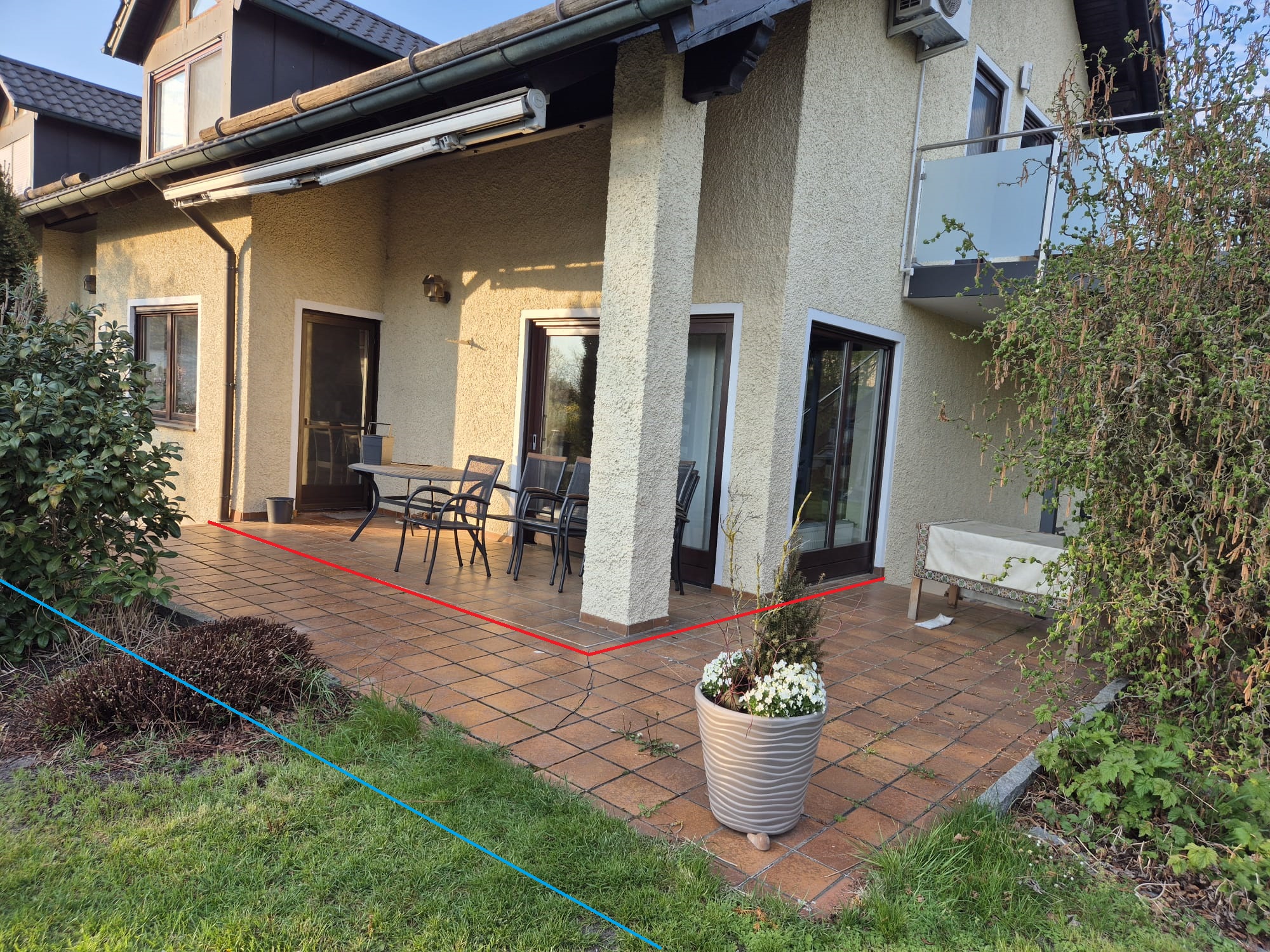
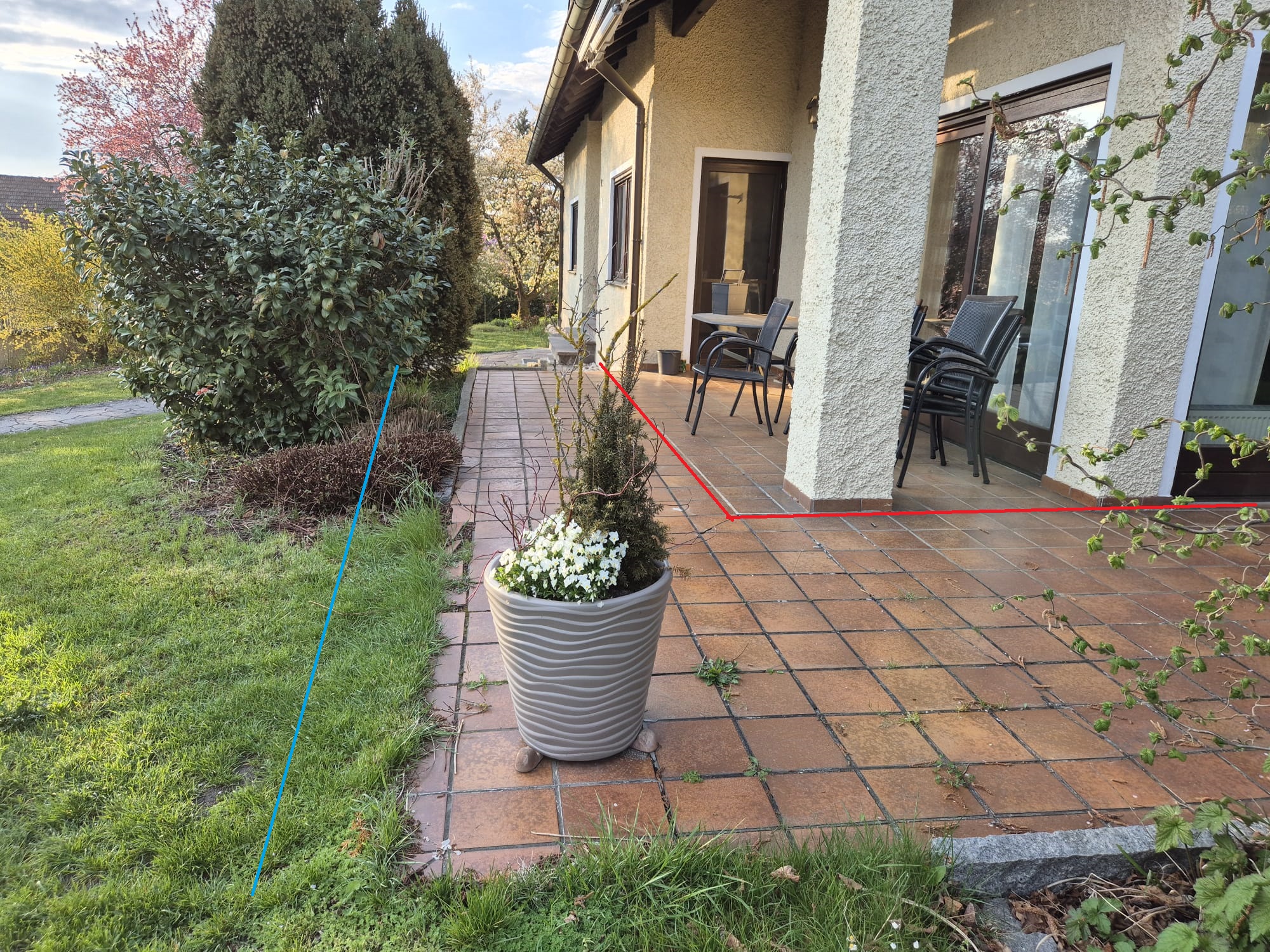
From what I understand, the concrete slab is split into two parts. One part was likely poured as a single piece during the house construction along with the basement ceiling. The column stands on this section and therefore it must remain. The terrace was then extended in two directions with one or two additional separate concrete slabs. You can see the joint (marked in red) in the photos.
As part of the renovation, we would also like to extend the terrace by 1 meter (3 feet) in one direction. See the blue line in the photos.
We are considering removing the tiles and screed and constructing the terrace with the following layers:
1. Patio slabs (4-5 cm thick) laid loosely on gravel.
2. Drainage layer (e.g., Schlüter Troba)
3. Bitumen waterproof membrane (single or double layer) + connection to the house with liquid waterproofing.
4. Old concrete slab
For the 1 meter (3 feet) extension strip, we want a frost-resistant construction with crushed stone, gravel, etc., and then lay the patio slabs loosely as well. No new concrete slab.
What do you generally think of this idea?
Now for our concerns and questions:
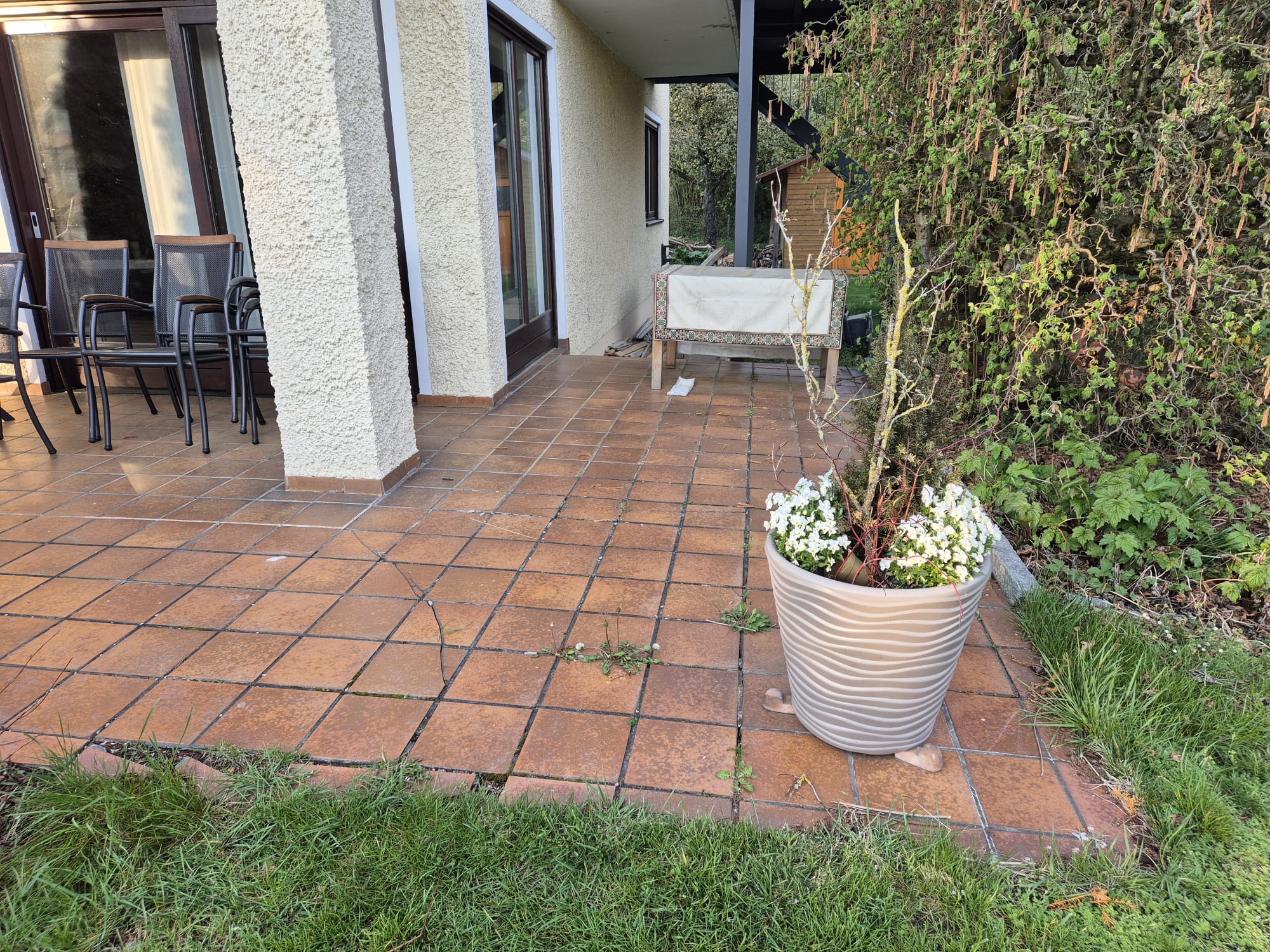
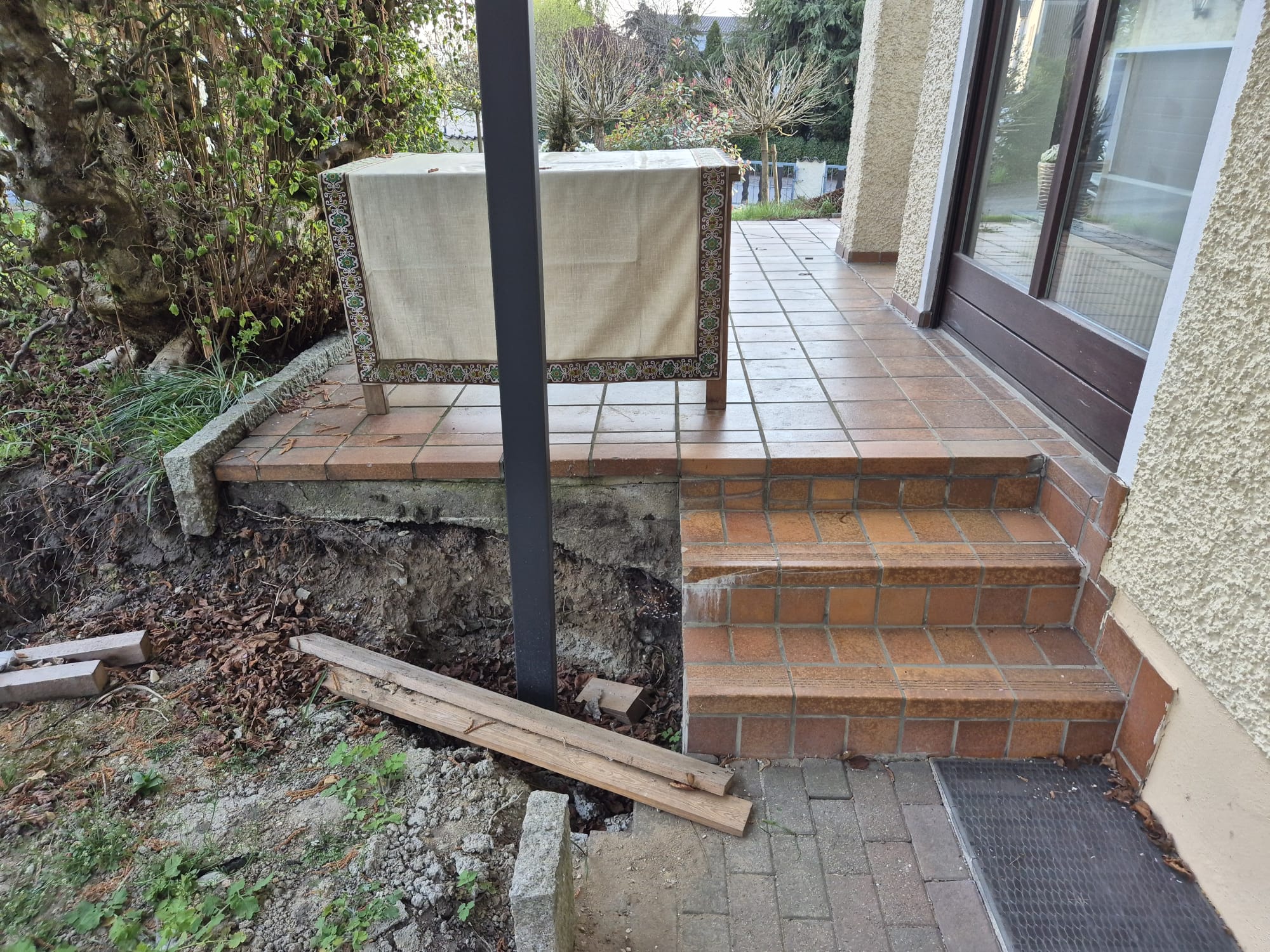
- The concrete slabs not connected to the house may no longer fully rest on the ground. The soil may have settled. See the photo next to the stairs. This means they could eventually sink or tip over. Should we not simply remove this concrete slab completely now and also build a "normal" frost-resistant base with crushed stone, etc.?
- What if, after removing the screed, it turns out that the concrete slab has no slope? Would a new screed with slope be necessary? Apart from the time needed for drying, the overall build-up height might become too low. If only the concrete slab connected to the house remains, could a slope be omitted there since this area is covered (south side)?
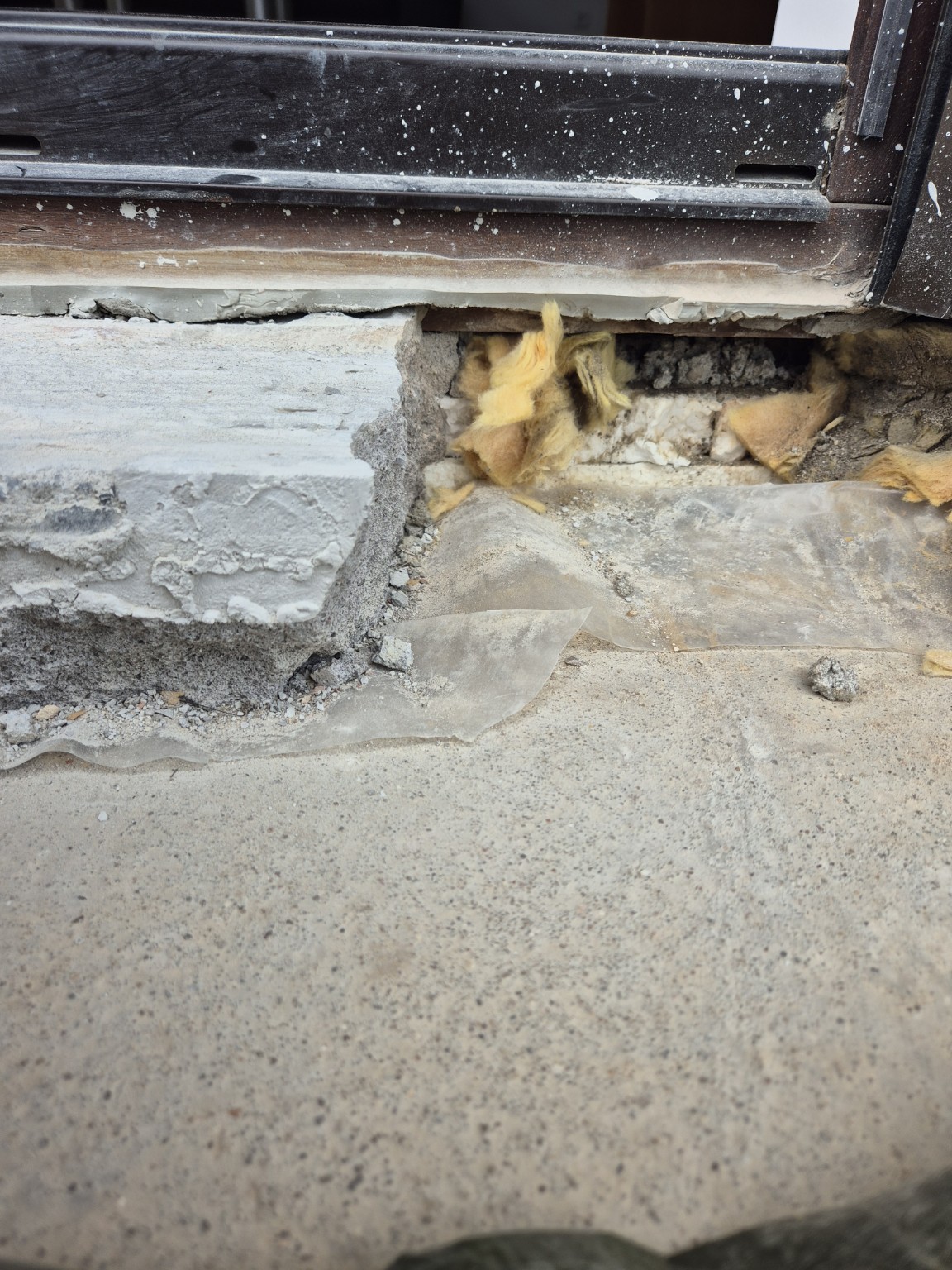
- Connection to the house wall and doors? I fear it might look similar to what I found during the balcony renovation upstairs last year after removing the screed. See last photo (left with screed still in place, right with screed removed). The door threshold then kind of hangs in the air. How is best to support this underneath? With a floor bearing profile (e.g., Purenit)? Is this possible to do later from the outside without problems?
Thank you very much in advance for your answers. I am really grateful for any advice.
The current structure from top to bottom is as follows:
1. Tiles
2. Screed
3. Thin membrane
4. Concrete slab
meaning there is no drainage layer. The membrane is very thin and probably only serves to separate the screed from the concrete slab.
From what I understand, the concrete slab is split into two parts. One part was likely poured as a single piece during the house construction along with the basement ceiling. The column stands on this section and therefore it must remain. The terrace was then extended in two directions with one or two additional separate concrete slabs. You can see the joint (marked in red) in the photos.
As part of the renovation, we would also like to extend the terrace by 1 meter (3 feet) in one direction. See the blue line in the photos.
We are considering removing the tiles and screed and constructing the terrace with the following layers:
1. Patio slabs (4-5 cm thick) laid loosely on gravel.
2. Drainage layer (e.g., Schlüter Troba)
3. Bitumen waterproof membrane (single or double layer) + connection to the house with liquid waterproofing.
4. Old concrete slab
For the 1 meter (3 feet) extension strip, we want a frost-resistant construction with crushed stone, gravel, etc., and then lay the patio slabs loosely as well. No new concrete slab.
What do you generally think of this idea?
Now for our concerns and questions:
- The concrete slabs not connected to the house may no longer fully rest on the ground. The soil may have settled. See the photo next to the stairs. This means they could eventually sink or tip over. Should we not simply remove this concrete slab completely now and also build a "normal" frost-resistant base with crushed stone, etc.?
- What if, after removing the screed, it turns out that the concrete slab has no slope? Would a new screed with slope be necessary? Apart from the time needed for drying, the overall build-up height might become too low. If only the concrete slab connected to the house remains, could a slope be omitted there since this area is covered (south side)?
- Connection to the house wall and doors? I fear it might look similar to what I found during the balcony renovation upstairs last year after removing the screed. See last photo (left with screed still in place, right with screed removed). The door threshold then kind of hangs in the air. How is best to support this underneath? With a floor bearing profile (e.g., Purenit)? Is this possible to do later from the outside without problems?
Thank you very much in advance for your answers. I am really grateful for any advice.
Hi,
The basic idea of waterproofing, drainage membrane, and loose laying is definitely more practical than the traditional approach of screed plus tiles. Especially for buildings from around 1985, you often see exactly the kind of damage you describe. The important thing is that the subfloor is truly stable over the long term; otherwise, even the best surface covering won’t perform well.
I would honestly be cautious about the cantilevered or later-added concrete slabs. If there are already hollow spots or settlements visible, demolition and frost-resistant rebuilding is probably the cleaner solution. Especially when planning an extension by about 1 meter (3 feet), a uniform construction usually makes more sense than carrying over old problematic partial areas. Have you checked whether the slab moves slightly when walked on or sounds hollow?
I wouldn’t install new waterproofing without proper slope, even if it’s covered. Some water will always get in, and standing water is never good in the long run. If the concrete slab has no slope, using slope screed or sloped insulation would actually be the right approach. The build-up height quickly becomes a critical factor here.
I would be particularly careful at the door connection. If, after removing the screed, the threshold is left “free,” it must be properly supported underneath and thermally separated at the same time. Purenit or similar compressive insulation profiles usually work well for this, even when added later from the outside. The waterproofing layer and height relative to the door are typically more critical.
The basic idea of waterproofing, drainage membrane, and loose laying is definitely more practical than the traditional approach of screed plus tiles. Especially for buildings from around 1985, you often see exactly the kind of damage you describe. The important thing is that the subfloor is truly stable over the long term; otherwise, even the best surface covering won’t perform well.
I would honestly be cautious about the cantilevered or later-added concrete slabs. If there are already hollow spots or settlements visible, demolition and frost-resistant rebuilding is probably the cleaner solution. Especially when planning an extension by about 1 meter (3 feet), a uniform construction usually makes more sense than carrying over old problematic partial areas. Have you checked whether the slab moves slightly when walked on or sounds hollow?
I wouldn’t install new waterproofing without proper slope, even if it’s covered. Some water will always get in, and standing water is never good in the long run. If the concrete slab has no slope, using slope screed or sloped insulation would actually be the right approach. The build-up height quickly becomes a critical factor here.
I would be particularly careful at the door connection. If, after removing the screed, the threshold is left “free,” it must be properly supported underneath and thermally separated at the same time. Purenit or similar compressive insulation profiles usually work well for this, even when added later from the outside. The waterproofing layer and height relative to the door are typically more critical.