
Hello everyone,
We have a terrace and a surrounding walkway around our house made of precast concrete slabs and want to replace them with more attractive slabs. To save costs, I plan to do the work myself.
My plan for the base is to remove 5-10 cm (2-4 inches) of the current gravel-sand subbase and apply a new layer of gravel. For aesthetic reasons, we are leaning towards using porcelain stoneware tiles, loosely laid on gravel bedding. What is your opinion on this: will the tiles constantly shift, or can this be done properly?
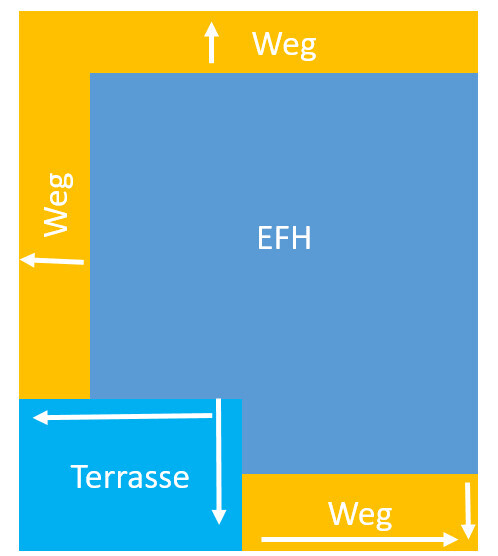
I am currently planning without steps, which means we need to compensate for small differences in height. We would design the terrace itself with a slope of 1-2% away from the house. The connected walkways also have a slope of about 2% away from the terrace. Is it easy to manage this with loose-laid gravel (considering there will be an edge between the terrace and the walkway)? In the sketch, I have indicated the terrace, walkways, and slopes (with arrows).
What do you think, does this make sense? Do you perhaps have a better idea on how to solve this?
Thank you very much and best regards
We have a terrace and a surrounding walkway around our house made of precast concrete slabs and want to replace them with more attractive slabs. To save costs, I plan to do the work myself.
My plan for the base is to remove 5-10 cm (2-4 inches) of the current gravel-sand subbase and apply a new layer of gravel. For aesthetic reasons, we are leaning towards using porcelain stoneware tiles, loosely laid on gravel bedding. What is your opinion on this: will the tiles constantly shift, or can this be done properly?
I am currently planning without steps, which means we need to compensate for small differences in height. We would design the terrace itself with a slope of 1-2% away from the house. The connected walkways also have a slope of about 2% away from the terrace. Is it easy to manage this with loose-laid gravel (considering there will be an edge between the terrace and the walkway)? In the sketch, I have indicated the terrace, walkways, and slopes (with arrows).
What do you think, does this make sense? Do you perhaps have a better idea on how to solve this?
Thank you very much and best regards
schlukkl schrieb:
Hi everyone,
thanks again for the advice here. To keep you updated on what has happened, a quick update:
* The metal lawn edging is installed on 10 cm (4 inches) of concrete plus a concrete wedge plus 10 cm (4 inches) of compacted crushed stone (somewhat visible in the picture to the left of the metal edge).
* Filled up with crushed stone and the sand that was there before. Compacted several times. Unfortunately, the sand is not as permeable as hoped and contains a certain amount of “clayey” material. I hope this doesn’t cause problems. I also laid water pipes and cables in the crushed stone.
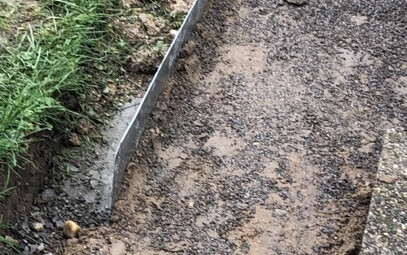
* I started behind the house at the “path.” The first 60x120 cm (24x48 inches) slabs are laid on 5-10 cm (2-4 inches) of grit and a grit bedding layer so the slabs shift less and don’t creak.
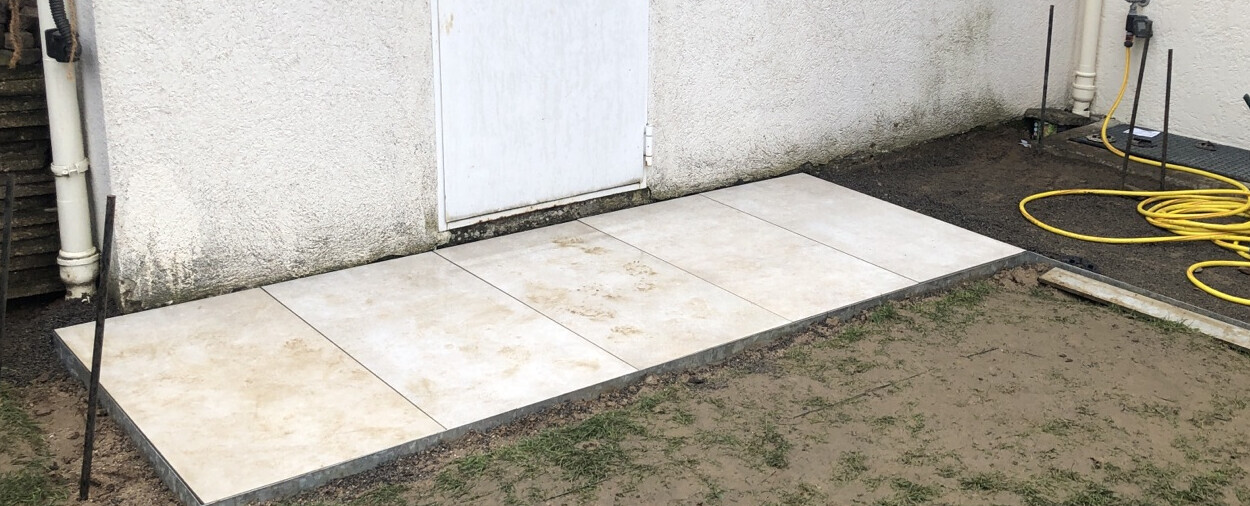
So far, the installation is going quite well. I hope it stays this stable.
Good luck,
Lukas Hey Lukas,
thanks for your feedback 🙂 It already looks very good. We like the slabs. Have you been able to lay more since then? Is the effort manageable? I also think your solution with the lawn edging is well done. We debated back and forth about this as well, since there are plenty of options — in the end, it was the classic 8 cm (3 inch) curb stone for us 🙂
Great work! Keep it up. Looking forward to more pictures, especially of the terrace 😉