
Hello everyone,
We have a terrace and a surrounding walkway around our house made of precast concrete slabs and want to replace them with more attractive slabs. To save costs, I plan to do the work myself.
My plan for the base is to remove 5-10 cm (2-4 inches) of the current gravel-sand subbase and apply a new layer of gravel. For aesthetic reasons, we are leaning towards using porcelain stoneware tiles, loosely laid on gravel bedding. What is your opinion on this: will the tiles constantly shift, or can this be done properly?
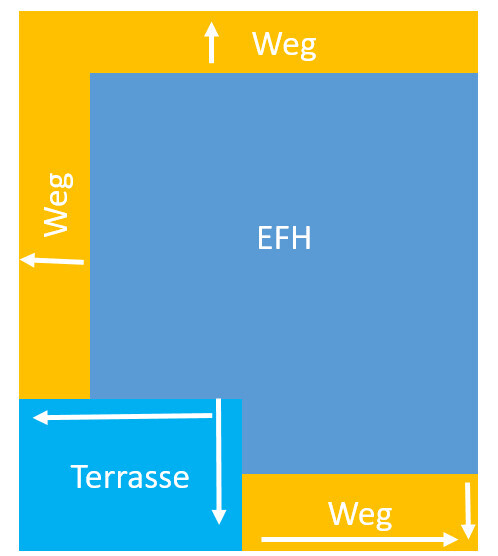
I am currently planning without steps, which means we need to compensate for small differences in height. We would design the terrace itself with a slope of 1-2% away from the house. The connected walkways also have a slope of about 2% away from the terrace. Is it easy to manage this with loose-laid gravel (considering there will be an edge between the terrace and the walkway)? In the sketch, I have indicated the terrace, walkways, and slopes (with arrows).
What do you think, does this make sense? Do you perhaps have a better idea on how to solve this?
Thank you very much and best regards
We have a terrace and a surrounding walkway around our house made of precast concrete slabs and want to replace them with more attractive slabs. To save costs, I plan to do the work myself.
My plan for the base is to remove 5-10 cm (2-4 inches) of the current gravel-sand subbase and apply a new layer of gravel. For aesthetic reasons, we are leaning towards using porcelain stoneware tiles, loosely laid on gravel bedding. What is your opinion on this: will the tiles constantly shift, or can this be done properly?
I am currently planning without steps, which means we need to compensate for small differences in height. We would design the terrace itself with a slope of 1-2% away from the house. The connected walkways also have a slope of about 2% away from the terrace. Is it easy to manage this with loose-laid gravel (considering there will be an edge between the terrace and the walkway)? In the sketch, I have indicated the terrace, walkways, and slopes (with arrows).
What do you think, does this make sense? Do you perhaps have a better idea on how to solve this?
Thank you very much and best regards
W
WilderSueden11 Oct 2022 23:03Usually, gravel is used, but compacted sand should also be sufficient to support foot traffic and allow water to drain well. The loads are not very high; we are talking about a person with luggage weighing around 100 kilograms (220 pounds), distributed over the surface of the slab. If this has lasted for many years without frost damage, I wouldn’t excavate everything. The condition, however, would be that the new slabs fit the dimensions of the sand base.
For a new installation, I wouldn’t cut costs here. But if everything is already in place, I think that would be excessive for a footpath.
For a new installation, I wouldn’t cut costs here. But if everything is already in place, I think that would be excessive for a footpath.
Thank you for your quick assessment.
From this, I have derived the plan:
For the terrace
* Complete reconstruction of the base and sub-base
* Excavation
* Gravel layer
* Compaction
* Crushed stone layer
For the walkways:
* Restore 30cm (12 inches) sand/crushed stone mixture
* Near the curbstones, I should probably compact well. Do you have any tips for compaction?
** Use a plate compactor to compact everything?
** Use a vibrating tamper, especially in the areas where I had to dig?
* Then about 5–8cm (2–3 inches) crushed stone layer (I need 2cm (1 inch) more because the old slabs were 2cm (1 inch) thicker)
From this, I have derived the plan:
For the terrace
* Complete reconstruction of the base and sub-base
* Excavation
* Gravel layer
* Compaction
* Crushed stone layer
For the walkways:
* Restore 30cm (12 inches) sand/crushed stone mixture
* Near the curbstones, I should probably compact well. Do you have any tips for compaction?
** Use a plate compactor to compact everything?
** Use a vibrating tamper, especially in the areas where I had to dig?
* Then about 5–8cm (2–3 inches) crushed stone layer (I need 2cm (1 inch) more because the old slabs were 2cm (1 inch) thicker)
Hello everyone,
I have now excavated the area around the curbstones to be able to set the concrete wedge.
I have found conflicting information about whether a frost protection layer should also be placed under the concrete wedge.
I had assumed it would be about 10cm (4 inches) of well-compacted mineral aggregate.
That is correct, right?
I have now excavated the area around the curbstones to be able to set the concrete wedge.
I have found conflicting information about whether a frost protection layer should also be placed under the concrete wedge.
I had assumed it would be about 10cm (4 inches) of well-compacted mineral aggregate.
That is correct, right?
schlukkl schrieb:
Hello everyone,
I have now excavated the area around the edging stones to be able to place the concrete kick strip.
I find conflicting information about whether a frost protection layer should also be placed under the concrete kick strip.
I was assuming about 10cm (4 inches) of well-compacted mineral aggregate.
That’s correct, right? Hello,
yes, exactly. Minimum 10cm (4 inches). The edging stones should, of course, rest on a stable base. There are many options for this. Usually, you excavate the entire width and create a suitable load-bearing layer. Then set the edging stones (path width), and once these are firmly in place, build up the remaining height (bottom edge of the gravel). Then install the gravel layer and lay the paving slabs 🙂.
What kind of edging stones will you be using? What are their dimensions in length, width, and height?
There should also be a minimum of 5 to 10cm (2 to 4 inches) of concrete under the edging stones, depending on their size.
deezey schrieb:
Hello,
yes, exactly. At least 10cm (4 inches). The edge stones should, of course, also be placed on a solid base. There are naturally many options again. Generally, level according to the full width and create a correspondingly good load-bearing layer. Set the edge stones (path width), and once they are "fixed," build up the remaining height (bottom edge of the gravel). Then install the gravel layer and lay the pavers 🙂.
What kind of edge stones will you be using? Dimensions like length, width & height?
There should also be at least 5-10cm (2-4 inches) of concrete underneath the edge stones, depending on the dimensions.I decided to use metal lawn edging as the "edge stones" because, in my opinion, all classic edge stones simply do not match the look of the pavers. They are about 120cm (47 inches) long and 20cm (8 inches) high (2mm thick). My plan is: 10cm (4 inches) of mineral aggregate mix, 5-10cm (2-4 inches) of concrete beneath the edging. That is why I excavated 40cm (16 inches).
I would then backfill with soil on the outside and inside add 10cm (4 inches) of mineral aggregate mix and 5-10cm (2-4 inches) of gravel layer.
Does that make sense?
Hi everyone,
thanks again for the advice here. To keep you updated on what has happened, a brief update:
* The metal lawn edges are installed on 10cm (4 inch) concrete + concrete wedge + 10cm (4 inch) compacted gravel (somewhat visible in the picture to the left of the metal edge).
* Filled with gravel and the sand that was there before. Compacted several times. Unfortunately, the sand is not as permeable as hoped and has a certain "clayey" component. I hope that doesn’t cause problems. I also laid water pipes and cables in the gravel layer.
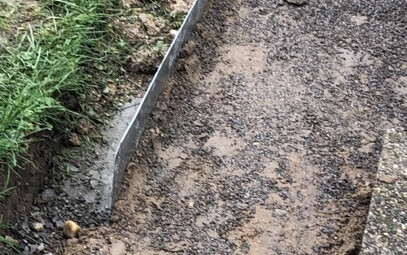
* I started behind the house at the “path.” The first 60x120cm (24x47 inch) slabs are laid on 5-10cm (2-4 inch) of crushed stone and bedding gravel so the slabs shift less against each other and don’t creak.
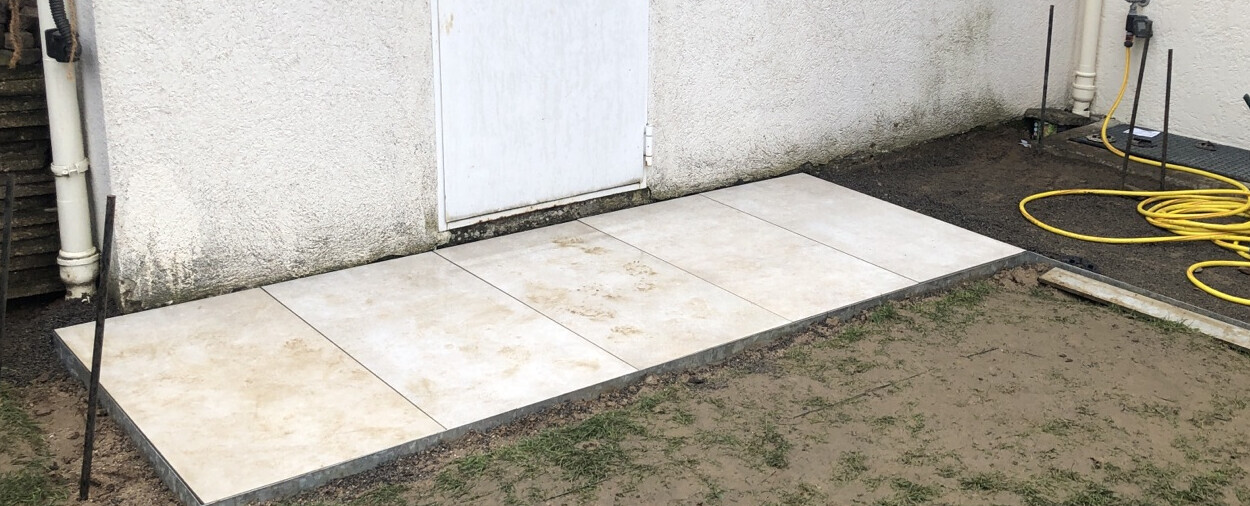
So far, the laying is going quite well. I hope it stays stable like this.
Good luck
Lukas
thanks again for the advice here. To keep you updated on what has happened, a brief update:
* The metal lawn edges are installed on 10cm (4 inch) concrete + concrete wedge + 10cm (4 inch) compacted gravel (somewhat visible in the picture to the left of the metal edge).
* Filled with gravel and the sand that was there before. Compacted several times. Unfortunately, the sand is not as permeable as hoped and has a certain "clayey" component. I hope that doesn’t cause problems. I also laid water pipes and cables in the gravel layer.
* I started behind the house at the “path.” The first 60x120cm (24x47 inch) slabs are laid on 5-10cm (2-4 inch) of crushed stone and bedding gravel so the slabs shift less against each other and don’t creak.
So far, the laying is going quite well. I hope it stays stable like this.
Good luck
Lukas
Similar topics