
ᐅ Terrace Planning for an End-Row House with a Large Garden – What to Consider?
Created on: 4 Aug 2025 13:41
B
Bauherrin123
Hello everyone,
we are now moving on to the outdoor area. We have an end-terrace house with a relatively large garden but a small budget. Still, we want to build a large, beautiful terrace.
We have contacted various craftsmen, gardeners, and companies with offers ranging from $5,000 to $25,000 (or equivalent), so all kinds of quotes.
I need some ideas now:
Below is the sketch: The main point is that I definitely want two terraces: one main terrace along the house in the front, 28m² (301 sq ft), and a smaller one on the side, 12m² (129 sq ft). Now I want to connect the terraces, and I have heard different opinions on this. Some recommend offsetting the terrace stones as a pathway, etc. I have actually decided to close off the corner, meaning to expand the main terrace on the side, creating a corner terrace. Sometimes I worry that it might not look good and I’m unsure. We have a large family; I want large tables with chairs, swings, and more solid surface, but without overdoing it. Also, I don’t want to have to take care of a huge garden, so that would be practical for me. The neighbor was not allowed to build wider or bigger due to property division rules limiting the sealed area, but for Jens, that should not be a problem.
Now my question to you:
How would you plan the terrace? The bigger it is, the more expensive it will be.
What kind of slabs do you have, what material and installation method? I have quotes for 2cm (3/4 inch) slabs set in concrete or 4cm (1 1/2 inch) slabs on a gravel/sand base. I want large slabs.
I would like light-colored slabs with anthracite edging. Regarding roofing, I’m not sure if I’m allowed to build 7m (23 ft) wide and whether I can exceed the building limit line. I would like about 7 by 4m (23 by 13 ft)... but that would be 1m (3 ft) over the building limit. On the side, I have already enlarged the living space with a bay window under a special permit; I don’t know if I can add a roof there too. Now I need advice, ideas, tips—I’m a bit lost about what to consider, etc.
I’m also happy to hear about your experiences with terraces, what mistakes you made, what worked well, what you would do differently. Especially, what did your terraces cost.
Thank you
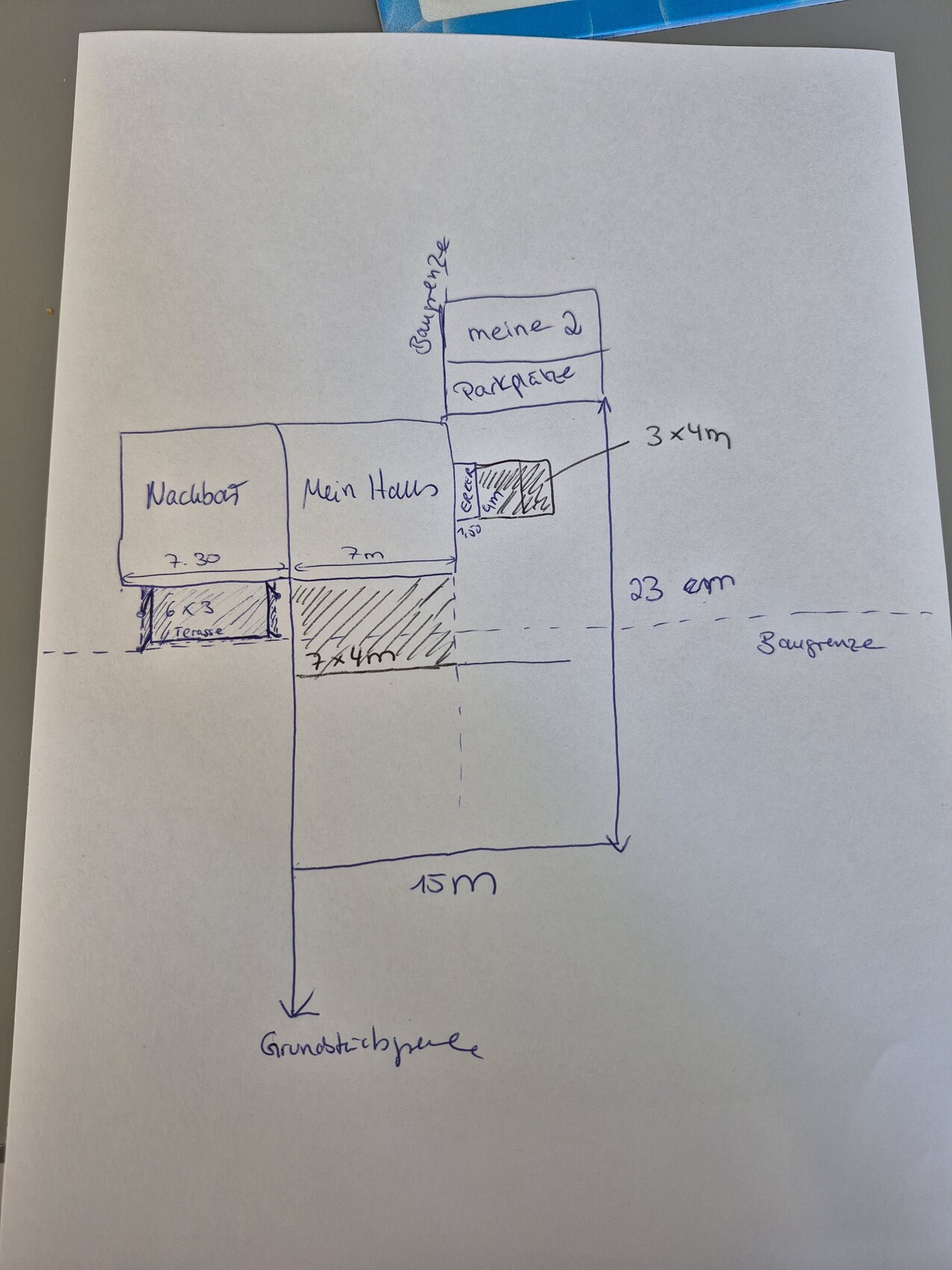
we are now moving on to the outdoor area. We have an end-terrace house with a relatively large garden but a small budget. Still, we want to build a large, beautiful terrace.
We have contacted various craftsmen, gardeners, and companies with offers ranging from $5,000 to $25,000 (or equivalent), so all kinds of quotes.
I need some ideas now:
Below is the sketch: The main point is that I definitely want two terraces: one main terrace along the house in the front, 28m² (301 sq ft), and a smaller one on the side, 12m² (129 sq ft). Now I want to connect the terraces, and I have heard different opinions on this. Some recommend offsetting the terrace stones as a pathway, etc. I have actually decided to close off the corner, meaning to expand the main terrace on the side, creating a corner terrace. Sometimes I worry that it might not look good and I’m unsure. We have a large family; I want large tables with chairs, swings, and more solid surface, but without overdoing it. Also, I don’t want to have to take care of a huge garden, so that would be practical for me. The neighbor was not allowed to build wider or bigger due to property division rules limiting the sealed area, but for Jens, that should not be a problem.
Now my question to you:
How would you plan the terrace? The bigger it is, the more expensive it will be.
What kind of slabs do you have, what material and installation method? I have quotes for 2cm (3/4 inch) slabs set in concrete or 4cm (1 1/2 inch) slabs on a gravel/sand base. I want large slabs.
I would like light-colored slabs with anthracite edging. Regarding roofing, I’m not sure if I’m allowed to build 7m (23 ft) wide and whether I can exceed the building limit line. I would like about 7 by 4m (23 by 13 ft)... but that would be 1m (3 ft) over the building limit. On the side, I have already enlarged the living space with a bay window under a special permit; I don’t know if I can add a roof there too. Now I need advice, ideas, tips—I’m a bit lost about what to consider, etc.
I’m also happy to hear about your experiences with terraces, what mistakes you made, what worked well, what you would do differently. Especially, what did your terraces cost.
Thank you
N
nordanney16 Nov 2025 14:21Bauherrin123 schrieb:
Which moisture is supposed to come up from below?Any moisture during rain. It can "rise" up (at least potentially). This does not happen with drainage concrete / no-fines concrete.Just take a look at the many threads here where water rises up the house walls... This can also happen with a concrete slab.
B
Bauherrin12316 Nov 2025 18:24nordanney schrieb:
No, it’s not single-grain mortar. It’s drainage concrete with small aggregate – but that’s something you can also use.
Why make something like that yourself?
P.S. Why add trass? Are you worried about efflorescence on natural stone? Otherwise, it doesn’t harm, but it costs more and offers no advantage for porcelain stoneware. We have porcelain stoneware slabs. No, we don’t want to mix anything ourselves; we just want to tell the landscaper what to use. There are so many different options, but I don’t like the one he wants to use, and as a layperson I don’t understand much or everyone says something different.
The fact is, I don’t want a dense screed with closed joints.
He should use 30cm (12 inches) of gravel topped with a permeable surface—mortar or single-grain mortar or trass or whatever. The water-permeable option is something he knows: mixing gravel with cement, 4:1 ratio. I only mentioned trass because I had landscapers who laid it in trass cement mortar since it’s supposed to be good… according to DIN standards or something, I don’t know.
To summarize:
I have the choice between:
1. Single-grain mortar
2. Trass cement mortar
3. Drainage concrete
Are these three good options? How should they be prepared? He will mix it on site. The big problem is that starting Wednesday, temperatures will drop below freezing.
B
Bauherrin12316 Nov 2025 18:26nordanney schrieb:
Any moisture from rain can be drawn upward (at least that can happen). This does not occur with drainage concrete / single-grain concrete.
Take a look at all the threads here discussing water rising up the exterior walls... This can also happen with a concrete slab. Yes, that’s why he shouldn’t use screed concrete. But regarding the mortar washing out, I’m not so sure—I think it would start to weaken after a few years.
N
nordanney16 Nov 2025 19:12Bauherrin123 schrieb:
Are these three good? It doesn’t really matter whether it’s 1 or 3.
And also 2, at least if by number 3 you mean the one with trass cement mortar. Otherwise, in the end it’s just screed with trass.
Bauherrin123 schrieb:
Are these three good? How are they prepared? He mixes it here on site. 1 and 3 are almost identical. Trass is simply an additive that is mixed into concrete to make it more frost resistant and to prevent efflorescence. You can also make drain concrete with trass.
I guess you mean drain concrete with trass, right?
Then the end result is practically the same.
Prepared? Not at all.
Bauherrin123 schrieb:
from Wednesday below freezing. Then work simply stops. Frost means work stoppage. The general rule is a minimum of about 5°C (41°F). Otherwise, you need heated concrete, which the landscape gardener usually can’t manage on site. And work won’t happen on frozen ground regardless of air temperature.
I would just take it easy and accept that work will probably continue calmly next year.
B
Bauherrin12316 Nov 2025 19:25nordanney schrieb:
It doesn’t matter whether it’s 1 or 3.
And also 2, at least if you mean number 3 with Trass cement mortar. Otherwise, in the end, it’s just screed with Trass.
1 and 3 are almost identical. Trass is simply an additive mixed into the concrete to make it frost-resistant and prevent efflorescence. You can also make drain concrete with Trass.
I guess you mean drain concrete with Trass, right?
Then the results are practically the same.
Prepared? Not at all.
Then no work will be done. Frost means construction stop. Here too, the temperature should preferably be 5°C (41°F) or higher. Otherwise, you need heated concrete, which the landscaping contractor on site won’t manage. And work won’t be done on frozen ground regardless of the air temperature.
I’d just relax and accept that it will probably continue calmly next year. The problem is, I have already had the terrace slabs delivered. I believe I can return them until November 25. Kind of annoying, but I’m seriously considering sending them back since I can’t check if they’re flawless and plan to continue next year.
Tomorrow the gravel will arrive, and the house wall with the cavity membrane and compacting, etc., can still be done. That way, the gravel will be there, the house wall protected, and you can walk on it again; right now everything is still exposed.
Regardless, I am not familiar with what mixes with what. I find it all so confusing, especially since the landscaping contractors first say one thing and then, once you place the order, suddenly different materials are used.
Oh man, I’m really annoyed… The worst part is, I still have to supervise everything to make sure they actually do what I ask to change.
B
Bauherrin12318 Nov 2025 16:17Hello everyone,
After a long rough start, we finally found a landscaper who knows what they’re doing. They compacted the gravel, about 30cm (12 inches) deep, using a 300-kilogram (660-pound) machine that compacts with a force equivalent to around 5 tons or so. On top of that, they mixed cement with gravel (2-5mm) by hand with some water, laid and leveled it, and then installed the tiles with adhesive. They didn’t put adhesive on the corners of the panels (120 by 60 cm (47 by 24 inches))—is that normal? He said it would spill over otherwise. Otherwise, I’m very happy with both the choice of tiles and the installation method, as long as there are no problems later with shifting or sinking. The only issue now is the temperature. Tomorrow it’s supposed to rain and snow, and it’s 2°C (36°F). The next few nights are forecasted to drop to minus 1°C (30°F). He says it won’t cause any problems, but I would prefer to stop work under these conditions.

After a long rough start, we finally found a landscaper who knows what they’re doing. They compacted the gravel, about 30cm (12 inches) deep, using a 300-kilogram (660-pound) machine that compacts with a force equivalent to around 5 tons or so. On top of that, they mixed cement with gravel (2-5mm) by hand with some water, laid and leveled it, and then installed the tiles with adhesive. They didn’t put adhesive on the corners of the panels (120 by 60 cm (47 by 24 inches))—is that normal? He said it would spill over otherwise. Otherwise, I’m very happy with both the choice of tiles and the installation method, as long as there are no problems later with shifting or sinking. The only issue now is the temperature. Tomorrow it’s supposed to rain and snow, and it’s 2°C (36°F). The next few nights are forecasted to drop to minus 1°C (30°F). He says it won’t cause any problems, but I would prefer to stop work under these conditions.
Similar topics