
ᐅ Terrace Planning for an End-Row House with a Large Garden – What to Consider?
Created on: 4 Aug 2025 13:41
B
Bauherrin123
Hello everyone,
we are now moving on to the outdoor area. We have an end-terrace house with a relatively large garden but a small budget. Still, we want to build a large, beautiful terrace.
We have contacted various craftsmen, gardeners, and companies with offers ranging from $5,000 to $25,000 (or equivalent), so all kinds of quotes.
I need some ideas now:
Below is the sketch: The main point is that I definitely want two terraces: one main terrace along the house in the front, 28m² (301 sq ft), and a smaller one on the side, 12m² (129 sq ft). Now I want to connect the terraces, and I have heard different opinions on this. Some recommend offsetting the terrace stones as a pathway, etc. I have actually decided to close off the corner, meaning to expand the main terrace on the side, creating a corner terrace. Sometimes I worry that it might not look good and I’m unsure. We have a large family; I want large tables with chairs, swings, and more solid surface, but without overdoing it. Also, I don’t want to have to take care of a huge garden, so that would be practical for me. The neighbor was not allowed to build wider or bigger due to property division rules limiting the sealed area, but for Jens, that should not be a problem.
Now my question to you:
How would you plan the terrace? The bigger it is, the more expensive it will be.
What kind of slabs do you have, what material and installation method? I have quotes for 2cm (3/4 inch) slabs set in concrete or 4cm (1 1/2 inch) slabs on a gravel/sand base. I want large slabs.
I would like light-colored slabs with anthracite edging. Regarding roofing, I’m not sure if I’m allowed to build 7m (23 ft) wide and whether I can exceed the building limit line. I would like about 7 by 4m (23 by 13 ft)... but that would be 1m (3 ft) over the building limit. On the side, I have already enlarged the living space with a bay window under a special permit; I don’t know if I can add a roof there too. Now I need advice, ideas, tips—I’m a bit lost about what to consider, etc.
I’m also happy to hear about your experiences with terraces, what mistakes you made, what worked well, what you would do differently. Especially, what did your terraces cost.
Thank you
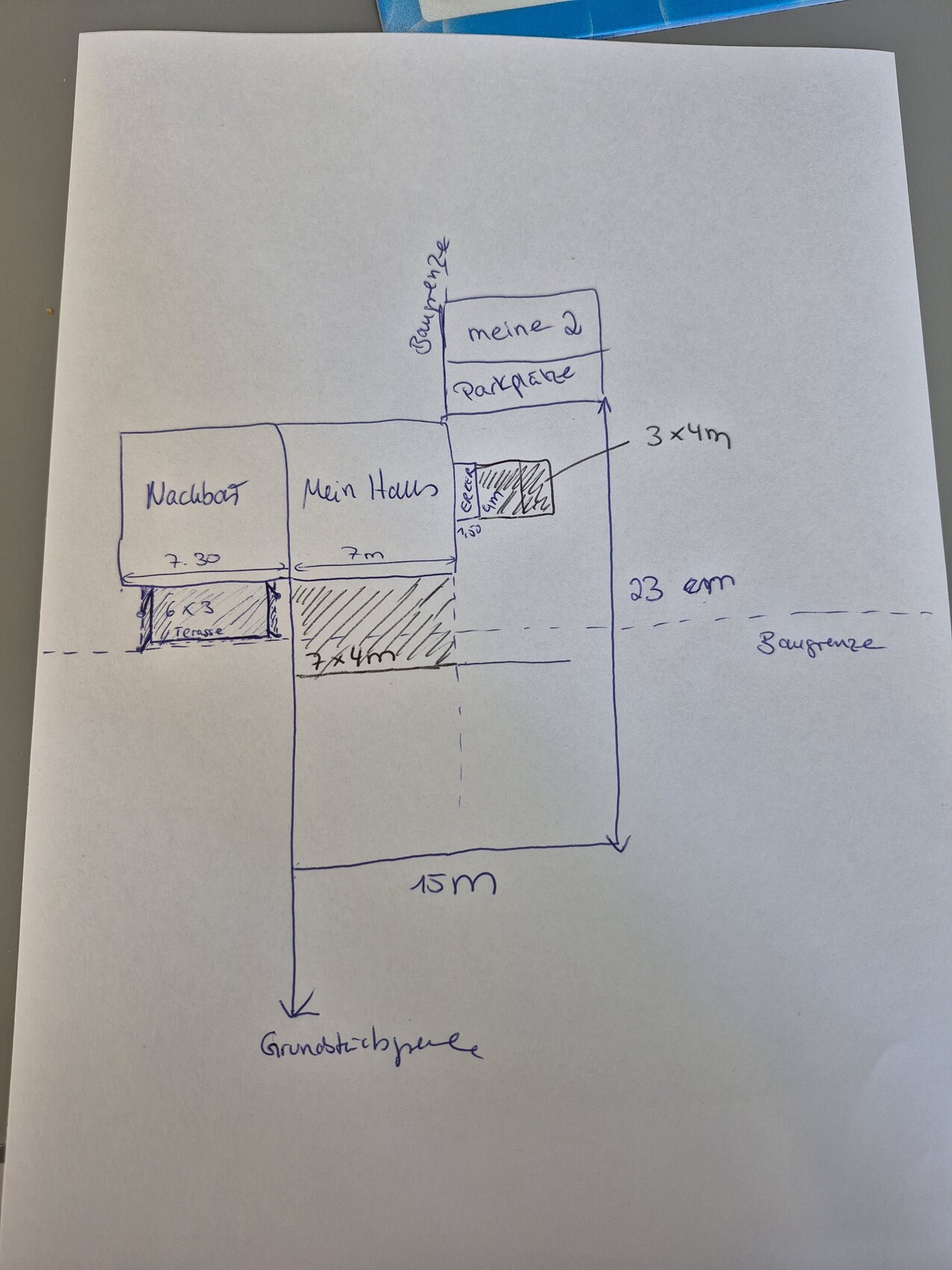
we are now moving on to the outdoor area. We have an end-terrace house with a relatively large garden but a small budget. Still, we want to build a large, beautiful terrace.
We have contacted various craftsmen, gardeners, and companies with offers ranging from $5,000 to $25,000 (or equivalent), so all kinds of quotes.
I need some ideas now:
Below is the sketch: The main point is that I definitely want two terraces: one main terrace along the house in the front, 28m² (301 sq ft), and a smaller one on the side, 12m² (129 sq ft). Now I want to connect the terraces, and I have heard different opinions on this. Some recommend offsetting the terrace stones as a pathway, etc. I have actually decided to close off the corner, meaning to expand the main terrace on the side, creating a corner terrace. Sometimes I worry that it might not look good and I’m unsure. We have a large family; I want large tables with chairs, swings, and more solid surface, but without overdoing it. Also, I don’t want to have to take care of a huge garden, so that would be practical for me. The neighbor was not allowed to build wider or bigger due to property division rules limiting the sealed area, but for Jens, that should not be a problem.
Now my question to you:
How would you plan the terrace? The bigger it is, the more expensive it will be.
What kind of slabs do you have, what material and installation method? I have quotes for 2cm (3/4 inch) slabs set in concrete or 4cm (1 1/2 inch) slabs on a gravel/sand base. I want large slabs.
I would like light-colored slabs with anthracite edging. Regarding roofing, I’m not sure if I’m allowed to build 7m (23 ft) wide and whether I can exceed the building limit line. I would like about 7 by 4m (23 by 13 ft)... but that would be 1m (3 ft) over the building limit. On the side, I have already enlarged the living space with a bay window under a special permit; I don’t know if I can add a roof there too. Now I need advice, ideas, tips—I’m a bit lost about what to consider, etc.
I’m also happy to hear about your experiences with terraces, what mistakes you made, what worked well, what you would do differently. Especially, what did your terraces cost.
Thank you
W
wiltshire25 Aug 2025 17:27That sounds like you are speaking at the caseworker level. For decisions outside the standard process, you need decision-makers with the appropriate authority. The caseworkers then implement what has been decided.
M
MachsSelbst25 Aug 2025 19:02What is a decision-maker supposed to decide with a competency framework here? 1.75 m (5 feet 9 inches) is acceptable, anything beyond that is not.
It's quite funny that you, who don’t want to build with an architect, are now getting creative about how to bypass the building permit / planning permission... with add-on parts that can be mounted and removed with wing screws when an inspection comes, or something similar.
By the way, a competent manager does not override or revise the decisions of their employees as long as those decisions are correct or within their discretion. Even if you chat about wing screws and sunshades over coffee and cake...
Did you get this from "Project management for beginners, this might work"?
It's quite funny that you, who don’t want to build with an architect, are now getting creative about how to bypass the building permit / planning permission... with add-on parts that can be mounted and removed with wing screws when an inspection comes, or something similar.
By the way, a competent manager does not override or revise the decisions of their employees as long as those decisions are correct or within their discretion. Even if you chat about wing screws and sunshades over coffee and cake...
Did you get this from "Project management for beginners, this might work"?
W
wiltshire25 Aug 2025 20:14MachsSelbst schrieb:
What is a decision-maker supposed to decide here with a competence framework?An exemption permit, of course, what else? That often works in my environment. We have already established that we come from different experience backgrounds.
MachsSelbst schrieb:
By the way, a competent manager does not override or revoke the decisions of their employees,Agreed. That is exactly why it makes sense to speak directly with decision-makers and not start with the technical staff. The sequence was wrong here. Reversing that is challenging, as everyone needs to be able to save face.MachsSelbst schrieb:
It’s funny that you, who do not want to build with an architectWhere do you pull that out of thin air again...B
Bauherrin12326 Aug 2025 07:35wiltshire schrieb:
That sounds like you are speaking at the administrative level.
For decisions outside the regular process, you need decision-makers with the appropriate authority.
The administrative staff then implement what has been decided. No, definitely not. I am speaking with decision-makers. They might also be overloaded with work or other issues, but the work ethic and my experiences with them have been just crazy. They hardly make any statements, don’t provide assistance, and direct you toward the easiest route for themselves or the one that avoids any new requests. You have to pull everything out of them. Only when they know that the paperwork is submitted and a request exists, and they must take action, do they get active, then they talk, review, advise, get familiar with the case, and then I negotiate. Before that, they barely manage to answer an email. As I said, it was similar with the building permit / planning permission. We had a plot of land that was divided between three parties, plus three parking spaces with separate plot numbers assigned to two houses, and we had a shared area that was divided again among all three. So our property actually consists of three separate plots. For this reason, we were a particularly difficult case for the building authority. At first, I defended them because our architect was no better. I dealt with the authority myself, then I noticed that every action they had to take was considered a burden. The best example was when one employee was working from home. At home, they had no computer or files, no access to anything else, no phone, and they couldn’t receive any deliveries because they only had a private number… So what do they actually do while working from home? Incidentally, they are only available by phone or in person twice a week, which means I have to take time off during my work hours. Maybe this is the case in every authority, but I have never seen such a work ethic before. The staff are still polite and friendly, though. I always smiled but cursed our architect whenever the authority did, because a thousand documents were always missing to just get through. Yes, the architect could have just submitted something even if it didn’t make much sense, but they weren’t without fault either, and the architect had never dealt with such a building authority before.
Bauherrin123 schrieb:
They hardly provide any information, don’t really help, and usually recommend the path that requires the least effort from them or avoids receiving a request altogether. You have to get everything out of them bit by bit. Only when they know that the paperwork is complete and a formal request has been submitted—and that they must take action—do they start to talk, look into things, advise, familiarize themselves with the case, and then negotiate.It should also be noted that the building authority is not fundamentally your advisory office but is "only" responsible for approvals and inspections of construction processes. That is why architects exist, who should prepare the appropriate documents.The situation is similar with tax authorities, as they are not responsible for providing advice—that is the role of tax consultants.
Of course, some employees are happy to give tips and recommendations, but especially in the case of building plans, the entire project should be submitted in writing, since answers to partial questions are often misleading.

They are not allowed to provide consultations. However, they must answer truthfully.
So, if you go and ask, "Can I build something 4m (13 feet) like this, is it likely to be approved?", they have to tell the truth when they respond. But they are not required to say, "This is how you have to build it to get approval." That’s why they usually only give verbal answers so they can avoid being pinned down to an immediate statement. Alternatively, they might just say you should submit a preliminary inquiry because the matter is too complicated.
Personally, under the circumstances you described, I would build without a fixed roof and instead use a fixed or partially extendable sunshade. If you really want to sit outside in the rain, either a freestanding pavilion or a 1.75m (5.7 feet) roof extension would work—you can sit under that in the rain as long as the wind isn’t blowing from the front.
But well, you have already asked now. I hope it gets approved, but I’m not very optimistic. It’s easier for them to reject it if your description is accurate.
So, if you go and ask, "Can I build something 4m (13 feet) like this, is it likely to be approved?", they have to tell the truth when they respond. But they are not required to say, "This is how you have to build it to get approval." That’s why they usually only give verbal answers so they can avoid being pinned down to an immediate statement. Alternatively, they might just say you should submit a preliminary inquiry because the matter is too complicated.
Personally, under the circumstances you described, I would build without a fixed roof and instead use a fixed or partially extendable sunshade. If you really want to sit outside in the rain, either a freestanding pavilion or a 1.75m (5.7 feet) roof extension would work—you can sit under that in the rain as long as the wind isn’t blowing from the front.
But well, you have already asked now. I hope it gets approved, but I’m not very optimistic. It’s easier for them to reject it if your description is accurate.
Similar topics