
ᐅ T8 (with perlite insulation) instead of KfW70 heating system? How to improve energy performance?
Created on: 30 Oct 2012 07:32
S
spiderchristianS
spiderchristian30 Oct 2012 07:32Hello everyone,
I had my house calculated with a T8 36.5 wall filled with perlite and received the following results:
Annual primary energy demand qp [kWh/(m²a)] 53.79
Transmission heat loss Ht [W/(m²K)] 0.357
Therefore, it does not meet the KfW70 standard, since the transmission heat loss is not below 0.336.
Is this possible, and what measures could I take to achieve better values?
Info: Heating system is a water-source heat pump, no solar, no ventilation system.
Thanks for your feedback!
I had my house calculated with a T8 36.5 wall filled with perlite and received the following results:
Annual primary energy demand qp [kWh/(m²a)] 53.79
Transmission heat loss Ht [W/(m²K)] 0.357
Therefore, it does not meet the KfW70 standard, since the transmission heat loss is not below 0.336.
Is this possible, and what measures could I take to achieve better values?
Info: Heating system is a water-source heat pump, no solar, no ventilation system.
Thanks for your feedback!
Hello,
That could be the case—nothing is certain ;-) The calculation would need to be reviewed. It seems that the heat transfer coefficient (Ht′) is the culprit here ;-) Let’s analyze the proportional shares of the different losses. Possibly, improving the energetic heat transfer coefficients of some components individually or combined could achieve the desired effect!
Alternatively, a detailed heating demand verification instead of the standard 0.05 W/m²K (W per square meter kelvin) according to 4108 Part 2. However, this is not cheap (calculation costs) and it’s hard to predict if it will ultimately be sufficient.
In fact, with a domestic hot water heat pump or ground-source heat pump, assuming accurate sizing, excessive insulation measures usually don’t make economic sense—unlike with gas condensing boilers, pellet heating, or, for example, air-source heat pumps.
Regards
spiderchristian schrieb:
...I had my house calculated with a T8 36.5 filled with perlite and got the following result:...
Therefore, no KFW70 either, since the transmission heat loss is not below 0.336... Could that be correct, or what measures could I take to achieve a better value?
That could be the case—nothing is certain ;-) The calculation would need to be reviewed. It seems that the heat transfer coefficient (Ht′) is the culprit here ;-) Let’s analyze the proportional shares of the different losses. Possibly, improving the energetic heat transfer coefficients of some components individually or combined could achieve the desired effect!
Alternatively, a detailed heating demand verification instead of the standard 0.05 W/m²K (W per square meter kelvin) according to 4108 Part 2. However, this is not cheap (calculation costs) and it’s hard to predict if it will ultimately be sufficient.
In fact, with a domestic hot water heat pump or ground-source heat pump, assuming accurate sizing, excessive insulation measures usually don’t make economic sense—unlike with gas condensing boilers, pellet heating, or, for example, air-source heat pumps.
Regards
S
spiderchristian30 Oct 2012 13:28Thank you for the information and your assessments. I still need to find one or two adjustments that can be made so that the desired effect (reducing heat loss) can be achieved with minimal effort.
The question now is, where is it easiest to start? At the insulation in the roof or the top floor ceiling?
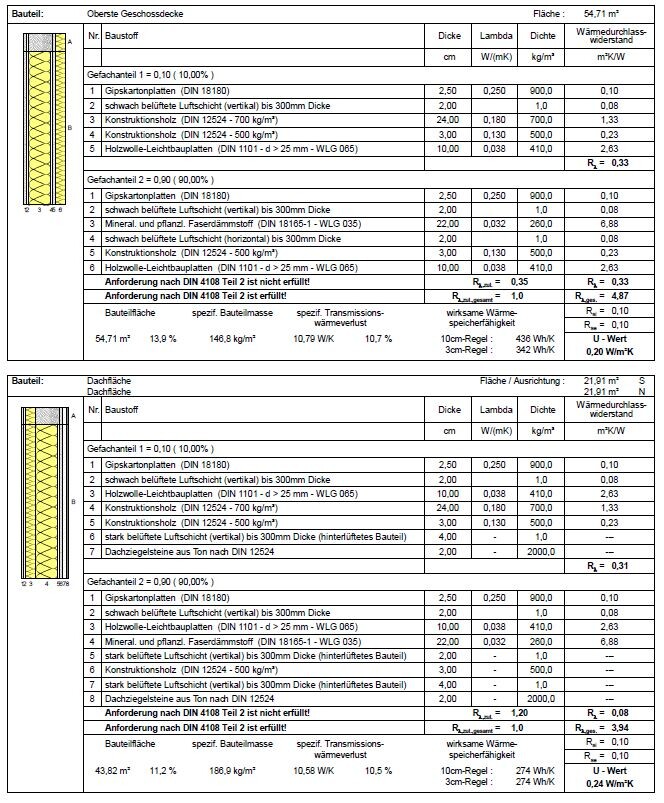
The question now is, where is it easiest to start? At the insulation in the roof or the top floor ceiling?
spiderchristian schrieb:
....The question now is, where is the simplest point to start? With the insulation in the roof or the top floor ceiling? Windows, roof, top floor ceiling. Just do the math. For example, increase the insulation thickness in the latter case.Best regards
Similar topics