
B
Brainstorming24 Oct 2020 21:45Hello everyone,
I have a question regarding stair lighting/step lighting as shown in the attached picture.
I was wondering about the best way to switch it on. Since this kind of lighting serves safety purposes as much as it does aesthetics, it would be ideal if it switches on automatically when someone steps onto the stairs. I am thinking of a solution with two motion sensors – one at the top and one at the bottom. Is it possible to connect one motion sensor as an input to the other in order to trigger the lighting switch?
How have you solved this?
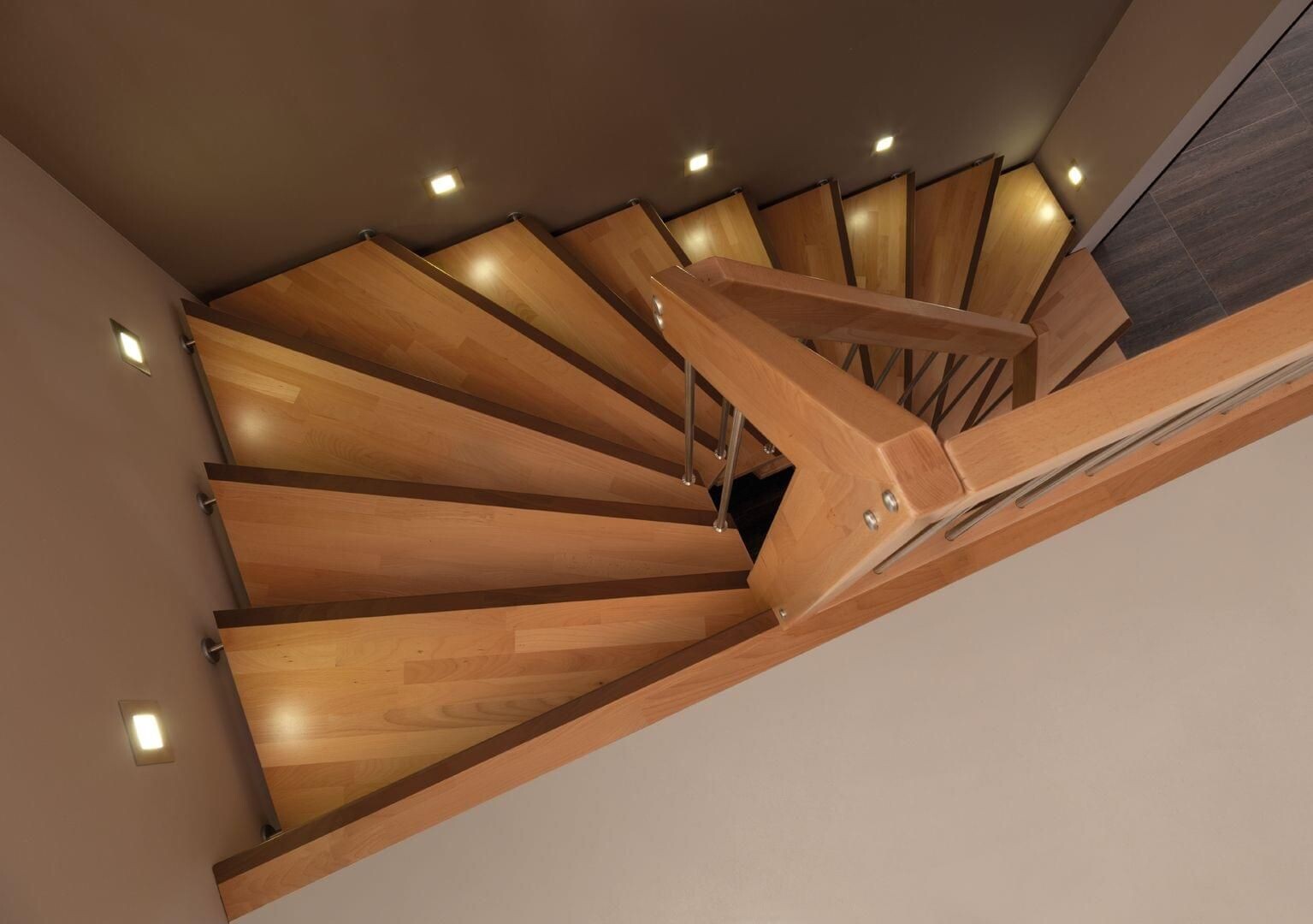
I have a question regarding stair lighting/step lighting as shown in the attached picture.
I was wondering about the best way to switch it on. Since this kind of lighting serves safety purposes as much as it does aesthetics, it would be ideal if it switches on automatically when someone steps onto the stairs. I am thinking of a solution with two motion sensors – one at the top and one at the bottom. Is it possible to connect one motion sensor as an input to the other in order to trigger the lighting switch?
How have you solved this?
We have a motion sensor upstairs that controls the hallway and stairwell on the first floor. Downstairs, we have a push button that does the same. Depending on your setup, a motion sensor downstairs may not be useful for you, as it cannot distinguish whether you want to continue downstairs or upstairs. In theory, it might be possible to integrate a motion sensor somewhere in the stairs downstairs, but it wasn’t important enough for us.
B
Brainstorming24 Oct 2020 22:31I thought that a motion sensor could be installed at the top of the last step and at the bottom of the first step, each detecting only its respective step and turning on the lighting as soon as someone passes by. After about 20 seconds, the lighting would then turn off automatically.
That can certainly be done locally, but it requires a motivated electrician. Unless you want to do the work yourself. You will also need to consider how the trades for the staircase and electrical work can be coordinated.
As I mentioned, we wanted the motion sensor for the first floor anyway.
As I mentioned, we wanted the motion sensor for the first floor anyway.
B
Brainstorming24 Oct 2020 22:44That wouldn’t be a problem in this case, as I would handle the stair enclosure, chases, and wiring myself. I have training in electrical engineering. However, I haven’t had any experience with residential electrical systems or, specifically, with motion detectors. I just don’t know if it’s possible to connect two motion detectors in series.
 HausiKlausi25 Oct 2020 00:15
Of course, that’s possible. I implemented it in my own yard (entrance gate (1) / front door (2)). Just run a search engine, and you’ll find the relevant wiring diagrams (there is also a very well-made YouTube video on it). Essentially, it’s a parallel circuit up to the light: when sensor 1 triggers, it supplies power to the light. This happens independently of what sensor 2 does—and vice versa. The only limitation is that if the light is already on and sensor 2 is triggered, the switch-on time resets. It’s important that both sensors are connected to the same fuse/circuit. But as always: have a professional handle the installation.
Similar topics