
ᐅ Switching from Gas to Solar / Photovoltaics with or without a Heat Pump
Created on: 10 Mar 2022 09:20
F
free2abc
Hello everyone,
We have a semi-detached house that we fully renovated in 2014. We installed underfloor heating, new pipes, electrical wiring, etc. The only thing we didn’t replace was the old gas heating system.
Due to climate change and rising energy costs (reasons you all know very well), we are now considering replacing the heating system.
What is important to us?
- Becoming less dependent on gas and electricity
- Subsidies through a loan
Unfortunately, I don’t have a clear overview yet of what would be best for us.
I hope you can help guide me in the right direction.
We have a semi-detached house that we fully renovated in 2014. We installed underfloor heating, new pipes, electrical wiring, etc. The only thing we didn’t replace was the old gas heating system.
Due to climate change and rising energy costs (reasons you all know very well), we are now considering replacing the heating system.
What is important to us?
- Becoming less dependent on gas and electricity
- Subsidies through a loan
- What is currently state-of-the-art and commonly installed?
- Solar thermal and/or photovoltaic systems with or without a heat pump?
- With or without electricity storage?
Unfortunately, I don’t have a clear overview yet of what would be best for us.
I hope you can help guide me in the right direction.

Drilling companies usually know exactly what is allowed in the respective area and what is not. In any case, the drilling must be approved in advance by the local authority. And yes, the machine is heavy since it sometimes has to drill over 100 meters (330 feet) deep. It also does not have a long boom; it needs to be positioned almost directly at the drilling site. So, there will definitely be a mess beforehand, but everything can be built over afterward. By the way, a ring trench collector can also be installed vertically if space is limited. If setback distances are possible, this might be an option?
Maybe deep drilling combined with a brine-to-water heat pump will work out! Since the temperature of the heat source remains relatively constant throughout the year, there is probably little need for additional electrical heating.
Back to the topic of photovoltaics + heat pump:
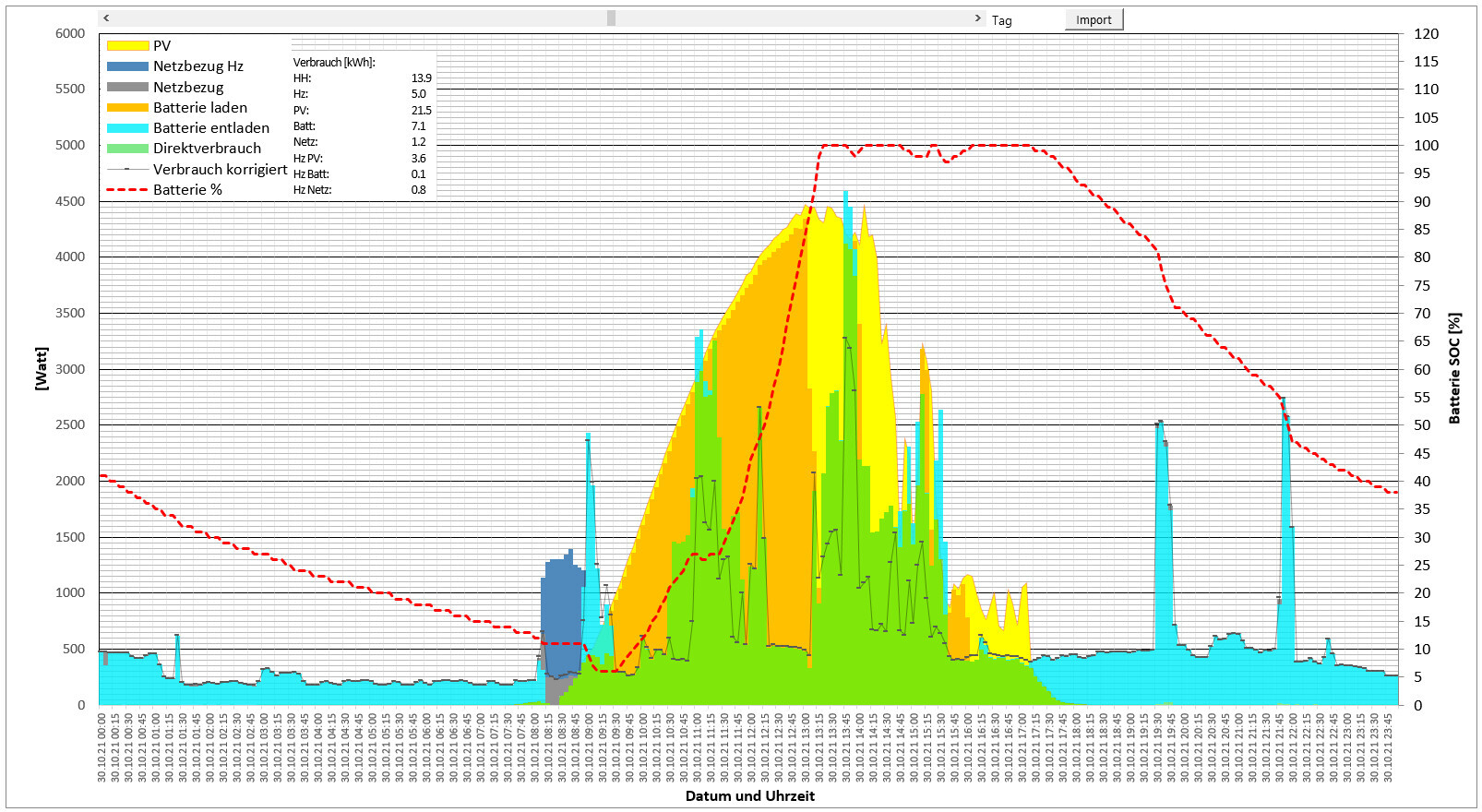
Here is an example chart from my logs at the end of October. I have already separated the heat pump data into household consumption in household electricity (below the fine line with dashed markers labeled "corrected consumption") and heat pump electricity (dark blue when grid power is used, otherwise green or turquoise above the fine line). The accumulated values in the box next to the legend are not completely accurate yet, as there is still one value missing somewhere. The correction in the consumption line includes, besides the separation of consumers, a correction of the household consumption recorded by the smart meter, which can be seen when there are large shares of photovoltaic surplus (yellow), where direct consumption drops below the black line. Sometimes this is more than 200 W. Since this represents both a relatively constant amount and a percentage of the power fed into the grid (conversion losses?), I can correct this mathematically, which I was able to validate well during vacation periods with constant household consumption.
With appropriate battery settings, I can also prevent the heat pump electricity (which costs me 20 ct/kWh) from being drawn from the battery, as can be seen, for example, between October 8 and 9 a.m.
Due to the relatively low heat demand, I have not yet used the configurable 0.5 to 6.5 kW electric heating element of the heat pump. However, mathematically it is even more efficient to generate heat with the compressor using heat pump electricity at 20 ct with a COP of 3–5, rather than "wasting" photovoltaic surplus for that purpose. This is because for the same heat output with a COP of 1 from the heating element, I need at least three times the electricity (in addition to the already running compressor), which then causes costs of more than 3 × 8 = 24 ct plus self-consumption taxes due to lost feed-in compensation. Arguments in favor of the electric heating element would be: avoiding compressor heating at significantly lower outdoor temperatures at night (for air-to-water heat pumps), storing heat in the screed to cover household electricity from the battery overnight, and reducing wear on the compressor.
Back to the topic of photovoltaics + heat pump:
Here is an example chart from my logs at the end of October. I have already separated the heat pump data into household consumption in household electricity (below the fine line with dashed markers labeled "corrected consumption") and heat pump electricity (dark blue when grid power is used, otherwise green or turquoise above the fine line). The accumulated values in the box next to the legend are not completely accurate yet, as there is still one value missing somewhere. The correction in the consumption line includes, besides the separation of consumers, a correction of the household consumption recorded by the smart meter, which can be seen when there are large shares of photovoltaic surplus (yellow), where direct consumption drops below the black line. Sometimes this is more than 200 W. Since this represents both a relatively constant amount and a percentage of the power fed into the grid (conversion losses?), I can correct this mathematically, which I was able to validate well during vacation periods with constant household consumption.
With appropriate battery settings, I can also prevent the heat pump electricity (which costs me 20 ct/kWh) from being drawn from the battery, as can be seen, for example, between October 8 and 9 a.m.
Due to the relatively low heat demand, I have not yet used the configurable 0.5 to 6.5 kW electric heating element of the heat pump. However, mathematically it is even more efficient to generate heat with the compressor using heat pump electricity at 20 ct with a COP of 3–5, rather than "wasting" photovoltaic surplus for that purpose. This is because for the same heat output with a COP of 1 from the heating element, I need at least three times the electricity (in addition to the already running compressor), which then causes costs of more than 3 × 8 = 24 ct plus self-consumption taxes due to lost feed-in compensation. Arguments in favor of the electric heating element would be: avoiding compressor heating at significantly lower outdoor temperatures at night (for air-to-water heat pumps), storing heat in the screed to cover household electricity from the battery overnight, and reducing wear on the compressor.
Similar topics