
ᐅ Future-Proof Garage Wiring: Electric Vehicles, Conductor Cross-Section
Created on: 11 Jan 2017 11:52
W
world-e
Hello everyone,
What conductor cross-section would you recommend for future-proof wiring to the garage? So far, a 16A CEE socket and several 230V outlets are planned for the garage. My concern is about the required capacity and cross-section in case an electric vehicle needs to be charged there later. It’s speculative, but perhaps someone else has already considered this. The cable length between the distribution board in the house and the garage is about 15 meters (50 feet). A sub-distribution panel in the garage is not planned at this stage. The individual outlets will be protected from the main distribution board in the house. The larger conductor cross-section for the future electric vehicle charging can initially have a lower circuit breaker rating.
Thank you.
What conductor cross-section would you recommend for future-proof wiring to the garage? So far, a 16A CEE socket and several 230V outlets are planned for the garage. My concern is about the required capacity and cross-section in case an electric vehicle needs to be charged there later. It’s speculative, but perhaps someone else has already considered this. The cable length between the distribution board in the house and the garage is about 15 meters (50 feet). A sub-distribution panel in the garage is not planned at this stage. The individual outlets will be protected from the main distribution board in the house. The larger conductor cross-section for the future electric vehicle charging can initially have a lower circuit breaker rating.
Thank you.


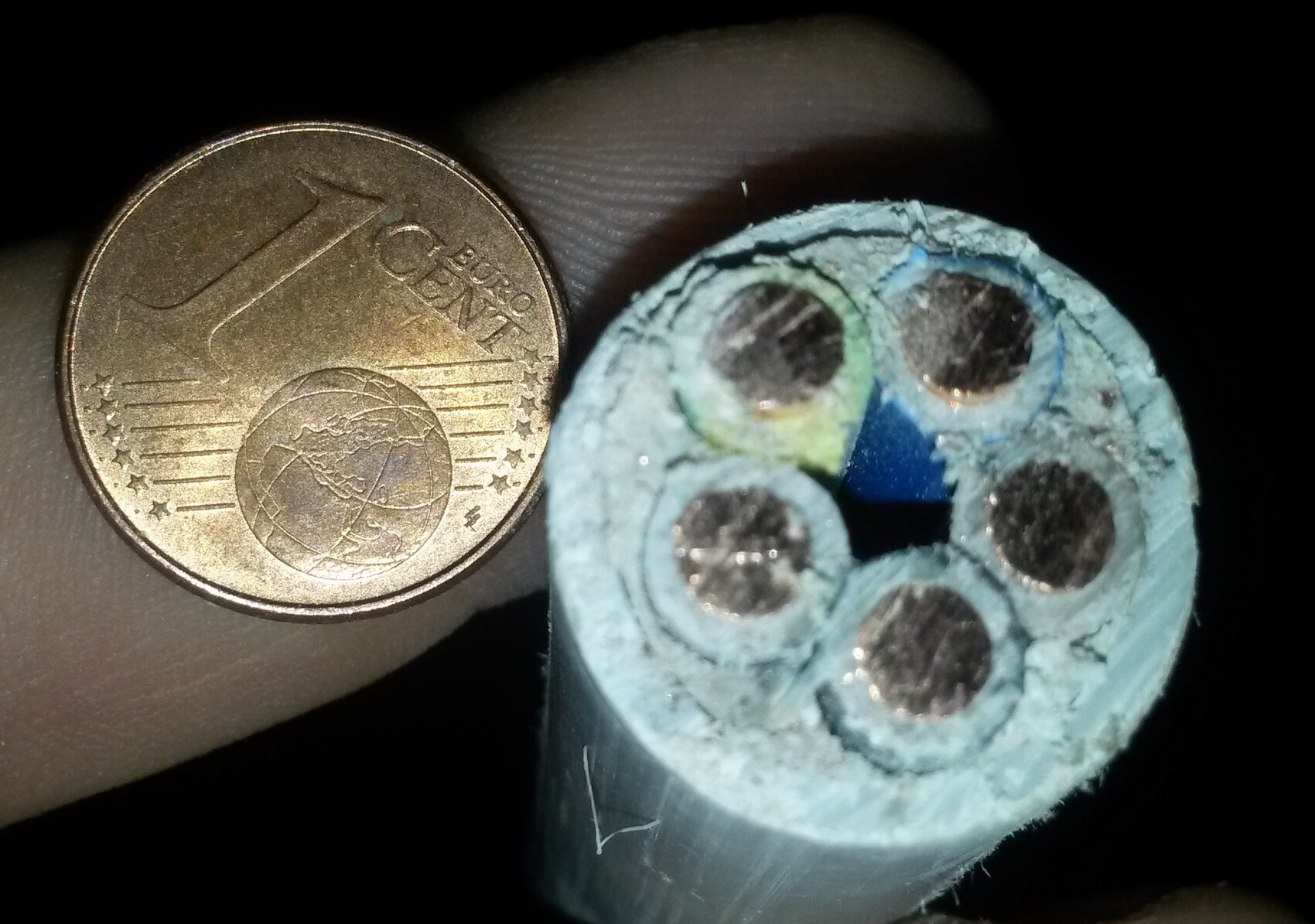
Without knowing exactly what you might possibly need in the future, as Gartenfreund suggested, have a sufficiently sized empty conduit installed from the meter cabinet to the garage, ensuring large bending radii are maintained. For example, a corrugated conduit M40. A standard M20 conduit is not sufficient for a proper cable (see attachment).
K
Knallkörper12 Jan 2017 09:38You won’t be able to pull more than 5x4 mm² cables through a conduit anyway, and your house connection won’t support more. Therefore, I wouldn’t install a conduit but rather use 5x4 mm² cables and be done with it if you want to be on the safe side.
Knallkörper schrieb:
You won’t be able to pull more than 5x4 mm2 cable through a conduit anyway Do you know each other? If he has a good breakfast...
Knallkörper schrieb:
Your house connection won’t allow for more Are you neighbors?
Knallkörper schrieb:
That’s why I wouldn’t install a conduit, just 5x4 mm2 cable and that’s it Are you sure that for 15 m (50 feet) installed in a conduit, and with a desired 32 A in the garage, the cable size you suggested is sufficient?
C
Caspar202012 Jan 2017 11:13Knallkörper schrieb:
You won’t be able to pull more than 5x4 mm2 cables through a conduit anyway, and your main electrical connection won’t support more. Therefore, I would not install a larger conduit but just use 5x4 mm2 cables if you want to be on the safe side.Caution: 4 mm² cables are not sufficient for 32A when installed in a conduit with three loaded conductors (installation method B2). 4 mm² would only be suitable for surface mounting under ideal conditions.
It may also be necessary to apply derating factors if the cable is installed together with others or routed jointly.
K
Knallkörper12 Jan 2017 13:47Of course, everyone has different skills when it comes to cable installation, but pulling cables larger than 4x5 mm2 through a conduit longer than 15 meters (50 feet) seems very difficult to me. For me, 5x4 mm2 would be the largest reasonable cross-section, and I would NOT put it inside a conduit, as mentioned. Voltage drop should not be an issue at 15m (50 ft) and 32A, even though I haven’t calculated it right now. If necessary, you would have to settle for 24A.
Similar topics