
ᐅ The support bracket for the concrete staircase was cut off. How can this be repaired?
Created on: 14 Oct 2023 18:16
D
domino55
Hello,
my construction company decided to install two prefabricated concrete staircases with a lower angle at once (apparently to only rent a larger crane once).
Staircase 1: Ground floor -> 1st floor and Staircase 2: 1st floor -> upper floor.
The ceiling of the ground floor and the masonry of the 1st floor were already completely finished. The prefabricated elements of the hollow-core slab were placed on the 1st floor.
See House_Section_GroundFloor_and_1stFloor.JPG.
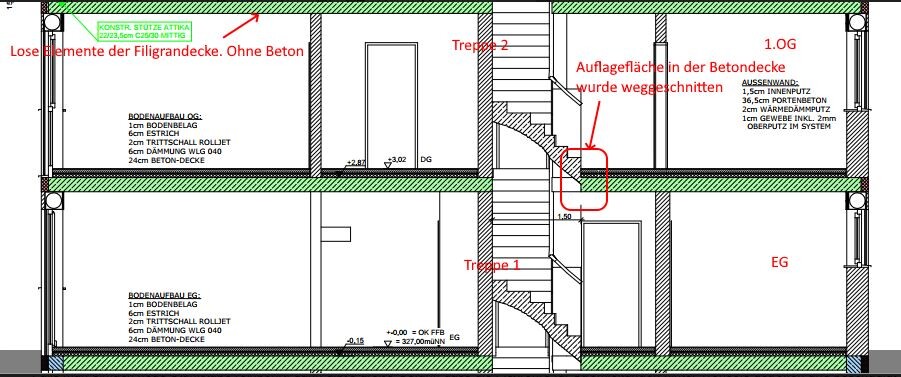
Staircase 1 could not be installed because the staircase bearing point (corbel) in the floor of the 1st floor was in the way. There was not enough space to maneuver (to tilt the staircase in order to rotate the axis). The construction company cut about 12 cm (5 inches) from the support point in the concrete slab and then installed the staircase from ground floor to 1st floor. For the second staircase, this cut corbel is now missing. The lower support on the staircase measures 11 cm (4.3 inches).
What can I demand here?
I have requested that a new concrete staircase be manufactured with a correspondingly wider lower support. The construction company refuses; they want to somehow "repair" the concrete slab and install the staircase on it. Allegedly, the structural engineer of the precast concrete plant where the stairs were manufactured approved this.
So far, I have only received a preliminary hand-drawn sketch from this "structural engineer":

I notice that his sketch shows less reinforcement than was already cut out. If new steel rods are simply drilled in, there is a high risk that the electrical conduit behind the corbel will be hit and damaged.
I would like to know if I am obliged to accept his proposal or if, for example, I can insist on a new staircase.
my construction company decided to install two prefabricated concrete staircases with a lower angle at once (apparently to only rent a larger crane once).
Staircase 1: Ground floor -> 1st floor and Staircase 2: 1st floor -> upper floor.
The ceiling of the ground floor and the masonry of the 1st floor were already completely finished. The prefabricated elements of the hollow-core slab were placed on the 1st floor.
See House_Section_GroundFloor_and_1stFloor.JPG.
Staircase 1 could not be installed because the staircase bearing point (corbel) in the floor of the 1st floor was in the way. There was not enough space to maneuver (to tilt the staircase in order to rotate the axis). The construction company cut about 12 cm (5 inches) from the support point in the concrete slab and then installed the staircase from ground floor to 1st floor. For the second staircase, this cut corbel is now missing. The lower support on the staircase measures 11 cm (4.3 inches).
What can I demand here?
I have requested that a new concrete staircase be manufactured with a correspondingly wider lower support. The construction company refuses; they want to somehow "repair" the concrete slab and install the staircase on it. Allegedly, the structural engineer of the precast concrete plant where the stairs were manufactured approved this.
So far, I have only received a preliminary hand-drawn sketch from this "structural engineer":
I notice that his sketch shows less reinforcement than was already cut out. If new steel rods are simply drilled in, there is a high risk that the electrical conduit behind the corbel will be hit and damaged.
I would like to know if I am obliged to accept his proposal or if, for example, I can insist on a new staircase.
hanghaus2023 schrieb:
It is clear that the company made a mistake here. But who authorized the removal of the plinth beam?The company cut away the plinth beam on their own. When pouring the ground floor slab, I verbally expressed concerns that they might not be able to integrate the staircase. Their response was that it was no problem and they would manage it.The defect can be repaired. Which the company also offered. A new staircase is an unreasonable demand.It seems to me that the proposed solution is not equivalent to the original condition. For example, the number of new reinforcement bars is less than before. Additionally, it will inevitably damage the conduit for the electrical wiring.
hanghaus2023 schrieb:
If they are too incompetent to thread the staircase in, then they should install the staircase before the slab above is poured. domino55 schrieb:
When the ground floor slab was being poured, I verbally expressed concerns that they wouldn’t be able to thread the staircase in. I was told that it wouldn’t be a problem and that they would manage it. I don’t think this has anything to do with incompetence in this case, but rather with excessive overconfidence, ignoring the client’s warning, and sheer pragmatism. In my opinion, this staircase should have been installed during a separate crane operation. With the wrong sequence, even a seven-joint mobile crane can’t manage it.
hanghaus2023 schrieb:
It’s clear that the company made a mistake. Who authorized the removal of the landing? [...] The defect can be fixed, which the company has also offered. A new staircase is an unreasonable demand. The removal was apparently done unilaterally and for questionable reasons, simply following the mentality of Cinderella’s stepsisters: once you’re queen, you no longer have to walk. I assume that the original poster’s suspicion of the motive being greed (to save the cost of a second crane operation that was actually necessary) hits the mark. I would neither downplay this deliberate, significant property damage as a mere “defect” nor, in my wildest dreams, expect the original poster to agree to a makeshift solution out of any duty to mitigate damages. On the contrary: the perpetrator should be strongly deterred from repeating this by penalty costs significantly exceeding any gained profits. I hope that the contractor will be represented by a judge who normally presides over criminal cases and who is a hardliner. The usual civil law leniency has no place in the case of such blatant misconduct.
However, the original poster has not yet convincingly disproved the impression that such bungling might be at least partly self-inflicted. The noticeable chain of poorly executed construction tasks suggests that the wrongdoers may not always be the contractors. For example, pricing expectations that discourage serious and qualified contractors from bidding are not an unlikely contributing factor ;-)
https://www.instagram.com/11antgmxde/
https://www.linkedin.com/company/bauen-jetzt/
S
sascha-t4-le16 Oct 2023 08:15In the end, I didn’t understand what you expect from the construction company. Are you prioritizing replacing the staircase to place it on the ceiling? That won’t work because the edge of the ceiling is not designed as a cantilever.
Were the reinforcing bars in position 15 also cut away, or are they located behind the cantilever? Can you show on the reinforcement plan where the staircase rests? Does it really rest over the corner? (I don’t see how that would be possible.)
What has been sketched there, I have done several times already, and it is generally fine. However, I’m only focusing on repairing the cantilever; the curvature of the ceiling (position 15!) must not be overlooked.
Make sure that the joint (the contact surface) is properly rough and interlocked. Chisel the top slightly so that the surface is not vertical but angled. It’s better to embed the top reinforcement bars about 50cm (20 inches) deep.
Regarding the pipes in the ceiling, I can’t really say anything.
Were the reinforcing bars in position 15 also cut away, or are they located behind the cantilever? Can you show on the reinforcement plan where the staircase rests? Does it really rest over the corner? (I don’t see how that would be possible.)
What has been sketched there, I have done several times already, and it is generally fine. However, I’m only focusing on repairing the cantilever; the curvature of the ceiling (position 15!) must not be overlooked.
Make sure that the joint (the contact surface) is properly rough and interlocked. Chisel the top slightly so that the surface is not vertical but angled. It’s better to embed the top reinforcement bars about 50cm (20 inches) deep.
Regarding the pipes in the ceiling, I can’t really say anything.
sascha-t4-le schrieb:
Can you show on the reinforcement plan where the staircase rests? Does it really rest over the corner? (I don’t know how that would work) You can see where the staircase rests here:
H
hanghaus202316 Oct 2023 13:05@11ant You couldn’t have put it better.
A single lawsuit can halt the construction site for months. I doubt the original poster wants that.
Especially since the original poster raised the concerns with the contractor beforehand. That’s quite audacious.
A single lawsuit can halt the construction site for months. I doubt the original poster wants that.
Especially since the original poster raised the concerns with the contractor beforehand. That’s quite audacious.
hanghaus2023 schrieb:
A construction site will be halted for months just because of a lawsuit. I doubt the original poster (OP) actually wants that. From my perspective, what the OP wants is to gain approval without admitting any personal responsibility, so that the stubborn parties who caused the mess on their own now have to follow his view on how to fix the problem.
hanghaus2023 schrieb:
Especially since the OP had already raised concerns with the contractor beforehand. That’s quite bold. ... and a good lesson for readers: dear children, please don’t copy this—never submit concerns without written proof.
https://www.instagram.com/11antgmxde/
https://www.linkedin.com/company/bauen-jetzt/
Similar topics