
ᐅ Supporting a structural opening with a beam – where should it be positioned?
Created on: 31 Dec 2023 05:59
Z
ZweiSiebzig
Hello dear forum, I need advice regarding a wall opening.
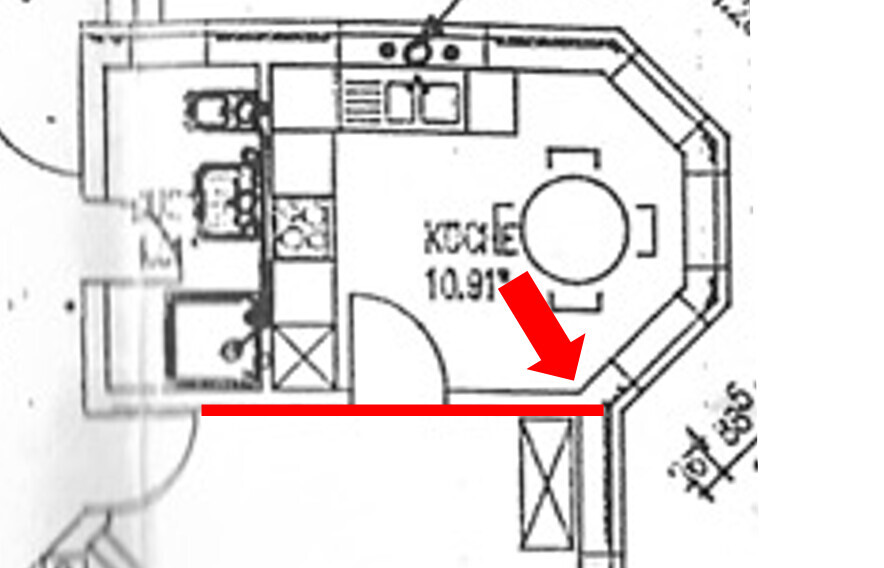
We want to enlarge the passage between the kitchen and living room by removing a wall. A company has already visited and provided an offer. The wall will be removed, and the ceiling will be supported with a beam (HEA 160, marked in red). This beam will rest on the interior wall. The width of the opening will then be approximately 2.90m (9.5 feet). So far, we have understood this.
Now my question: Where can the beam rest on the exterior side and why (location marked with a red arrow)?
The company proposed installing a second beam in front of the wall, which the “ceiling beam” would rest on. The reason given for this option was that it would avoid having to open the masonry and reduce the risk of damaging the insulation.
For aesthetic reasons, however, we would prefer the beam to rest directly on the masonry, so that no additional beam is visible in the room in front of the wall.
Is there any reason against the option we prefer? Should we rather look for another company that feels confident executing our preferred solution without causing any damage?
Thank you for your input.
We want to enlarge the passage between the kitchen and living room by removing a wall. A company has already visited and provided an offer. The wall will be removed, and the ceiling will be supported with a beam (HEA 160, marked in red). This beam will rest on the interior wall. The width of the opening will then be approximately 2.90m (9.5 feet). So far, we have understood this.
Now my question: Where can the beam rest on the exterior side and why (location marked with a red arrow)?
The company proposed installing a second beam in front of the wall, which the “ceiling beam” would rest on. The reason given for this option was that it would avoid having to open the masonry and reduce the risk of damaging the insulation.
For aesthetic reasons, however, we would prefer the beam to rest directly on the masonry, so that no additional beam is visible in the room in front of the wall.
Is there any reason against the option we prefer? Should we rather look for another company that feels confident executing our preferred solution without causing any damage?
Thank you for your input.
H
hanghaus20231 Jan 2024 13:20Yes, there are reasons. For example, if the masonry of the wall cannot support the load.
What kind of wall is it? Concrete? Then in my opinion, it is possible without a support.
What kind of wall is it? Concrete? Then in my opinion, it is possible without a support.
S
Simon-1892 Jan 2024 23:17There are various reasons why an additional support may become necessary. Most likely, the wall thickness is not sufficient for the required bearing width, or the load-bearing capacity of the wall is inadequate.
However, I would currently consider the specified HEA 160 profile as not yet structurally calculated. It seems rather small to me. Please also consider how you will handle a 3.00 m (10 feet) long profile inside the house. An HEA 160 at 3.00 m (10 feet) already weighs over 90 kg (200 lbs)!
As a precaution, have a structural engineer calculate one or two rigid connections, depending on how long the pieces can be for handling inside the house.
However, I would currently consider the specified HEA 160 profile as not yet structurally calculated. It seems rather small to me. Please also consider how you will handle a 3.00 m (10 feet) long profile inside the house. An HEA 160 at 3.00 m (10 feet) already weighs over 90 kg (200 lbs)!
As a precaution, have a structural engineer calculate one or two rigid connections, depending on how long the pieces can be for handling inside the house.