
Hello,
We want to convert our upper floor (house built in 2019).
Current situation: The subfloor consists of rough-sawn boards. A load-bearing timber frame drywall partition wall is installed, containing 8 cm (3 inches) of insulation, and covered on both sides with 15 mm (0.6 inch) OSB boards and 12.5 mm (0.5 inch) gypsum plasterboard. Now, we plan to install underfloor heating. The heating installer recommended the herotec tempus Dry 30-16 system (3 cm (1.2 inch) thickness), with 16x2 mm (5/8 inch) aluminum pipes and heat-conducting fins. Unfortunately, I can’t find a company able to install the remaining layers (impact sound insulation and dry screed) this year. Every company I contacted is fully booked. Therefore, I probably have to install the impact sound insulation and dry screed myself. That is no problem technically, but I wanted to avoid it for warranty reasons.
Now the static load capacity comes into play.
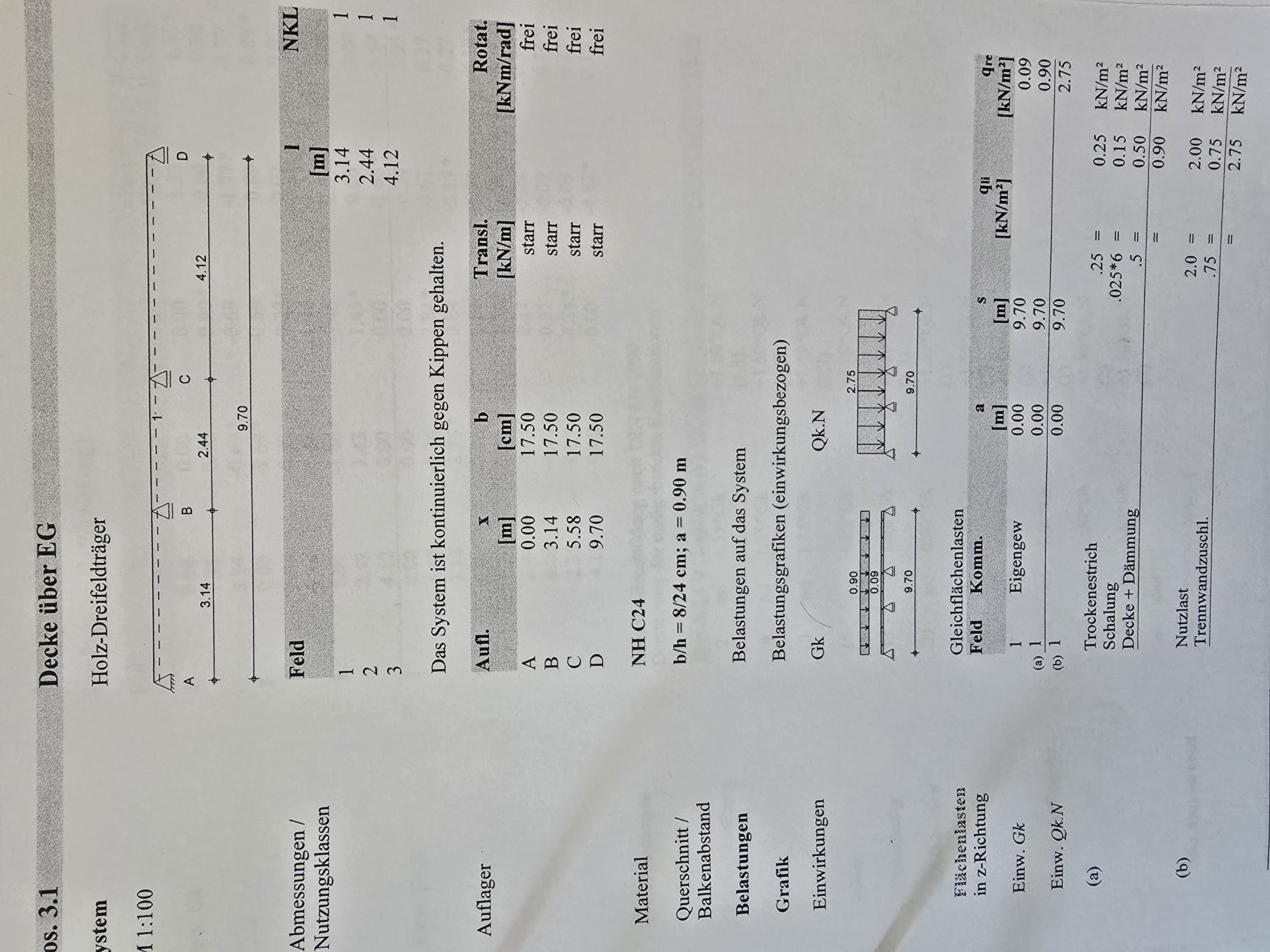
My planned floor build-up is as follows:
1. 2 cm (0.8 inch) impact sound insulation made of mineral wool (approx. 5 kg/m² (1.0 lb/sq ft))
2. 3 cm (1.2 inch) underfloor heating system Tempusdry as mentioned above (approx. 4 kg/m² (0.8 lb/sq ft), including water-filled pipes)
3. 2.5 cm (1 inch) dry screed panel (approx. 39 kg/m² (8 lb/sq ft))
This initially exceeds the load limits considered in the structural calculations. According to the structural engineer, this is not an issue because very high values are used for the live load, which compensate for it. However, I prefer to rely on a person rather than only on the engineer’s software. What is your opinion? Is this acceptable, or would it be better to switch to a 2 cm (0.8 inch) dry screed, which would keep the total load within the limits?
Best regards
We want to convert our upper floor (house built in 2019).
Current situation: The subfloor consists of rough-sawn boards. A load-bearing timber frame drywall partition wall is installed, containing 8 cm (3 inches) of insulation, and covered on both sides with 15 mm (0.6 inch) OSB boards and 12.5 mm (0.5 inch) gypsum plasterboard. Now, we plan to install underfloor heating. The heating installer recommended the herotec tempus Dry 30-16 system (3 cm (1.2 inch) thickness), with 16x2 mm (5/8 inch) aluminum pipes and heat-conducting fins. Unfortunately, I can’t find a company able to install the remaining layers (impact sound insulation and dry screed) this year. Every company I contacted is fully booked. Therefore, I probably have to install the impact sound insulation and dry screed myself. That is no problem technically, but I wanted to avoid it for warranty reasons.
Now the static load capacity comes into play.
My planned floor build-up is as follows:
1. 2 cm (0.8 inch) impact sound insulation made of mineral wool (approx. 5 kg/m² (1.0 lb/sq ft))
2. 3 cm (1.2 inch) underfloor heating system Tempusdry as mentioned above (approx. 4 kg/m² (0.8 lb/sq ft), including water-filled pipes)
3. 2.5 cm (1 inch) dry screed panel (approx. 39 kg/m² (8 lb/sq ft))
This initially exceeds the load limits considered in the structural calculations. According to the structural engineer, this is not an issue because very high values are used for the live load, which compensate for it. However, I prefer to rely on a person rather than only on the engineer’s software. What is your opinion? Is this acceptable, or would it be better to switch to a 2 cm (0.8 inch) dry screed, which would keep the total load within the limits?
Best regards

S
SmokinAces23 Mar 2026 11:38Yes, I am of course aware that I won’t receive legally binding answers. Ultimately, I am responsible. My goal is more to get a sense of whether the project is completely unrealistic or still feasible.
For example, a partition wall surcharge of 75 kg/m2. The walls were constructed using 8x6 cm (3x2 inch) structural timber, 8 cm (3 inch) mineral wool, 2 layers of 15 mm (0.6 inch) OSB, and 2 layers of 12.5 mm (0.5 inch) gypsum board. This results in a total weight of about 50-55 kg/m2. So theoretically, I have a buffer of 20 kg/m2, but it’s clear this cannot simply be added to the 25 kg/m2 allowed for the dry screed because of point loads versus uniformly distributed loads. However, I just don’t know, and these are surely matters that can be clarified as well.
For example, a partition wall surcharge of 75 kg/m2. The walls were constructed using 8x6 cm (3x2 inch) structural timber, 8 cm (3 inch) mineral wool, 2 layers of 15 mm (0.6 inch) OSB, and 2 layers of 12.5 mm (0.5 inch) gypsum board. This results in a total weight of about 50-55 kg/m2. So theoretically, I have a buffer of 20 kg/m2, but it’s clear this cannot simply be added to the 25 kg/m2 allowed for the dry screed because of point loads versus uniformly distributed loads. However, I just don’t know, and these are surely matters that can be clarified as well.
S
Simon-18923 Mar 2026 13:48Hello,
you are making things more complicated than necessary. You have a structural analysis report. It includes the address, phone number, and contact person (=the signatory). The data must be archived for 10 years, so they still have access to it.
You call them and ask if they could please check in the structural analysis software how the utilization of the ceiling increases if the screed is applied with 0.5 kN/m² (10.5 psf).
You already have utilization values on page 19 under bending of n = 0.92, meaning 92%. The expected result when doubling the load should be clear.
This won’t be possible without further steps, especially not without coordinating with your structural engineer.
My manager would rightly be upset if I didn’t discuss such deviations first...
Best regards from a structural engineer
you are making things more complicated than necessary. You have a structural analysis report. It includes the address, phone number, and contact person (=the signatory). The data must be archived for 10 years, so they still have access to it.
You call them and ask if they could please check in the structural analysis software how the utilization of the ceiling increases if the screed is applied with 0.5 kN/m² (10.5 psf).
You already have utilization values on page 19 under bending of n = 0.92, meaning 92%. The expected result when doubling the load should be clear.
This won’t be possible without further steps, especially not without coordinating with your structural engineer.
My manager would rightly be upset if I didn’t discuss such deviations first...
Best regards from a structural engineer
S
SmokinAces23 Mar 2026 14:28I am completely confused right now. Back then, the structural requirements specified that the upper floor should be expandable to accommodate 3 living rooms and 1 bathroom. Unfortunately, I specified dry screed instead of wet screed. All the connections for the bathroom were also already prepared.
Do I understand correctly that, according to the structural requirements, tiles are actually not allowed in the bathroom? They weigh about 20-25 kg/m2 (4-5 lb/ft2).
Additionally, with tiles up to 1.5 meters (5 feet) high on the wall—which is quite common—you quickly reach 30-37.5 kg/m2 (6-7.7 lb/ft2). So none of this is allowed? Did my site manager not pay attention back then, or am I just overthinking this?
Do I understand correctly that, according to the structural requirements, tiles are actually not allowed in the bathroom? They weigh about 20-25 kg/m2 (4-5 lb/ft2).
Additionally, with tiles up to 1.5 meters (5 feet) high on the wall—which is quite common—you quickly reach 30-37.5 kg/m2 (6-7.7 lb/ft2). So none of this is allowed? Did my site manager not pay attention back then, or am I just overthinking this?
S
Simon-18924 Mar 2026 07:41Hello,
I believe that tiles or floor coverings in general are included in the live load of 2.00 kN/m² (42 lb/ft²).
However, only a structural engineer can give you a precise answer.
I believe that tiles or floor coverings in general are included in the live load of 2.00 kN/m² (42 lb/ft²).
However, only a structural engineer can give you a precise answer.
A
ajokr20255 Apr 2026 19:57The dead load of the ceiling has been set at 50 kg/m² (10.2 lb/ft²). For wooden beams measuring 8 x 24 cm (3 x 9.5 inches) spaced at 90 cm (35 inches) plus insulation and ceiling paneling underneath, this is more than sufficient. You can calculate the weights more precisely here, which will give you some reserves for your screed.
The main concern is the single-span system; the three-span system is only loaded to 69%. Depending on the actual location of the partition walls, you can also apply the surcharge for the screed in areas without partitions.
No, permanent loads are not included in the live loads. A structural engineer will confirm that ;-)
The partition wall surcharge of 0.75 kN/m² as an area load accounts for walls with up to 100 kg/m² (20.5 lb/ft²) wall surface weight.
The main concern is the single-span system; the three-span system is only loaded to 69%. Depending on the actual location of the partition walls, you can also apply the surcharge for the screed in areas without partitions.
Simon-189
I think the tiles or the floor covering in general are included in the live load of 2.00 kN/m².
But only a structural engineer can give you exact information.
No, permanent loads are not included in the live loads. A structural engineer will confirm that ;-)
The partition wall surcharge of 0.75 kN/m² as an area load accounts for walls with up to 100 kg/m² (20.5 lb/ft²) wall surface weight.
Similar topics