
ᐅ Shell Construction Window Dimensions; Decisions Between Planning and Construction
Created on: 23 Apr 2022 20:47
K
karl.jonas
Hello,
I have received the first draft of the floor plan from the architect. The windows are shown with a width of 180cm (71 inches). I assume this is the rough opening size that the mason uses as a reference? Until now, I thought such dimensions would always be calculated as n * 12.5cm + 1cm (joint), which would result in 176 or 188.5cm (69 or 74 inches). I am attaching a picture.
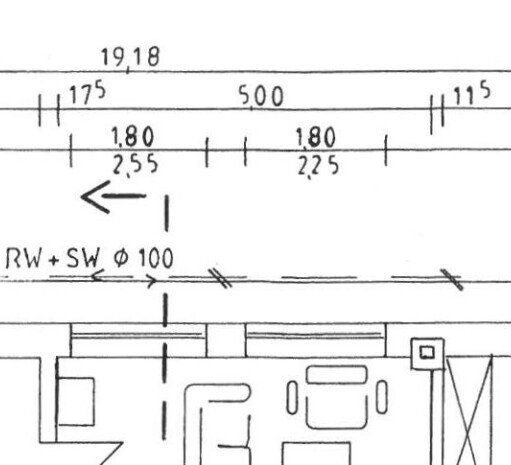
Before I raise this with the architect, I would like to know if the misunderstanding is on my side (probably yes…).
We are still undecided on a few other issues. All of these will be decided before the trades are contracted, but which of these must or should already be clarified for the building permit / planning permission?:
(There are no external requirements, especially no zoning plan.)
Thank you very much for any information and comments.
Karl
I have received the first draft of the floor plan from the architect. The windows are shown with a width of 180cm (71 inches). I assume this is the rough opening size that the mason uses as a reference? Until now, I thought such dimensions would always be calculated as n * 12.5cm + 1cm (joint), which would result in 176 or 188.5cm (69 or 74 inches). I am attaching a picture.
Before I raise this with the architect, I would like to know if the misunderstanding is on my side (probably yes…).
We are still undecided on a few other issues. All of these will be decided before the trades are contracted, but which of these must or should already be clarified for the building permit / planning permission?:
- The roof is planned with a 20-degree pitch; the choice between tiles and metal sheets is still open.
- The upper floor will be open up to the ridge. However, some ceilings (e.g., bathroom) may be suspended later.
- We would also like to decide later whether and where to install roof windows.
(There are no external requirements, especially no zoning plan.)
Thank you very much for any information and comments.
Karl

You should ask the architect about the reasons behind the dimensions he has chosen (a poor answer would be irrelevant, and personally, it would be enough reason for me to terminate the contract with him—any other answer would be of great interest to me). After all, what good is it if he doesn’t understand masonry and, for example, writes down 176cm (69 inches) just to accommodate your supposed special request?
Regarding the material and color of your roof, I see no reason to worry that the building authority might reject any of the options. Double casement windows should always be acceptable for the permit/planning permission, and I see no objection to partially open eaves or the need for prior specification.
https://www.instagram.com/11antgmxde/
https://www.linkedin.com/company/bauen-jetzt/
Regarding the material and color of your roof, I see no reason to worry that the building authority might reject any of the options. Double casement windows should always be acceptable for the permit/planning permission, and I see no objection to partially open eaves or the need for prior specification.
https://www.instagram.com/11antgmxde/
https://www.linkedin.com/company/bauen-jetzt/
K
karl.jonas4 May 2022 22:59Today we went to see the construction supervisor (future) with the architect’s plans, and he saw no problem with the proposed dimensions. Buildings are no longer constructed according to the stone sizes, cutting the stones is unproblematic and hardly takes any time. At least not enough to be a concern.
karl.jonas schrieb:
Today we took the architect's plans to the (future) construction supervisor, and he didn’t see any issues with the proposed dimensions.That doesn’t necessarily mean he would be a poor construction supervisor. But it would make me very suspicious.karl.jonas schrieb:
Based on the stone dimensions, construction wouldn’t be done this way anymore,Well, which came first – the chicken or the egg? There really is a generation of planners who couldn’t care less about basic knowledge and fundamentals, arrogantly ignoring the usual 80 cm (31.5 inches) modular grid.karl.jonas schrieb:
Cutting the stones is unproblematic and would hardly take any time. Certainly not enough to worry about.That is as true as it is nonsense. The mason wants to work on piecework performance. He can’t afford to be held up by the ignorance of “academics.” What else can he do? File a complaint, teach the planner a lesson, be branded a troublemaker by his boss, and lose his job? No! Of course, he will pragmatically realize that the smarter one gives in, and a stone saw is something that doesn’t need a blessing or can only be operated by a druid. So if necessary, he will cut the stone.But: the unrealistic dimensions from the ignorant planner don’t always work out easily, and then some patchwork happens (I wouldn’t call it botched work because the real culprit behind this belongs to the planner, not the mason). So where is the problem? I will gladly explain again: it lies in the correlation between joint spacing and overlap length. This problem is somewhat relative, depending on the “joint spacing” parameter, which can vary. The overlap length is related to this and should be professionally at least 40%. This means the (usually dry) vertical joint should ideally be centered under/over the stone in the adjacent course—in percent terms 50/50, tolerating 40/60 to 60/40. So the tolerance is 10% of the spacing.
Now the sizes come into play: for aerated concrete (or with external thermal insulation composite systems), we talk about a 50 cm (20 inches) grid and therefore a 5 cm (2 inches) tolerance range; for porous bricks, pumice, expanded clay or similar (monolithic walls) it’s a 25 cm (10 inches) grid and thus only a 2.5 cm (1 inch) tolerance range. Let’s take an example with two wall segments of an ideal 200 cm (79 inches). If the ignorant planner specifies once 193 cm (76 inches) and once 207 cm (81 inches), then in the first case that is “eight modules minus 7 cm (3 inches),” meaning tight-fitting masonry with the last stone cut by 7 cm (3 inches), okay, recognized correctly as no big deal; and in the second case “eight modules plus 7 cm (3 inches).”
This extra length has to be “fairly” distributed over the seven joints, but this is no longer tight-fitting; at best, it may still be dry if tolerated. The mason will only do this if he’s a precise virtuoso with lots of experience and time for a steady hand. In reality, however, it is more common that this is compensated only in the last joint (but wait! This alone would be too much). So there will be five normal, tight, dry joints—followed by two joints sharing the 7 cm (3 inches) gap, which are then filled with mortar (and – as a realist – I don’t imagine anyone checking that closely: a quick smearing with joint mortar). Not even a romantic like me would seriously assume our diligent mason carried a leftover piece from earlier to use at the end...
https://www.instagram.com/11antgmxde/
https://www.linkedin.com/company/bauen-jetzt/
Similar topics