
K
koelnumland20 Oct 2024 08:00Hello,
Our apartment is currently being completely skim-coated (including sanding and priming). After that, all walls will be painted white.
The first rooms are finished, and unfortunately, strong transitions are visible on the walls, so the surface is not even. Depending on the angle of the light, this is very noticeable.
Can these transitions be corrected by applying another coat of paint? Because the result shouldn’t look like this, right?
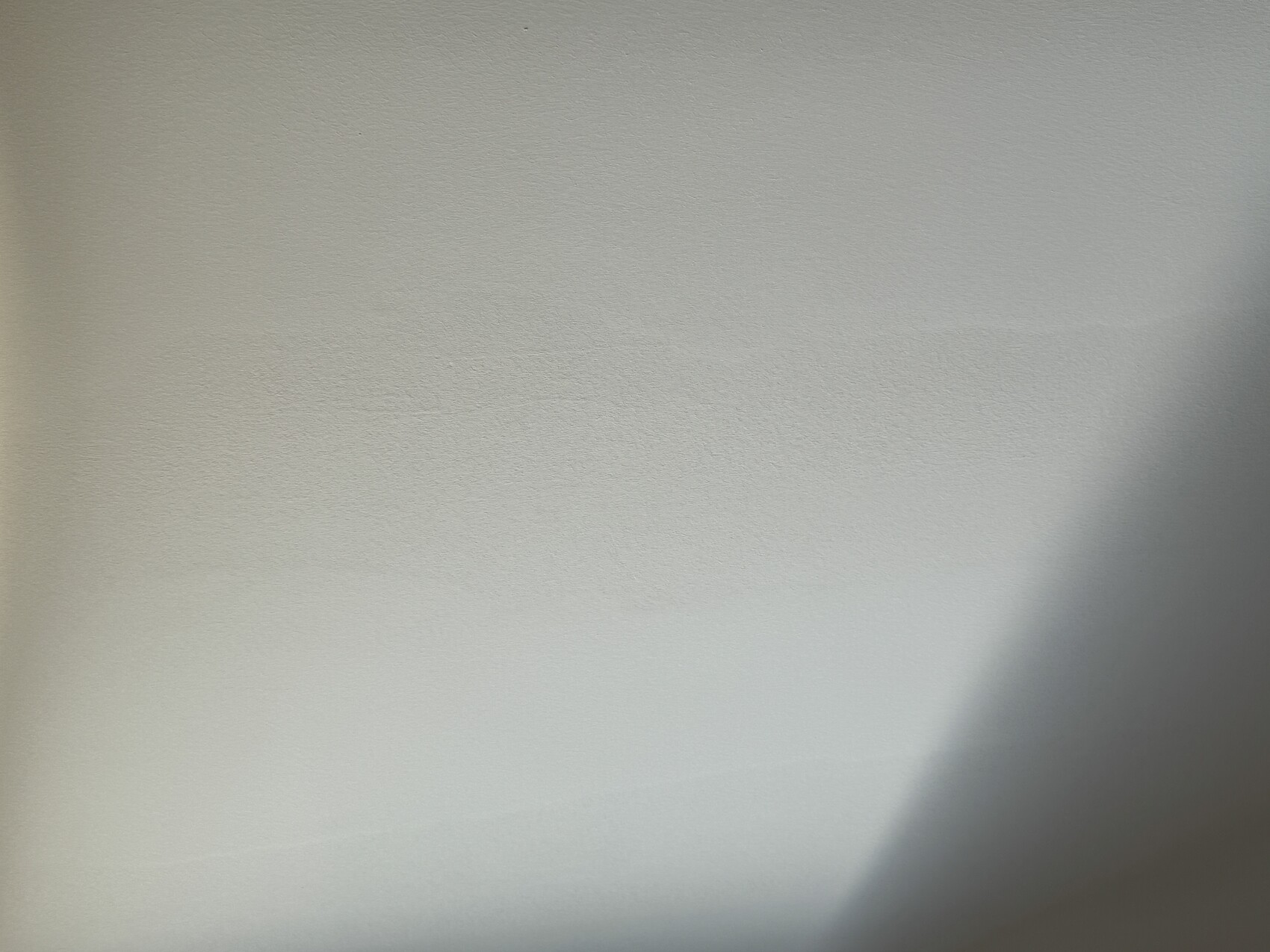
Our apartment is currently being completely skim-coated (including sanding and priming). After that, all walls will be painted white.
The first rooms are finished, and unfortunately, strong transitions are visible on the walls, so the surface is not even. Depending on the angle of the light, this is very noticeable.
Can these transitions be corrected by applying another coat of paint? Because the result shouldn’t look like this, right?
This will be the raking light where you can see the grooves. You won’t be able to remove them by simply smoothing the surface.
As far as I know, an expert should not assess plaster quality under raking light, but only under diffuse light.
Just try to address the issue with the tradesperson. Did you order and pay them? What quality was specified?
As far as I know, an expert should not assess plaster quality under raking light, but only under diffuse light.
Just try to address the issue with the tradesperson. Did you order and pay them? What quality was specified?
K
koelnumland20 Oct 2024 09:45But this is not a grazing light, is it? I have never seen such transitions on white walls. I even just looked at my brother-in-law’s walls, and there is nothing like that visible.
The finish is supposed to be Q3 level skim-coated.
The finish is supposed to be Q3 level skim-coated.
koelnumland schrieb:
But that’s not grazing light, is it?No idea. I wasn’t/am not on site, but you were. Ultimately, this photo is only somewhat useful for detailed assessment because the positioning and size cannot be determined. The light source seems to be a window with a sill, which is the only feature for gauging the size of the white area. The window could be located at the corner of the wall, in which case it would be grazing light.
I’ll copy here the first search result for the definition of quality level Q3. We don’t know what your brother-in-law ordered. Q3 includes a fleece layer. Anyone who omits that must accept some minor and few irregularities.
Q2: This quality level, unless otherwise contractually agreed, represents the standard quality and meets the usual requirements for wall and ceiling surfaces.
These types of plaster surfaces are suitable for topcoats with grain size > 1.0 mm (0.04 inches), medium to coarse textured wall coverings (woodchip wallpaper with grain RM or RG), or for matte, filled paints (quartz-filled dispersion coatings) applied with a long-nap or textured roller. Occasional trowel marks are acceptable at this quality level. Shadow-free effect under grazing light is not achieved.
Q3: This quality level includes, compared to Q2, an additional smoothing pass or an extra smoothing plaster layer. Smoothed plaster surfaces at Q3 are suitable for topcoats with grain size < 1.0 mm (0.04 inches), for finely textured wall coverings (fleece), woodchip wallpapers with grain RF, or for matte finely textured paints. Processing marks should barely be visible. Shadowing under grazing light cannot be completely avoided but should be less pronounced than at Q2.
M
MachsSelbst20 Oct 2024 11:06What else could it be if not grazing light? It hits the wall from the side, and you are also looking at it from the side. Q3 does not include a fleece; rather, Q3 is the required quality level for applying a fleece.
N
nordanney20 Oct 2024 12:04When I take a closer look at that one (please provide more from different angles and without glare),

the bumps don’t look like a Level 3 finish. It was simply sanded poorly. Nothing more, nothing less.
the bumps don’t look like a Level 3 finish. It was simply sanded poorly. Nothing more, nothing less.
Similar topics