
ᐅ Street approximately 50 cm higher than the plot – options: raise the ground level or build a basement
Created on: 17 Oct 2020 20:33
V
ValeolKB
Hello dear house building community,
I have been actively reading here for a few months now, and our project is finally starting.
This week we bought a plot of land from the municipality in a new development area (Northern BW).
We chose this particular plot because, unlike the others, it is "flat." (Most of the other plots are on slopes—either south or north facing; we chose the saddle point.)
Details about the plot are below.
Because of the limited ceiling height of 4.1m (13 ft 5 in), we will have knee walls about 1 to 1.2m (3 ft 3 in to 3 ft 11 in) high. Since we opted for a flat plot, we decided to build without a basement, aiming to make the house as large as possible so that the upper floor simply works (160-170 sqm (1722-1830 sq ft) building footprint = 140-150 sqm (1507-1615 sq ft) living space depending on knee wall height), plus a garage or carport with boundary construction.
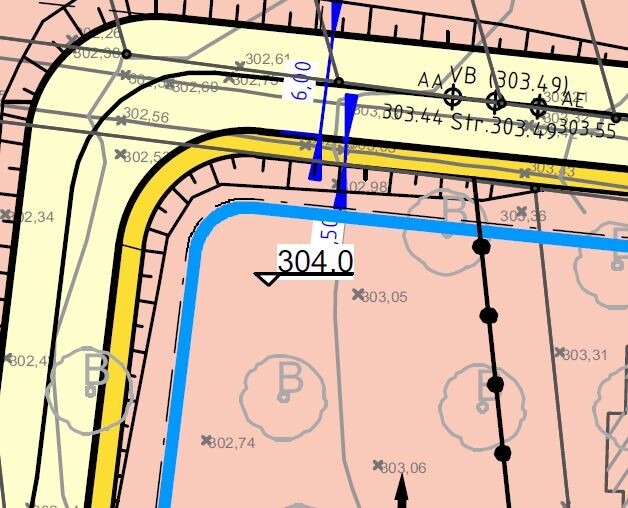
That was the plan... However, I noticed something while measuring the plot myself with a ruler on the digital survey plan: The planned street is at an elevation of 303.49, which is at least 50cm (20 inches) higher than the plot level.
We have now asked three potential builders (one of whom will hopefully be selected in about four weeks) for their opinions:
Prefab timber frame house: The foundation slab works perfectly; the house will be elevated anyway due to the gravel foundation.
Prefab solid house: Please build with a basement so you can use the excavation material as fill. Otherwise, you will have to fill the plot for 15,000 with no added value. Also, below street level is always problematic because of rain.
Architect of a general contractor (solid construction, masonry): Avoid the basement due to possible rock and disposal fees. I can even raise your knee wall to 1.5m (4 ft 11 in), and filling won’t really be necessary. I also don’t see a problem if you end up slightly below street level.
Three answers, but I’m no wiser. (The only thing was that my wife was thrilled when she heard about a 1.5-meter (4 ft 11 in) knee wall.)
We plan to position the house as far to the north as possible and put the garage/carport toward the east next to the neighbor.
I’ve attached a section of the plot (including stipulated and planned contour lines).
Right now, I am hoping for advice from @11ant or @Escroda, as we are at a loss.
--------------------------------------
Development Plan / Restrictions
Plot size: 451 sqm (4850 sq ft)
Slope: 60cm (24 inches) over 20m (66 ft)—or even less
Plot ratio: 0.35
Floor area ratio: none specified in the development plan
Building envelope, building line, and boundary: see attached building envelope, otherwise 3m (10 ft) to neighbors
Boundary construction: no
Parking spaces: minimum 2 required
Number of floors: 2
Roof shape: gable roof, half-hipped roof (30-40 degrees)
Style: classic
Orientation: either parallel to the boundary or ridge direction per development plan
Maximum heights/limits:
Ceiling height: 4.1m (13 ft 5 in)
Ridge height: 8.9m (29 ft 2 in)
Other requirements:
Miscellaneous (tree planting types, etc.), but nothing relevant for the house
--------------------------------------
I have been actively reading here for a few months now, and our project is finally starting.
This week we bought a plot of land from the municipality in a new development area (Northern BW).
We chose this particular plot because, unlike the others, it is "flat." (Most of the other plots are on slopes—either south or north facing; we chose the saddle point.)
Details about the plot are below.
Because of the limited ceiling height of 4.1m (13 ft 5 in), we will have knee walls about 1 to 1.2m (3 ft 3 in to 3 ft 11 in) high. Since we opted for a flat plot, we decided to build without a basement, aiming to make the house as large as possible so that the upper floor simply works (160-170 sqm (1722-1830 sq ft) building footprint = 140-150 sqm (1507-1615 sq ft) living space depending on knee wall height), plus a garage or carport with boundary construction.
That was the plan... However, I noticed something while measuring the plot myself with a ruler on the digital survey plan: The planned street is at an elevation of 303.49, which is at least 50cm (20 inches) higher than the plot level.
We have now asked three potential builders (one of whom will hopefully be selected in about four weeks) for their opinions:
Prefab timber frame house: The foundation slab works perfectly; the house will be elevated anyway due to the gravel foundation.
Prefab solid house: Please build with a basement so you can use the excavation material as fill. Otherwise, you will have to fill the plot for 15,000 with no added value. Also, below street level is always problematic because of rain.
Architect of a general contractor (solid construction, masonry): Avoid the basement due to possible rock and disposal fees. I can even raise your knee wall to 1.5m (4 ft 11 in), and filling won’t really be necessary. I also don’t see a problem if you end up slightly below street level.
Three answers, but I’m no wiser. (The only thing was that my wife was thrilled when she heard about a 1.5-meter (4 ft 11 in) knee wall.)
We plan to position the house as far to the north as possible and put the garage/carport toward the east next to the neighbor.
I’ve attached a section of the plot (including stipulated and planned contour lines).
Right now, I am hoping for advice from @11ant or @Escroda, as we are at a loss.
--------------------------------------
Development Plan / Restrictions
Plot size: 451 sqm (4850 sq ft)
Slope: 60cm (24 inches) over 20m (66 ft)—or even less
Plot ratio: 0.35
Floor area ratio: none specified in the development plan
Building envelope, building line, and boundary: see attached building envelope, otherwise 3m (10 ft) to neighbors
Boundary construction: no
Parking spaces: minimum 2 required
Number of floors: 2
Roof shape: gable roof, half-hipped roof (30-40 degrees)
Style: classic
Orientation: either parallel to the boundary or ridge direction per development plan
Maximum heights/limits:
Ceiling height: 4.1m (13 ft 5 in)
Ridge height: 8.9m (29 ft 2 in)
Other requirements:
Miscellaneous (tree planting types, etc.), but nothing relevant for the house
--------------------------------------
Please share your design. That way, we can better understand the issues. Is a driveway planned for the garage? Is there a slope towards the street?
The street and sidewalk must definitely not drain onto your property. I assume this is already planned accordingly. Your house will likely be built right up to the building line, so the maximum width for this strip is about 3 meters (10 feet)? This is manageable, even if the house is set lower than the street.
The street and sidewalk must definitely not drain onto your property. I assume this is already planned accordingly. Your house will likely be built right up to the building line, so the maximum width for this strip is about 3 meters (10 feet)? This is manageable, even if the house is set lower than the street.
[QUOTE="11ant, post: 442085, member: 32750"
Quite naive. One and a half meters of knee wall, and she will hardly be able to "look over the steering wheel," meaning she will only see the bottom edges of the window frames. You only wish for that if you can’t count to pi.
In the plan excerpt, I see a kneeling line. Does the eaves height refer to the valley side or the mountain side?
[/QUOTE]
That’s not naive, but fully understandable. With a roof pitch of 40 degrees, it’s definitely possible to install windows in the gables, or to consider double casement windows, dormers, or bay windows. However, I haven’t read the development plan. That’s your area of expertise.
In the development plan, I had a 1 m (3 ft 3 in) knee wall but managed to achieve 1.60 m (5 ft 3 in) in a bay window. The difference is significant with a 45-degree roof pitch.
Quite naive. One and a half meters of knee wall, and she will hardly be able to "look over the steering wheel," meaning she will only see the bottom edges of the window frames. You only wish for that if you can’t count to pi.
In the plan excerpt, I see a kneeling line. Does the eaves height refer to the valley side or the mountain side?
[/QUOTE]
That’s not naive, but fully understandable. With a roof pitch of 40 degrees, it’s definitely possible to install windows in the gables, or to consider double casement windows, dormers, or bay windows. However, I haven’t read the development plan. That’s your area of expertise.
In the development plan, I had a 1 m (3 ft 3 in) knee wall but managed to achieve 1.60 m (5 ft 3 in) in a bay window. The difference is significant with a 45-degree roof pitch.
11ant schrieb:
Quite naive. One and a half meters (5 feet) of knee wall, she will hardly be able to "look over the steering wheel," meaning you will only see the bottom edges of the window frames. That is only wished for if you can’t count to pi.
In the plan excerpt, I see a nodal line. Does the eaves height refer to the valley or mountain side? That is not naive, but perfectly understandable. With a roof pitch of 40 degrees, it is quite feasible to install windows in the gable ends and/or include double casement windows, dormers, or bay windows. However, I have not read the development plan, as that is your area of expertise.
In the development plan, I had a 1 meter (3 feet 3 inches) knee wall but managed to achieve 1.60 meters (5 feet 3 inches) in a bay window. The difference is significant with a 45-degree roof pitch.
Similar topics