
Hello everyone,
This concerns a single-family house built in 2004/2005. At one spot in the wall plaster, there are strange deposits visible, see photo. According to the documents, a “colored stone plaster No. 900 with a grain size of 3 mm (0.12 inches)” was applied to the base area, and on the house wall a “Terrastar 222 disc plaster light 3 mm (0.12 inches).” Around the house, a 40 cm (16 inches) wide eaves strip filled with gravel has been laid. However, in front of it are flower beds with many hydrangeas and other larger plants, some of which cover the edge of the eaves strip and in some cases reach almost up to the house wall. The stain varied from gray to brown to slightly pink.
At first, I thought the pinkish color might be caused by algae due to shading on the wall in this area (the wall faces directly north). However, these stains do not appear anywhere else along the same wall, so it can’t be solely due to the northern exposure. Also, there are no plants directly at this spot. My second guess was that the previous occupants had a permanently installed hose system to water the flower beds, and over time, the (quite iron-rich!) well water was sprayed uncontrollably onto the wall. The shape of the stain could support this idea: to me, it looks like stalagmites growing upwards from the floor of a cave. A watering system might have sprayed several thin water jets at the same points on the wall repeatedly, from where the water then ran down in a widening streak.
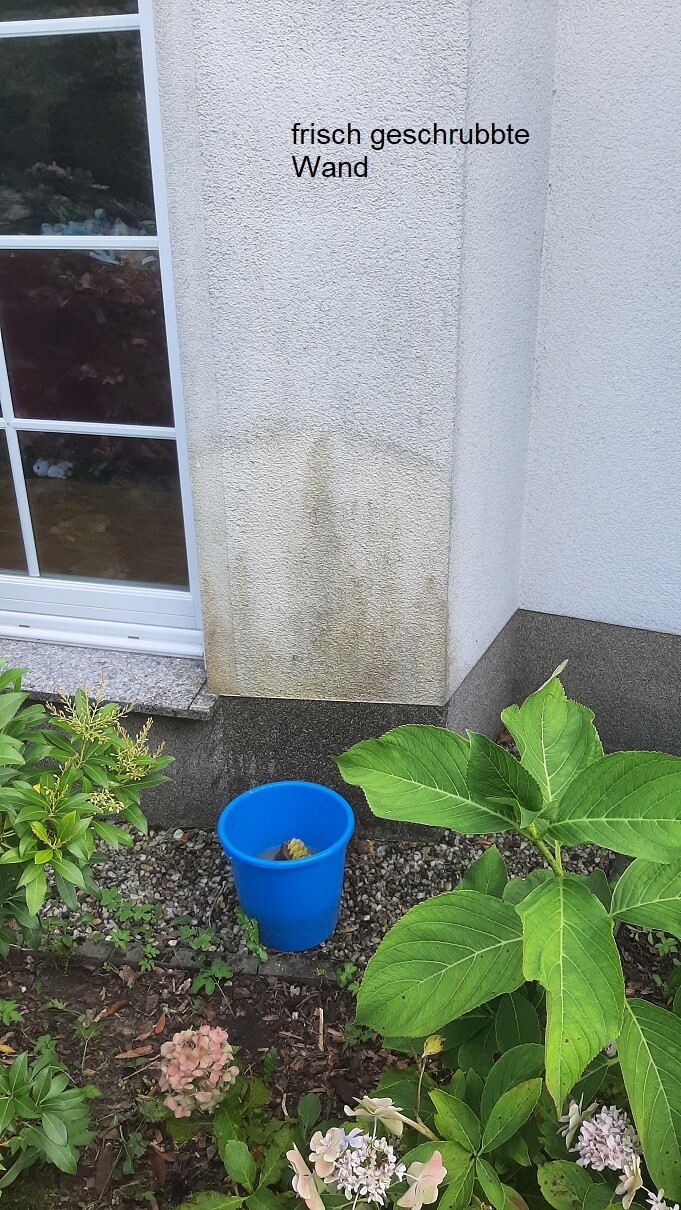
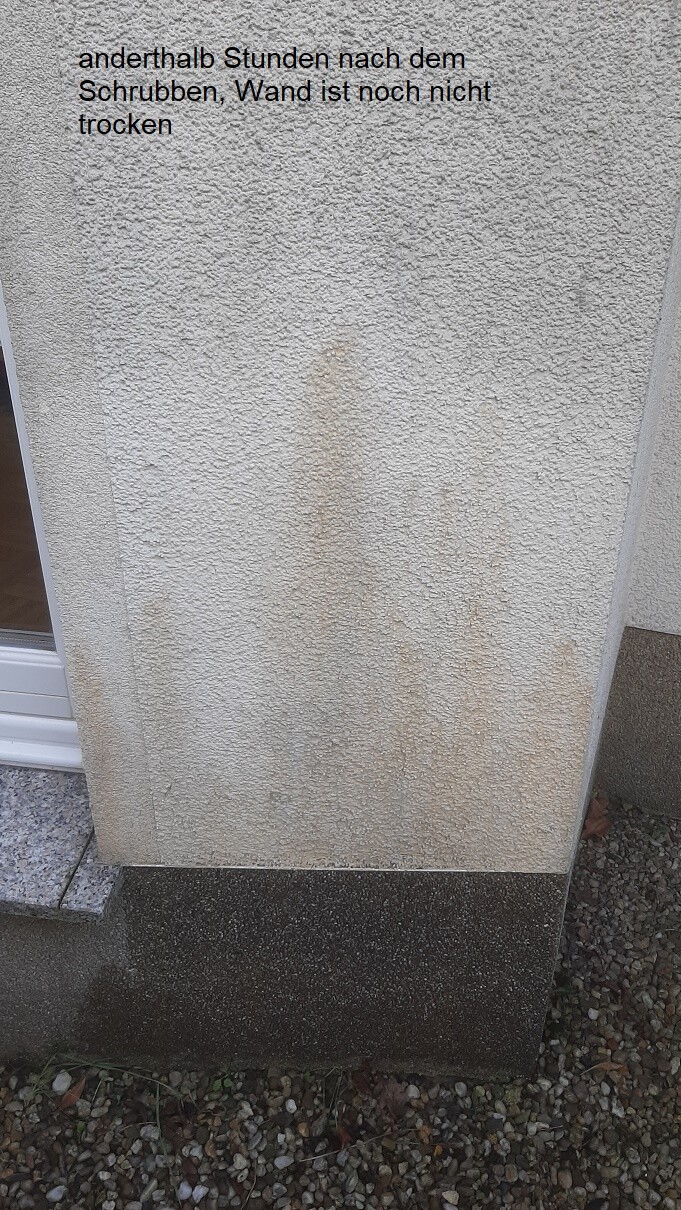
Yesterday, I applied a generous amount of Biostein with a brush onto the damp wall (for those unfamiliar with Biostein: a very effective household cleaner that removes most stains), let it sit for about 15 minutes, and then scrubbed. A strong ocher-yellow liquid ran down (unfortunately, I didn’t take a picture of it in my enthusiasm for scrubbing). The last photo shows the scrubbed wall, still slightly damp and not fully dry yet; the remaining stains do not come off further.
What do you think about the algae theory? What do you make of the permanently installed watering system idea? What other causes for this kind of damage come to mind? And: which of these is most likely, and why?
Thank you very much, and best regards,
Marco
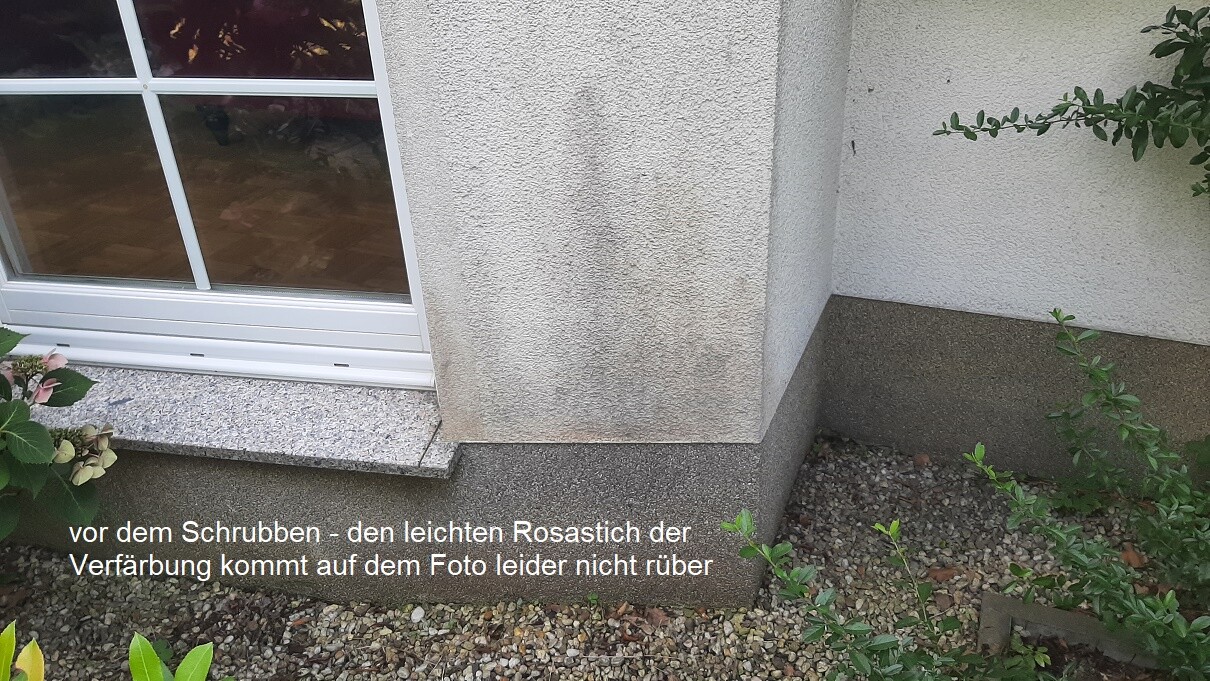
This concerns a single-family house built in 2004/2005. At one spot in the wall plaster, there are strange deposits visible, see photo. According to the documents, a “colored stone plaster No. 900 with a grain size of 3 mm (0.12 inches)” was applied to the base area, and on the house wall a “Terrastar 222 disc plaster light 3 mm (0.12 inches).” Around the house, a 40 cm (16 inches) wide eaves strip filled with gravel has been laid. However, in front of it are flower beds with many hydrangeas and other larger plants, some of which cover the edge of the eaves strip and in some cases reach almost up to the house wall. The stain varied from gray to brown to slightly pink.
At first, I thought the pinkish color might be caused by algae due to shading on the wall in this area (the wall faces directly north). However, these stains do not appear anywhere else along the same wall, so it can’t be solely due to the northern exposure. Also, there are no plants directly at this spot. My second guess was that the previous occupants had a permanently installed hose system to water the flower beds, and over time, the (quite iron-rich!) well water was sprayed uncontrollably onto the wall. The shape of the stain could support this idea: to me, it looks like stalagmites growing upwards from the floor of a cave. A watering system might have sprayed several thin water jets at the same points on the wall repeatedly, from where the water then ran down in a widening streak.
Yesterday, I applied a generous amount of Biostein with a brush onto the damp wall (for those unfamiliar with Biostein: a very effective household cleaner that removes most stains), let it sit for about 15 minutes, and then scrubbed. A strong ocher-yellow liquid ran down (unfortunately, I didn’t take a picture of it in my enthusiasm for scrubbing). The last photo shows the scrubbed wall, still slightly damp and not fully dry yet; the remaining stains do not come off further.
What do you think about the algae theory? What do you make of the permanently installed watering system idea? What other causes for this kind of damage come to mind? And: which of these is most likely, and why?
Thank you very much, and best regards,
Marco
M
MarcomitZeh14 Sep 2025 12:56nordanney schrieb:
North-facing areas and spots behind plants are particularly prone to this. They stay damp repeatedly and hardly dry out because no sunlight reaches them. You can observe this in any new housing development.Well, that’s exactly the only part of the wall where there are no plants. I’m attaching an overview photo again – the stained area is below the orange arrow. Everywhere else, even in places more or less covered by plants, the wall is completely fine. So, what now?M
MarcomitZeh22 Sep 2025 15:50Hello everyone,
After receiving a quick diagnosis here in the forum (algae) but no explanation for my questions about why they appear exactly at this spot, and only there, I have meanwhile found a very informative article by an expert elsewhere on the internet. Its key points might also interest you – at least, it fully answers my questions (not only "what," but also "why"). Consequently, I have completely abandoned the theory of rust stains and garden water.
1. Algae and mold fungi preferably occur on synthetic resin renders or synthetic resin paints. They are rare on purely mineral renders (like the one I have) – in that case, several unfavorable conditions must come together.
2. Although I have a 70cm (28 inch) roof overhang all around, the bay window with the stain protrudes below the roof and is sprayed with water. In addition, this wall is north-facing.
3. Algae are pioneer organisms that only need light and water to settle. They produce organic matter through photosynthesis, taking the required carbon from the CO2 in the surrounding air. In contrast, mold develops where organic matter is already present (e.g., on a surface previously colonized by algae) and where water is present; light is not necessary. This is the long-sought explanation why the algae grow exactly at this one spot on the house wall that is NOT covered by plants: light and water.
Since the missing roof overhang at this spot unfortunately cannot be fixed, the renovation will proceed as follows: mechanical cleaning (already done), followed by disinfection with an algaecide. Next summer (when the window repairs and plaster cracks/chips have also been addressed), the entire facade will be pressure-washed, primed, and repainted with a mineral-based, hydrophobic paint suitable for the mineral, hydrophobic render. The surrounding plants will be trimmed back (to promote drying of the facade by wind), but above all, facade cleaning and repainting will be repeated every 10–12 years.
Best regards from the Havelland,
Marco
After receiving a quick diagnosis here in the forum (algae) but no explanation for my questions about why they appear exactly at this spot, and only there, I have meanwhile found a very informative article by an expert elsewhere on the internet. Its key points might also interest you – at least, it fully answers my questions (not only "what," but also "why"). Consequently, I have completely abandoned the theory of rust stains and garden water.
1. Algae and mold fungi preferably occur on synthetic resin renders or synthetic resin paints. They are rare on purely mineral renders (like the one I have) – in that case, several unfavorable conditions must come together.
2. Although I have a 70cm (28 inch) roof overhang all around, the bay window with the stain protrudes below the roof and is sprayed with water. In addition, this wall is north-facing.
3. Algae are pioneer organisms that only need light and water to settle. They produce organic matter through photosynthesis, taking the required carbon from the CO2 in the surrounding air. In contrast, mold develops where organic matter is already present (e.g., on a surface previously colonized by algae) and where water is present; light is not necessary. This is the long-sought explanation why the algae grow exactly at this one spot on the house wall that is NOT covered by plants: light and water.
Since the missing roof overhang at this spot unfortunately cannot be fixed, the renovation will proceed as follows: mechanical cleaning (already done), followed by disinfection with an algaecide. Next summer (when the window repairs and plaster cracks/chips have also been addressed), the entire facade will be pressure-washed, primed, and repainted with a mineral-based, hydrophobic paint suitable for the mineral, hydrophobic render. The surrounding plants will be trimmed back (to promote drying of the facade by wind), but above all, facade cleaning and repainting will be repeated every 10–12 years.
Best regards from the Havelland,
Marco
Similar topics