
Hello everyone,
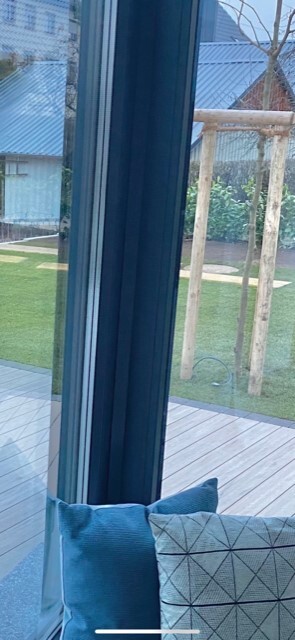
In our new build, we have some corner windows. The structural steel columns were installed directly onto the masonry by the shell contractor, and then the window installer fitted the windows. The window profiles were insulated and formworked on the outside at these points. We generally have a 16cm (6 inch) external thermal insulation composite system (ETICS). Inside, the steel columns are still exposed because we weren’t sure yet whether to clad or paint them.
Now I’ve noticed that the steel columns feel quite cold at the top and bottom. With an outside temperature of 3°C (37°F), the wall surface is about 20.3°C (68.5°F), the window frame 17.4°C (63.3°F), and the column in the middle 14.5°C (58.1°F). At the bottom, the steel columns are even colder, around 12.4°C to 13.2°C (54.3°F to 55.8°F). In the cavity (between the exterior cladding and the concrete), it’s as low as 10.7°C (51.3°F). The steel column runs down to the floor, and due to the floor construction there is essentially a small cavity beneath. For the other windows, this is, for example, where the window sill is.
I’ve heard that these steel columns can generally be problematic, but is this normal? I’ve been advised to fill the cavity with insulating foam and to insulate and clad the steel columns.
What do you think? Is this normal and the proposed solution the best approach, or has something been “forgotten” and the suggestion is just to show that something was done? It would be frustrating if the column starts to rust due to condensation—especially if I clad it and can no longer check on it.
What are your thoughts?
In our new build, we have some corner windows. The structural steel columns were installed directly onto the masonry by the shell contractor, and then the window installer fitted the windows. The window profiles were insulated and formworked on the outside at these points. We generally have a 16cm (6 inch) external thermal insulation composite system (ETICS). Inside, the steel columns are still exposed because we weren’t sure yet whether to clad or paint them.
Now I’ve noticed that the steel columns feel quite cold at the top and bottom. With an outside temperature of 3°C (37°F), the wall surface is about 20.3°C (68.5°F), the window frame 17.4°C (63.3°F), and the column in the middle 14.5°C (58.1°F). At the bottom, the steel columns are even colder, around 12.4°C to 13.2°C (54.3°F to 55.8°F). In the cavity (between the exterior cladding and the concrete), it’s as low as 10.7°C (51.3°F). The steel column runs down to the floor, and due to the floor construction there is essentially a small cavity beneath. For the other windows, this is, for example, where the window sill is.
I’ve heard that these steel columns can generally be problematic, but is this normal? I’ve been advised to fill the cavity with insulating foam and to insulate and clad the steel columns.
What do you think? Is this normal and the proposed solution the best approach, or has something been “forgotten” and the suggestion is just to show that something was done? It would be frustrating if the column starts to rust due to condensation—especially if I clad it and can no longer check on it.
What are your thoughts?
Did I understand correctly that the windows are installed directly next to the steel columns? That’s the case for us as well. We also had major issues with three steel columns positioned between floor-to-ceiling units. Today, neither the architect, the window supplier, the structural engineer, nor the thermal insulation consultant could provide a convincing explanation of how to properly cover them. However, we had a fundamental problem with the structural design, the ring beam, and the windows, because the architect made an error in the plans, which made it impossible to build as specified. That was an additional challenge. But that’s beside the point now. On the exterior, we insulated the steel columns and window frames with the external thermal insulation composite system (ETICS). We also drilled each column at three points and filled them with lots of foam. On the interior side, we will glue Styrofoam boards and then plaster over them.
Regards
Regards
M
Martial.white24 Jan 2021 07:03Hello everyone,
We are also getting corner windows. However, I don’t quite understand the problem. Could you please post a picture of the steel support?
We are also getting corner windows. However, I don’t quite understand the problem. Could you please post a picture of the steel support?
imsi123 schrieb:
Did I understand correctly that the windows are installed directly against the steel support columns? That’s how it is in our case as well. We also had big problems with three steel columns located between floor-to-ceiling window elements. Today, neither the architect, the window installer, the structural engineer, nor the thermal insulation consultant have been able to provide a clear explanation on how to properly cover them.
However, we had a fundamental problem with the structural engineering, the ring beam, and the windows – the architect made a mistake in the plans, which meant the design could not be built as originally drawn. That added to the difficulties. But let’s put that aside for now. On the outside, we insulated the steel columns and the window frames with an external thermal insulation composite system (ETICS / EIFS). We also drilled three holes into each column and filled them with large amounts of expanding foam. From the inside, we are now going to glue on polystyrene insulation boards (Styrodur) and then plaster over them.
Best regards So, does that mean the steel columns are still visible to you? How are the temperatures? Did the measures help?
Martial.white schrieb:
Hello everyone,
we are also getting corner windows. But I don’t really understand the problem. Could you post a picture of the steel support column? I have now found some pictures...
In the pictures, you can see one and the same steel column. Unfortunately, I don’t have a photo of the windows before installation, but I think it’s still clear enough. In the second picture, you can see how the column was covered from the outside. After that, additional insulation was installed, followed by cladding.
Inside, there are now two options: one with window sills (don’t worry, nothing has been plastered there) and one with glazing down to the floor. You can see that there is a gap under the window sills and also under the parquet flooring. I would spray insulation material into those gaps, insulate the column with some polystyrene, and then cover it.
P.S. I recall that there was a loud whistling noise when it was quite windy. The window installer sealed one of the columns a bit more afterwards, but I think this is just a general problem.
Yes, same here, but with floor-to-ceiling windows... we are still building, so we don’t know yet if it was effective or the right/wrong choice: no idea. I would definitely do the foam sealing. It only costs a few euros, doesn’t require much work, and it can’t do any harm.
Best regards
Best regards
A
Alessandro26 Jan 2021 08:37That is really poorly designed. This way, you always have an edge sticking out into the room!
In our case, the beam was installed with a 45° angle so that the flat side, not the edge, faces into the room. Then, an insulated plastic profile was attached to visually connect the two windows.
In our case, the beam was installed with a 45° angle so that the flat side, not the edge, faces into the room. Then, an insulated plastic profile was attached to visually connect the two windows.
Similar topics