
Hello and good morning,
an opening in an outbuilding wall is being enlarged to a clear width of 4m (13 feet) and a clear height of 2.125m (7 feet) for a sectional garage door, or is already at that size. An IPE450 steel beam is involved here. The attached sketch illustrates the situation somewhat more clearly – although it is unfortunately not to scale. The web of the IPE beam is actually much taller, and the flange is relatively short by comparison, so the drawing is somewhat misleading. Both the interior and exterior will be plastered. However, the top of the door frame must be secured inside.
My questions:
What materials and methods are best for insulating the beam?
Simply gluing insulation (e.g. XPS) seems quite risky, especially underneath (overhead) the beam. Screwing would certainly be better, but how can potential thermal bridges be managed in that case?
What could I use to fix or screw the door frame to?
Thank you very much for your ideas.
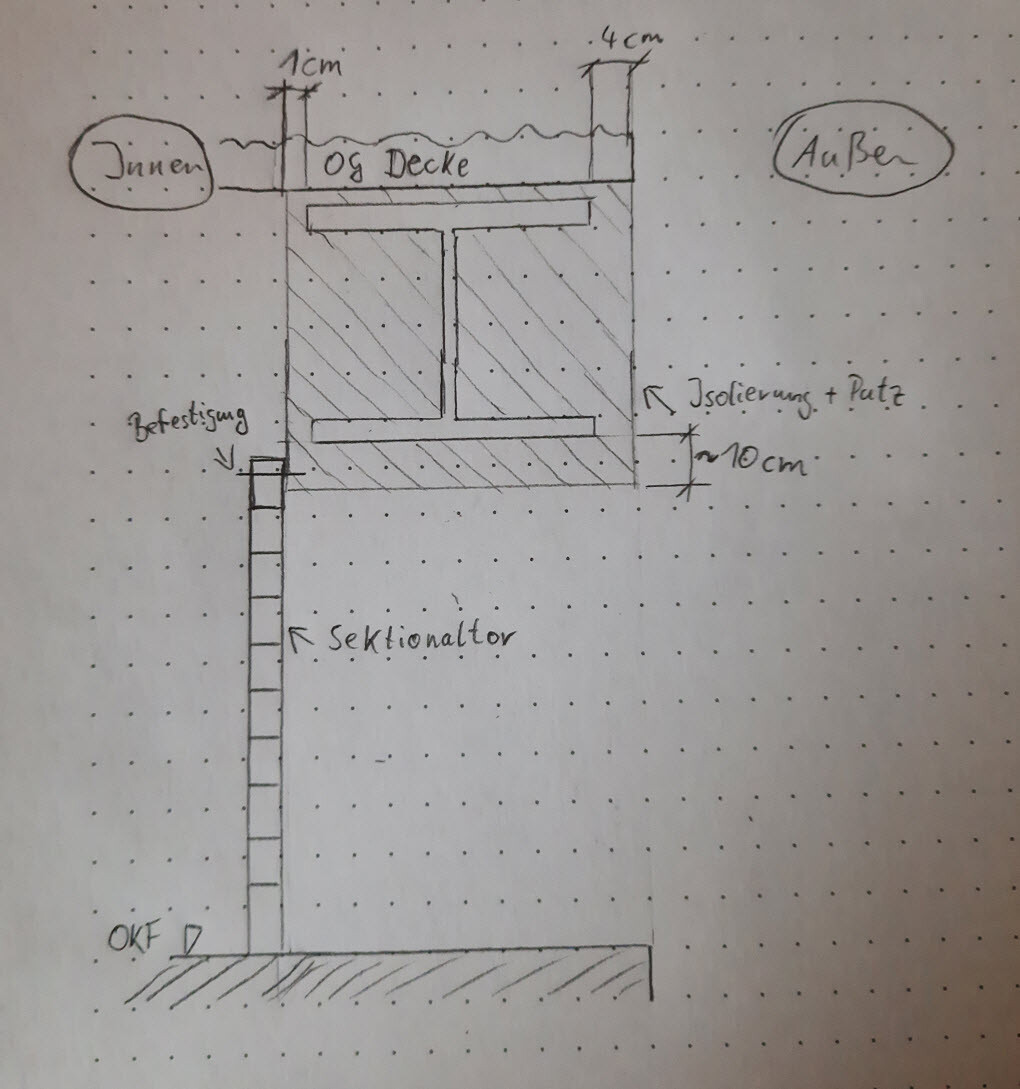
an opening in an outbuilding wall is being enlarged to a clear width of 4m (13 feet) and a clear height of 2.125m (7 feet) for a sectional garage door, or is already at that size. An IPE450 steel beam is involved here. The attached sketch illustrates the situation somewhat more clearly – although it is unfortunately not to scale. The web of the IPE beam is actually much taller, and the flange is relatively short by comparison, so the drawing is somewhat misleading. Both the interior and exterior will be plastered. However, the top of the door frame must be secured inside.
My questions:
What materials and methods are best for insulating the beam?
Simply gluing insulation (e.g. XPS) seems quite risky, especially underneath (overhead) the beam. Screwing would certainly be better, but how can potential thermal bridges be managed in that case?
What could I use to fix or screw the door frame to?
Thank you very much for your ideas.
S
Simon-1896 Apr 2022 21:17Hello,
The IPE 450 beam seems appropriately sized, depending on the loads (wall height, how much live load in N/m² is calculated on the ceiling, etc.). So that should be fine.
To cover a steel lintel like this, it almost always comes down to the same construction: steel angles are welded on the inside and outside, top and bottom, usually around 50x5 or 60x6 millimeters (2x0.2 or 2.4x0.24 inches). The space between the angles is filled with mineral wool, and OSB boards or drywall panels are screwed onto the inside of the angles. On the outside, render carrier boards are attached and then plastered as desired.
I would proceed similarly on the underside. Add thickness to create a mounting surface for the render carrier board, insulate, and plaster. Although I question why so much attention is given to minimizing thermal bridges caused by screws in a 24-centimeter (9.5-inch) wall. I wouldn’t prioritize that too much, as it doesn’t significantly affect the overall calculation.
What exactly will be fastened to your gate lintel at the top? A standard sectional door only has its sealing lip along the top, which should or must press against the lintel from the inside. All loads are transferred via the side guide rails directly down to the floor slab. Unless we are talking about an industrial door with a torsion spring mounted at the top? However, that seems unlikely given the mentioned gate size.
Do you have enough space for a standard redirecting fitting, or do you require a low-headroom hardware?
Best regards,
Simon
The IPE 450 beam seems appropriately sized, depending on the loads (wall height, how much live load in N/m² is calculated on the ceiling, etc.). So that should be fine.
To cover a steel lintel like this, it almost always comes down to the same construction: steel angles are welded on the inside and outside, top and bottom, usually around 50x5 or 60x6 millimeters (2x0.2 or 2.4x0.24 inches). The space between the angles is filled with mineral wool, and OSB boards or drywall panels are screwed onto the inside of the angles. On the outside, render carrier boards are attached and then plastered as desired.
I would proceed similarly on the underside. Add thickness to create a mounting surface for the render carrier board, insulate, and plaster. Although I question why so much attention is given to minimizing thermal bridges caused by screws in a 24-centimeter (9.5-inch) wall. I wouldn’t prioritize that too much, as it doesn’t significantly affect the overall calculation.
What exactly will be fastened to your gate lintel at the top? A standard sectional door only has its sealing lip along the top, which should or must press against the lintel from the inside. All loads are transferred via the side guide rails directly down to the floor slab. Unless we are talking about an industrial door with a torsion spring mounted at the top? However, that seems unlikely given the mentioned gate size.
Do you have enough space for a standard redirecting fitting, or do you require a low-headroom hardware?
Best regards,
Simon
Hello Simon,
Thank you very much for your detailed response.
The beam has been officially assessed for structural stability, which is fine.
Currently, the described room is intended to be used as a garage. Above it, there are plans to eventually build a small residential unit, and since I am completely reinstalling the lintel, I would like to include solid technical thermal insulation. Perhaps the garage will be repurposed again at some point...
The sectional door from a major German manufacturer will be a so-called thermal version, providing a good basis for thermal insulation there as well. The dimensions are 4 x 2.125 m (13 ft 1 1/2 in x 6 ft 11 3/4 in) with N-hinges and a pre-installed torsion spring. Regarding the number of fixing points for the lintel cover, I am unfortunately unsure. Both the fixing of the cover and the drive chain will need to be securely and rigidly attached to the steel lintel. Here, I am considering a welded angle bracket.
Regarding the insulation, I have come up with the following amateur idea:
Fill the beam on the left and right sides of the web with XPS insulation (90 mm (3 1/2 in) – sufficiently pressure-resistant for the height of the I-beam) up to the flange edge (using mounting adhesive). Do the same below the beam up to the lintel cover for the door. Then, apply full-surface building boards on both the inside and outside. Additionally, at the ceiling of the upper floor, close to the transition to the I-beam, screw expanded metal mesh on the inside and outside, running all around the beam. This would ensure that the insulation below the lintel is not held exclusively by the adhesive. Then plaster everything, applying corner beads with mesh tape or corner plaster beads beforehand.
Also, provide smaller welded metal brackets as stops for the door lintel cover and for screwing (as mentioned above).
What do you think of this? (It seems more elaborate than your suggestion...?)
Good luck
Thank you very much for your detailed response.
The beam has been officially assessed for structural stability, which is fine.
Currently, the described room is intended to be used as a garage. Above it, there are plans to eventually build a small residential unit, and since I am completely reinstalling the lintel, I would like to include solid technical thermal insulation. Perhaps the garage will be repurposed again at some point...
The sectional door from a major German manufacturer will be a so-called thermal version, providing a good basis for thermal insulation there as well. The dimensions are 4 x 2.125 m (13 ft 1 1/2 in x 6 ft 11 3/4 in) with N-hinges and a pre-installed torsion spring. Regarding the number of fixing points for the lintel cover, I am unfortunately unsure. Both the fixing of the cover and the drive chain will need to be securely and rigidly attached to the steel lintel. Here, I am considering a welded angle bracket.
Regarding the insulation, I have come up with the following amateur idea:
Fill the beam on the left and right sides of the web with XPS insulation (90 mm (3 1/2 in) – sufficiently pressure-resistant for the height of the I-beam) up to the flange edge (using mounting adhesive). Do the same below the beam up to the lintel cover for the door. Then, apply full-surface building boards on both the inside and outside. Additionally, at the ceiling of the upper floor, close to the transition to the I-beam, screw expanded metal mesh on the inside and outside, running all around the beam. This would ensure that the insulation below the lintel is not held exclusively by the adhesive. Then plaster everything, applying corner beads with mesh tape or corner plaster beads beforehand.
Also, provide smaller welded metal brackets as stops for the door lintel cover and for screwing (as mentioned above).
What do you think of this? (It seems more elaborate than your suggestion...?)
Good luck
Similar topics