
We have reserved a plot and are still looking for the right floor plan. Technically, everything is possible, meaning a townhouse, one-and-a-half storeys, or even a bungalow. The plot is almost square and 600 sqm (6,458 sq ft) in size. It faces south-southwest. We need 2 children’s bedrooms (preferably on the south side), a master bedroom, a bathroom upstairs and downstairs, a living/dining/kitchen area that is as open as possible, a guest toilet, and a utility room (possibly 6–7 sqm (65–75 sq ft)). Both floors will of course be connected by a staircase. No basement, no finished attic, a very large double garage separate from but not directly attached to the house. We are thinking of around 130 sqm (1,400 sq ft) in total.
These are basically standard requirements, and the orientation with almost due south, plus the relatively large, square plot, should all make it easy to choose a very standard floor plan, right? But apparently, this is not possible, at least not with about 130 sqm (1,400 sq ft)?
In all the plans we have seen, something here or there doesn’t fit, or there is one big problem: The staircase to the upper floor is immediately at the entrance, placing it in the "dirt zone." Does anyone know of an absolutely standard floor plan, perhaps from a builder, self-built, or from friends or family, that is really good? Or is EVERY floor plan more or less a compromise, even when the requirements and the situation (plot, orientation, everything can be built) are actually so simple?
These are basically standard requirements, and the orientation with almost due south, plus the relatively large, square plot, should all make it easy to choose a very standard floor plan, right? But apparently, this is not possible, at least not with about 130 sqm (1,400 sq ft)?
In all the plans we have seen, something here or there doesn’t fit, or there is one big problem: The staircase to the upper floor is immediately at the entrance, placing it in the "dirt zone." Does anyone know of an absolutely standard floor plan, perhaps from a builder, self-built, or from friends or family, that is really good? Or is EVERY floor plan more or less a compromise, even when the requirements and the situation (plot, orientation, everything can be built) are actually so simple?

S
Sebastian7921 Jun 2015 19:32Yvonne, you’re being mean – he really hoped for it.
Yvonne has pinned a very helpful thread at the top of the idea generation forum section:
https://www.hausbau-forum.de/threads/grundrissplanung-bitte-vor-Thread-Erstellung-lesen.11714/
Since there is obviously already a potential plot of land in consideration, having a site plan with the building boundary and a north arrow, etc., would be very useful information.
https://www.hausbau-forum.de/threads/grundrissplanung-bitte-vor-Thread-Erstellung-lesen.11714/
Since there is obviously already a potential plot of land in consideration, having a site plan with the building boundary and a north arrow, etc., would be very useful information.
Plot:
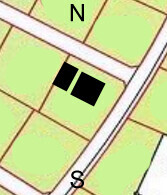
The adjacent streets are traffic-calmed, similar to what is known as a play street. The black bars are intended to represent a garage along the boundary and a house. Two parking spaces are mandatory. Eaves height up to 6.30 meters (20.7 feet). Hip roof, pyramid roof, and gable roof are possible. Roof pitch between 25 and 45 degrees. No building envelope or similar restrictions. The plot measures 600 square meters (about 6,458 square feet) and, as you can see, is almost square.
The adjacent streets are traffic-calmed, similar to what is known as a play street. The black bars are intended to represent a garage along the boundary and a house. Two parking spaces are mandatory. Eaves height up to 6.30 meters (20.7 feet). Hip roof, pyramid roof, and gable roof are possible. Roof pitch between 25 and 45 degrees. No building envelope or similar restrictions. The plot measures 600 square meters (about 6,458 square feet) and, as you can see, is almost square.
Here’s a useful tip for you!
Houses are designed on paper—you use either the site plan or the draft from the general contractor. And measurements are included.
You should not be distracted by colorful pictures but rather take a pencil and paper and get a real sense of the property.
I have been following quite a bit over there in the last few days—I also read that you have been working on your own plans since last year and haven’t made much progress.
It might be that you are approaching the house building process the wrong way. While you are drawing your “dream house,” you should also find a general contractor you trust to handle your housing needs.
If architects repeatedly give you advice along this challenging journey, consider it carefully—but don’t get stuck on ideas like only visiting the kitchen twice a week or that 2 square meters (22 square feet) of storage space for household items (if the caretaker doesn’t bring everything themselves ) will be sufficient.
However, you usually cannot just combine advice x and advice y from different sources into one design without compromising the overall plan. Examples mentioned should always be reconsidered, and if you are convinced you want to include them, starting over often leads to better results than trying to implement improvements within an imaginary square of exterior walls.
Have you really been drawing since October?
Houses are designed on paper—you use either the site plan or the draft from the general contractor. And measurements are included.
You should not be distracted by colorful pictures but rather take a pencil and paper and get a real sense of the property.
I have been following quite a bit over there in the last few days—I also read that you have been working on your own plans since last year and haven’t made much progress.
It might be that you are approaching the house building process the wrong way. While you are drawing your “dream house,” you should also find a general contractor you trust to handle your housing needs.
If architects repeatedly give you advice along this challenging journey, consider it carefully—but don’t get stuck on ideas like only visiting the kitchen twice a week or that 2 square meters (22 square feet) of storage space for household items (if the caretaker doesn’t bring everything themselves ) will be sufficient.
However, you usually cannot just combine advice x and advice y from different sources into one design without compromising the overall plan. Examples mentioned should always be reconsidered, and if you are convinced you want to include them, starting over often leads to better results than trying to implement improvements within an imaginary square of exterior walls.
Have you really been drawing since October?
Similar topics