
Hello everyone,
Our architects' current stair design shows that the second-to-last step extends into the hallway on the upper floor (see attached image). This means there is already an opening about 10 cm (4 inches) wide in the hallway area where the step descends.
We are concerned that this might create a kind of "tripping hazard."
What do you think? Is this not a problem, or should we definitely avoid it?
Best regards,
k.loe
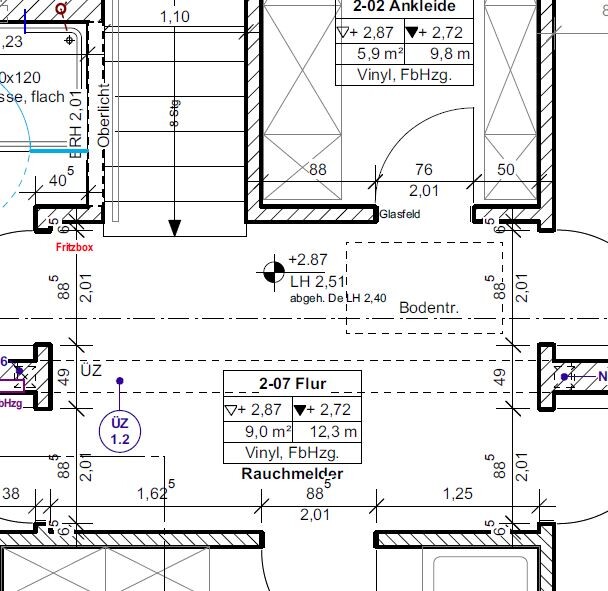
Our architects' current stair design shows that the second-to-last step extends into the hallway on the upper floor (see attached image). This means there is already an opening about 10 cm (4 inches) wide in the hallway area where the step descends.
We are concerned that this might create a kind of "tripping hazard."
What do you think? Is this not a problem, or should we definitely avoid it?
Best regards,
k.loe
O
Osnabruecker12 Jul 2020 13:01A simple solution would be to extend the handrail around the corner on both sides.
The handrail would then protrude into the hallway, reducing the chance of stepping onto the stair tread.
If it is not going to be a standard staircase, the tread depth could possibly be reduced by 1 cm (0.4 inches) on each step.
The handrail would then protrude into the hallway, reducing the chance of stepping onto the stair tread.
If it is not going to be a standard staircase, the tread depth could possibly be reduced by 1 cm (0.4 inches) on each step.
 bauenmk202012 Jul 2020 13:35
Are you sure this is the second-to-last level? It looks more like the final level, which roughly corresponds to the finished floor height (FFH).
By the way, I would move the door to the walk-in closet slightly to the left because of the wardrobe depth.
By the way, I would move the door to the walk-in closet slightly to the left because of the wardrobe depth.
Hello, I was also initially confused and didn’t recognize it on the plans right away.
However, only the second-to-last step is actually drawn, from which there is another rise of about 18 cm (7 inches) up to the finished floor level (step dimensions: 17.9/27).
I have also attached the separate stair plan, where this is clearer.
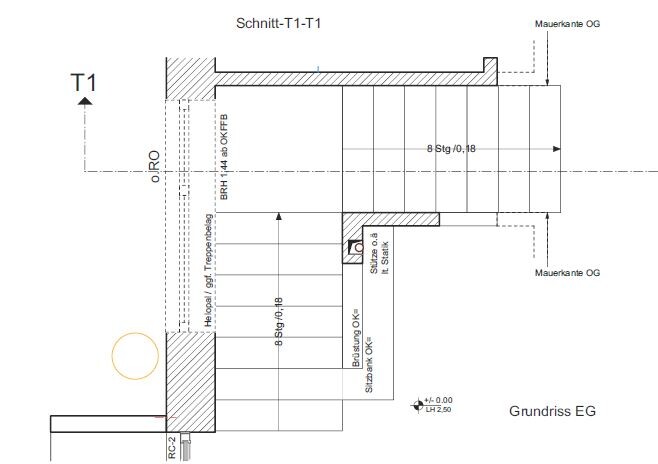
However, only the second-to-last step is actually drawn, from which there is another rise of about 18 cm (7 inches) up to the finished floor level (step dimensions: 17.9/27).
I have also attached the separate stair plan, where this is clearer.
bauenmk202012 Jul 2020 14:50I would also find it bothersome if the stairway is directly in front of the bathroom door.
You have a spacious staircase, so why are the doors comparatively less generous?
If you reduced the stair width to 1m (3.3 ft), the staircase would also become a bit shorter. Maybe that would be sufficient?
Would door dimensions of 90cm (35 inches) width and over 2.10m (6 ft 11 in) height be possible?
You have a spacious staircase, so why are the doors comparatively less generous?
If you reduced the stair width to 1m (3.3 ft), the staircase would also become a bit shorter. Maybe that would be sufficient?
Would door dimensions of 90cm (35 inches) width and over 2.10m (6 ft 11 in) height be possible?
That could indeed be a possible "solution" to reduce the stair width to 1.00 m (3 ft 3.7 in) or 1.05 m (3 ft 5.3 in), which would make the step width only 26.5 cm (10.4 inches). This way, the staircase would be flush with the wall.
However, we fundamentally want to keep the stair width at 1.10 m (3 ft 7.3 in) to have enough "maneuvering space," since the staircase is walled on both sides.
What do you mean by less generous doors? Except for the walk-in closet, they are planned with a width of 88 cm (34.6 inches), and since we are both under 1.75 m (5 ft 8.9 in) tall, we did not consider a greater height necessary.
However, we fundamentally want to keep the stair width at 1.10 m (3 ft 7.3 in) to have enough "maneuvering space," since the staircase is walled on both sides.
What do you mean by less generous doors? Except for the walk-in closet, they are planned with a width of 88 cm (34.6 inches), and since we are both under 1.75 m (5 ft 8.9 in) tall, we did not consider a greater height necessary.
Similar topics