
Hello everyone,
We are currently working on the interior finishing and are having some difficulty planning the design of our concrete staircase. The problem is the border strip.
During the shell construction phase, a raised edge was created around the ceiling opening on the concrete floor on the ground floor and first floor. This was recommended to us and is now unfortunately fixed. This raised edge is about 10 cm (4 inches) wide and 13 cm (5 inches) high. The finished floor height is 16 cm (6 inches). This results in a step difference.
Here is a photo showing how it looks now on the ground floor:
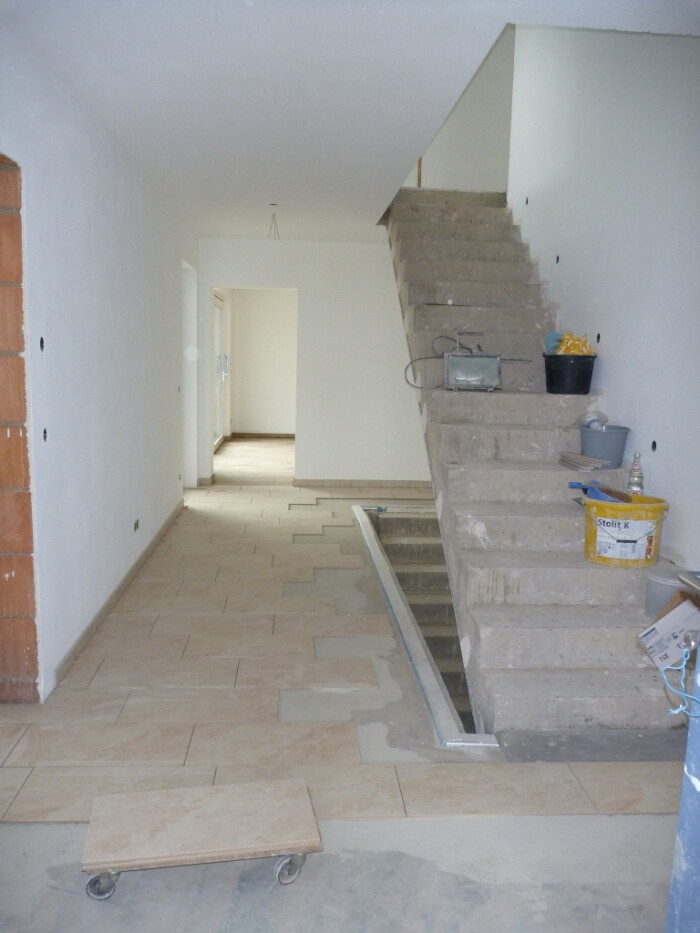
The ceiling edges will be plastered. However, we still need a covering for this raised edge. A border strip was recommended. We then discussed the options with the respective professionals:
Border strip tiled like the rest of the floor, but with an expansion joint:
According to the tiler, this does not look good visually because the tiles are divided into smaller pieces and the expansion joint creates an inconsistent appearance.
Border strip covered with wood, matching the stair treads:
According to several carpenters in our area, this is not recommended because the wood is exposed to heavy wear, for example from wet cleaning of the tiles or from shoes, which would cause scratches. They say it would no longer look good after about a year.
Border strip plastered and painted white (or matching the floor):
According to our plasterer, this is also too sensitive to water and mechanical impact and would require frequent repainting.
Each tradesperson deflects the issue and recommends the other options.
How did you solve this in your house? Do you have any ideas on how to cover the border strip?
Thank you very much for your answers.
Regards,
Stefan
We are currently working on the interior finishing and are having some difficulty planning the design of our concrete staircase. The problem is the border strip.
During the shell construction phase, a raised edge was created around the ceiling opening on the concrete floor on the ground floor and first floor. This was recommended to us and is now unfortunately fixed. This raised edge is about 10 cm (4 inches) wide and 13 cm (5 inches) high. The finished floor height is 16 cm (6 inches). This results in a step difference.
Here is a photo showing how it looks now on the ground floor:
The ceiling edges will be plastered. However, we still need a covering for this raised edge. A border strip was recommended. We then discussed the options with the respective professionals:
Border strip tiled like the rest of the floor, but with an expansion joint:
According to the tiler, this does not look good visually because the tiles are divided into smaller pieces and the expansion joint creates an inconsistent appearance.
Border strip covered with wood, matching the stair treads:
According to several carpenters in our area, this is not recommended because the wood is exposed to heavy wear, for example from wet cleaning of the tiles or from shoes, which would cause scratches. They say it would no longer look good after about a year.
Border strip plastered and painted white (or matching the floor):
According to our plasterer, this is also too sensitive to water and mechanical impact and would require frequent repainting.
Each tradesperson deflects the issue and recommends the other options.
How did you solve this in your house? Do you have any ideas on how to cover the border strip?
Thank you very much for your answers.
Regards,
Stefan

I would go with tiles. In my parents’ house, the hallway and all the stairs (steps and skirting) are covered with marble tiles, which have looked great for decades and handle wet cleaning without any problems. And if you want to hide an edge joint, that’s exactly what baseboards are for...
If you don’t want to use the same tiles, you can choose a different color (for contrast) and a smaller size (which means less cutting).
If you don’t want to use the same tiles, you can choose a different color (for contrast) and a smaller size (which means less cutting).
ypg schrieb:
What kind of railing will be installed, and where? What material will it be made of?
Nice tiles, by the way—AT extreme or Trust?
The railing will be made of stainless steel with horizontal bars and an oak wood handrail. For the gallery, glass panels will be installed in front of the bars to prevent climbing.
Thank you very much, we just really liked the look of the tiles, and the price-performance ratio was excellent—these are called Barge (beige) in 30x60cm (12x24 inches). Do you have AT extreme or Trust tiles?
kivaas schrieb:
I would go with the tiles. In my parents’ house, the hallway and all the stairs (steps and risers) are covered with marble tiles, and they still look great after decades. They tolerate wet cleaning without any issues. If you want to hide the edge joints, that’s what baseboards/skirtings are for...
If you don’t want the same tiles, you could choose a different color (contrast) and a smaller format (then you won’t have to cut as much) The idea of a different format also sounds interesting. For simplicity, we are now considering using the same tiles already installed, but rotated 90 degrees. That way, they only need to be cut once in the middle and can be laid along the length.
Hmm... I think it will probably come down to tiles after all. Now I just have to convince my wife. She still really loves wood as a border.
kivaas schrieb:
You can have both, whatever you prefer: there are also wood-look tiles. A dark wood tone would create a nice contrast to your light floor. It looks like wood (unless you look very closely) and can still be cleaned when wet.That would definitely be a good compromise. Thanks for the suggestion! We have now asked our tiler to come by again. We’ll compare the existing tiles with the wood-look option (we still have some leftover from the living room for testing). Let’s see which one convinces us!
He also asked us how the edge should be finished at the ceiling recess. Should the tiles simply end there leaving a gap, or should there be a trim strip similar to, for example, a tiled window sill?
I guess a trim strip looks neater, but is that usually done with a frieze?
Similar topics