
Hello everyone,
I had a chance to take a look at our heating plan on the construction site. The subcontractor’s subcontractor will be installing the underfloor heating next week.
Now to the question:
Do you see any major mistakes here, or just things that could be quickly clarified with the tradespeople on site?
Generally, I don’t have much say regarding the underfloor heating, so I wasn’t involved in the planning. However, I hope to work out one or two minor details directly with the workers on site.
So far, I’d only try to convince them to install the underfloor heating beneath the bathtub as well (acrylic on screed / showers are embedded in the screed). Or is making a last-minute adjustment a bad idea because it could mess everything up?
Any other tips? Should I try to negotiate anything about spacing?
Thanks a lot and best regards
KingJulien

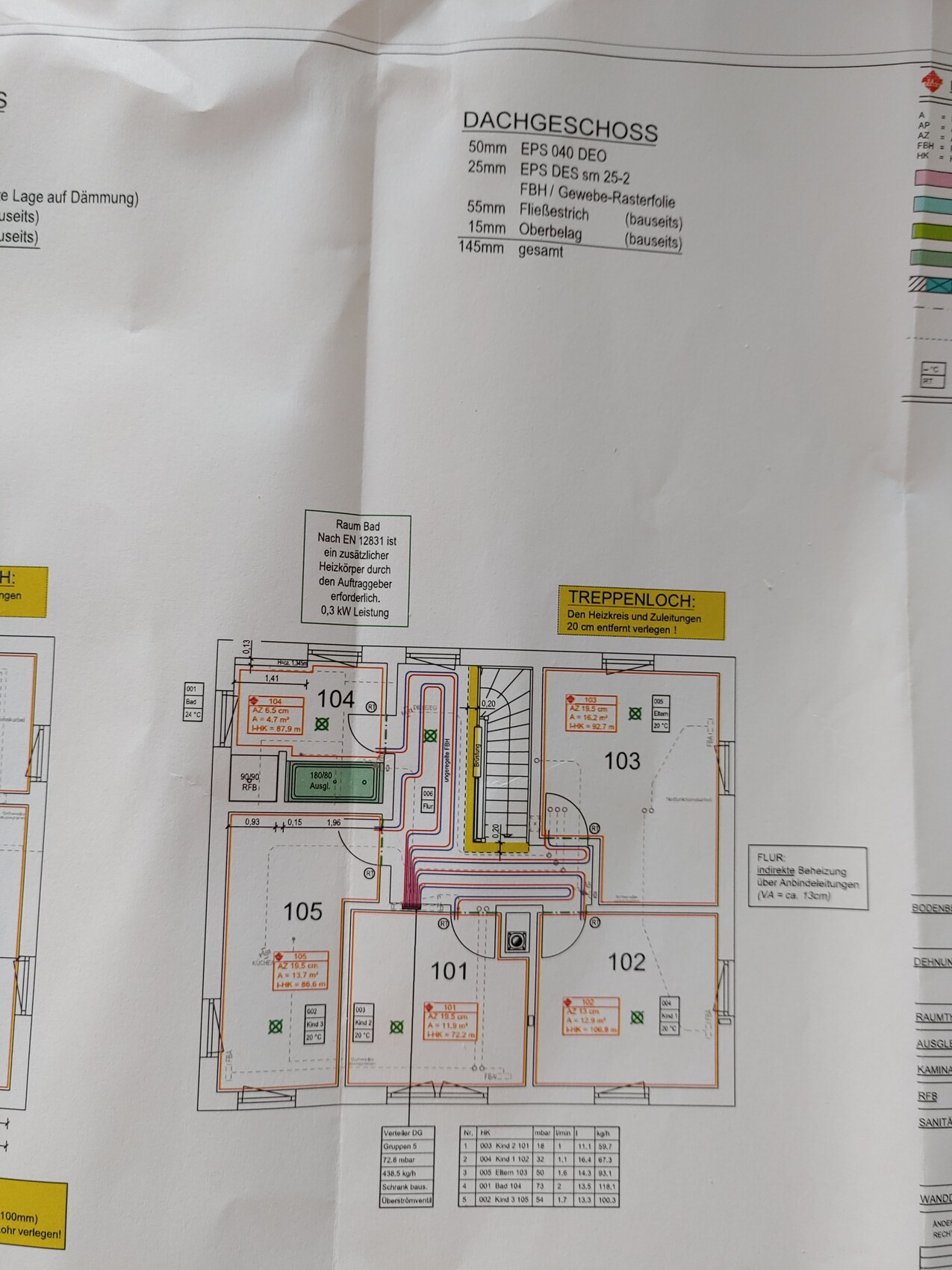
I had a chance to take a look at our heating plan on the construction site. The subcontractor’s subcontractor will be installing the underfloor heating next week.
Now to the question:
Do you see any major mistakes here, or just things that could be quickly clarified with the tradespeople on site?
Generally, I don’t have much say regarding the underfloor heating, so I wasn’t involved in the planning. However, I hope to work out one or two minor details directly with the workers on site.
So far, I’d only try to convince them to install the underfloor heating beneath the bathtub as well (acrylic on screed / showers are embedded in the screed). Or is making a last-minute adjustment a bad idea because it could mess everything up?
Any other tips? Should I try to negotiate anything about spacing?
Thanks a lot and best regards
KingJulien
A
Alessandro14 Jan 2021 13:10Oh, right. I missed the stub at the manifold.
I find the long pipes in the rooms on the upper floor inconvenient, as they are used to heat the hallway as well...
Unnecessary heat loss, especially for the bathroom!
I find the long pipes in the rooms on the upper floor inconvenient, as they are used to heat the hallway as well...
Unnecessary heat loss, especially for the bathroom!
D
daniel1985ffo18 Jan 2021 16:54In our case, the plumbing company took the initiative to optimize the installation plan originally proposed by a design firm.
The design firm did not want to run any pipes through the ground floor hallway, but the plumbing company improved two rows and ended up routing the pipes through the hallway after all.
I have 128 m² (1,377 sq ft) of living space with 18 heating circuits. Each room upstairs has 2 circuits, the bathroom also 2, the kitchen 2, the hallway 1, the utility room 1, the guest toilet 1, and the living room 4 circuits.
They installed and connected everything using 28 mm (1.1 inch) stainless steel pipes (for the two heating circuit manifolds). They also mentioned on their own that they maintained a 10 cm (4 inch) pipe spacing due to the heat pump. If it had been a gas system, they would have increased the spacing.
The design firm did not want to run any pipes through the ground floor hallway, but the plumbing company improved two rows and ended up routing the pipes through the hallway after all.
I have 128 m² (1,377 sq ft) of living space with 18 heating circuits. Each room upstairs has 2 circuits, the bathroom also 2, the kitchen 2, the hallway 1, the utility room 1, the guest toilet 1, and the living room 4 circuits.
They installed and connected everything using 28 mm (1.1 inch) stainless steel pipes (for the two heating circuit manifolds). They also mentioned on their own that they maintained a 10 cm (4 inch) pipe spacing due to the heat pump. If it had been a gas system, they would have increased the spacing.
 KingJulien18 Jan 2021 17:16
Very commendable, your plumbers.
What are the advantages of stainless steel or copper compared to PE? Or is it just about the pipe diameter?
lesmue79 schrieb:
At least 28mm (1 inch) copper pipe, and no nonsense with 20mm (¾ inch) or 25mm (1 inch) PE or aluminum composite pipes
daniel1985ffo schrieb:
Everything installed and connected with 28mm (1 inch) stainless steel pipe
What are the advantages of stainless steel or copper compared to PE? Or is it just about the pipe diameter?
KingJulien18 Jan 2021 17:27@T_im_Norden
Is it a problem if the pressure loss increases in the longer heating loop, which already has the highest pressure loss on the upper floor?
Regarding the bedroom and living room, I’m no longer sure if that’s a good idea. The bedroom won’t be used daily or permanently, while the living room should always stay nicely warm.
Should I really take away the option to control both separately?
Also, there is a wood stove in the living room. For that reason, I assume the underfloor heating in the living room will run at a rather low load during winter.
I’m undecided.
Is it a problem if the pressure loss increases in the longer heating loop, which already has the highest pressure loss on the upper floor?
Regarding the bedroom and living room, I’m no longer sure if that’s a good idea. The bedroom won’t be used daily or permanently, while the living room should always stay nicely warm.
Should I really take away the option to control both separately?
Also, there is a wood stove in the living room. For that reason, I assume the underfloor heating in the living room will run at a rather low load during winter.
I’m undecided.
Just ask him how much extra he wants to charge for installing a larger distribution board with 2 time circuits for the living room. Combining rooms can be done, but not like that. We connected the guest bathroom, which is 3m² (32 sq ft), to the hallway; that’s acceptable, but I would always recommend having living areas controlled separately.
KingJulien18 Jan 2021 17:49matte1987 schrieb:
larger distribution board with 2 timers for the living roomThe distribution boards are already installed and live, the heat pump is already running on standby. I think the moment has passed. But then I’d rather just stick to the bathtub.
Similar topics