
ᐅ Sound insulation in timber frame construction. Any recommendations?
Created on: 25 Apr 2021 20:05
C
Cola341
Hello,
we are building a single-family house using a timber frame construction with a basement, ground floor, and upper floor.
The spaces between the rafters between the basement and ground floor are insulated with cellulose. The roof is also insulated with cellulose. The ceiling between the ground floor and upper floor is empty, as it does not require insulation. Now we are considering whether it would be beneficial to fill these cavities with something to improve sound insulation between the ground floor and upper floor. Any recommendations?
Thank you!
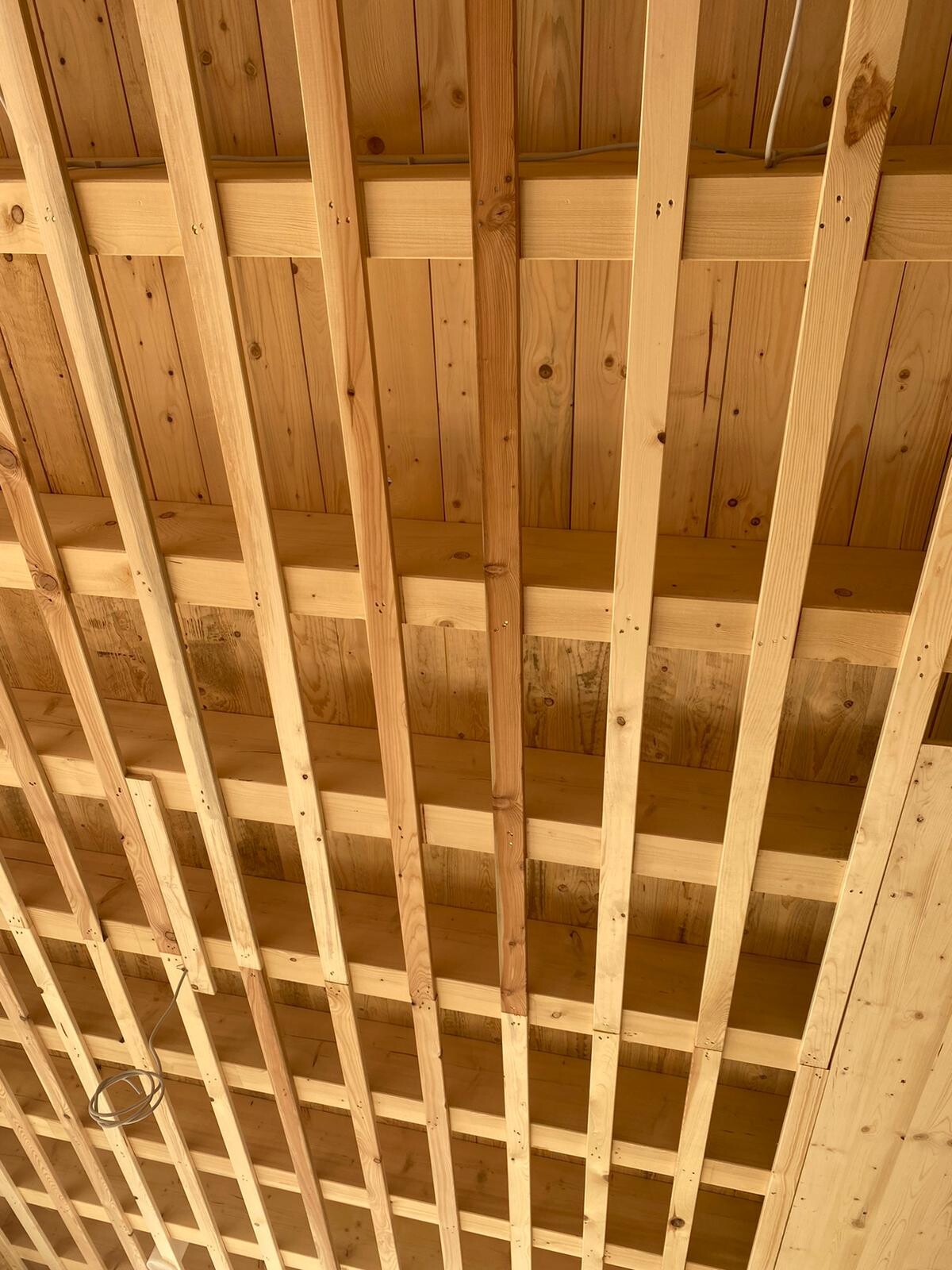
we are building a single-family house using a timber frame construction with a basement, ground floor, and upper floor.
The spaces between the rafters between the basement and ground floor are insulated with cellulose. The roof is also insulated with cellulose. The ceiling between the ground floor and upper floor is empty, as it does not require insulation. Now we are considering whether it would be beneficial to fill these cavities with something to improve sound insulation between the ground floor and upper floor. Any recommendations?
Thank you!

Note, this is just an amateur opinion: The frequency range of human speech is between 2 and 4 kHz (kilohertz). You want to dampen this as effectively as possible without heavy insulation between the joists? Well, the best soundproofing is achieved through good decoupling of the layers (not possible anymore? Or is a suspended ceiling underneath still an option) and sufficient damping of the cavity (to avoid standing waves). The cavity should not be fully insulated (similar to how partition boards should be thinner than the timber frame – for example, 6 cm (2.4 inches) boards in 10 cm (4 inches) walls = about 60%). The upper floor construction is already quite suitable for reducing impact noise!
i_b_n_a_n schrieb:
Warning, just an amateur opinion: The frequency range of human speech lies between 2 and 4 kHz (kilohertz). You want to dampen this as effectively as possible without heavy insulation between the joists? Well, the highest sound insulation is achieved by good decoupling of the layers (not possible anymore? Or is a suspended ceiling underneath still an option?) plus sufficient damping of the cavity (to avoid standing waves). The cavity should not be completely filled with insulation (similar to how partition wall boards should be thinner than the timber frame -> 6 cm (2.4 inches) boards in 10 cm (4 inches) walls = about 60%). The upper floor structure is already quite suitable for reducing impact noise! What about the walls from room to room? Currently: drywall, OSB, 10 cm (4 inches) timber studs, OSB, drywall.
Should these also be filled with cellulose insulation, for example?
R
Reini123426 Apr 2021 09:04Why shouldn’t the ceiling be insulated? In my timber frame house, this was standard from the beginning. Rafters with wood fiber insulation/OSB/infill/screed/floor covering. The rafters are still visible and only insulated halfway. You can still hear almost every step from the upper floor. I hope this is due to the “cork” laminate, which I might replace in 10 years.
Reini1234 schrieb:
Why shouldn’t the ceiling be insulated? In my timber frame house, that was standard from the start. Rafters with wood fiber insulation/OSB/loose fill/screed/floor covering. The rafters are still visible and only half insulated. Still, you can hear almost every step from the upper floor. I hope that’s because of the "cork" laminate, which I can replace in about 10 years. Complete elimination of impact sound transmission from the upper floor to the ground floor is never fully achievable. However, if every step is clearly audible, something is likely wrong. Probably a construction not optimized for sound insulation?
From my limited experience with my own projects and discussions with architects, this aspect is often given too little attention (sometimes not even meeting the minimum requirements in rental units or multi-family buildings).
Improving this situation afterward is always very difficult and expensive 🙄
Similar topics